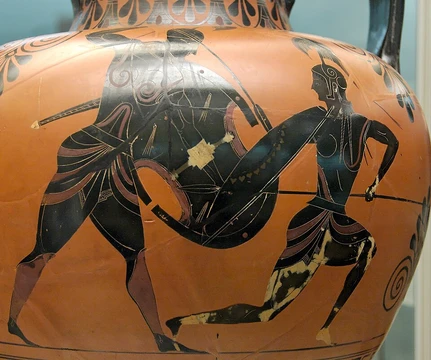
Perseus
Legendary Greek hero and slayer of the Gorgon Medusa.

Perseus ( PUR-see-əs, UK also -shəs, -sews; Ancient Greek: Περσεύς, romanized: Perseús) is a legendary figure in Greek mythology, known as the founder of the Perseid dynasty. He is considered, alongside Cadmus and Bellerophon, one of the greatest Greek heroes and slayers of monsters before the days of Heracles. He was a demigod, the son of Zeus and the mortal Danaë, and the half-brother and great-grandfather of Heracles.
The name "Perseus" is obscure and likely pre-Greek, though some etymologists propose a derivation from the Greek verb *pérthein*, meaning "to ravage" or "sack," suggesting an agent noun meaning "sacker of cities," a fitting title for a Mycenaean warrior. A folk etymology linked the name to the Persians, and Herodotus recounts a story in which Perseus and Andromeda had a son, Perses, from whom the Persians took their name.
Perseus was born after King Acrisius of Argos, warned by an oracle that his grandson would kill him, imprisoned his daughter Danaë in a bronze tower. Zeus visited her as a shower of gold, fathering Perseus. Acrisius cast mother and child into the sea in a wooden chest, but they washed ashore on Seriphos, where the fisherman Dictys raised Perseus. The king, Polydectes, lusted after Danaë and, to rid himself of Perseus, demanded the head of the Gorgon Medusa. With winged sandals, a harpe sword, Hades's helm of invisibility, a polished shield from Athena, and a knapsack, Perseus located the Graeae, three witches sharing one eye, and forced them to reveal the Gorgons' island. Using the shield's reflection to avoid Medusa's petrifying gaze, he beheaded her. He later saved Andromeda from the sea monster Cetus.
- born
- Argos (to Danaë and Zeus)
- field
- Greek mythology
- nationality
- Greek (Argive)
- known_for
- Beheading the Gorgon Medusa; rescuing Andromeda from the sea monster Cetus
- notable_weapons
- Harpe sword, winged sandals, Hades's helm of darkness, Athena's polished shield, kibisis
Quick Facts
- God Of
- King of Argos / Founder and king of Mycenae / Slayer of Medusa and Cetus
- Abode
- Seriphus, then Argos
- Symbol
- Medusa's head
- Consort
- Andromeda
- Parents
- Zeus and Danaë
- Siblings
- Several paternal half-siblings
- Children
- Perses, Heleus, Alcaeus, Sthenelus, Electryon, Mestor, Cynurus, Gorgophone, Autochthe
Facts from the source article.
Lore & Background
Perseus was born after Zeus visited his mother Danaë in the form of a shower of gold. King Acrisius, warned by an oracle that his grandson would kill him, cast Danaë and the infant Perseus into the sea in a wooden chest. They washed ashore on Seriphos, where the fisherman Dictys raised Perseus. The king of Seriphos, Polydectes, lusted after Danaë and, to be rid of Perseus, demanded he fetch the head of Medusa. With aid from Hermes and Athena, Perseus obtained winged sandals, a harpe sword, Hades's helm of darkness, a polished shield, and a kibisis. He forced the Graeae to reveal the Gorgons' location, then beheaded Medusa while she slept, using the shield's reflection to avoid petrification. From Medusa's neck sprang Pegasus and Chrysaor. On his return, Perseus rescued Andromeda from the sea monster Cetus and married her, later petrifying her former suitor Phineus. He also petrified King Atlas for refusing him hospitality, forming the Atlas mountains.
Reader's Guide
Perseus's significance in Greek mythology lies in his role as a foundational hero of the Perseid dynasty, which included Heracles. His exploits—especially the beheading of Medusa and the rescue of Andromeda—became archetypal monster-slaying narratives. The story of his birth, exile, and eventual fulfillment of the oracle (killing Acrisius) illustrates common mythic themes of prophecy, divine intervention, and the hero's journey. His use of Medusa's head as a weapon, even after death, and its placement on Athena's aegis as the Gorgoneion, cemented the Gorgon as a lasting symbol in Greek art and culture. The etymology of his name remains uncertain, with possible pre-Greek or Proto-Indo-European origins, and a Greek folk etymology connected him to the Persians. His legacy endures through ancient tragedies by Sophocles and Euripides, and numerous works of art.
Did You Know?
- Perseus was the half-brother and great-grandfather of Heracles, as both were sons of Zeus and Heracles's mother was Perseus's granddaughter.
- The falling drops of Medusa's blood, as Perseus flew over Libya, created a race of toxic serpents, one of which later killed the Argonaut Mopsus.
- After her death, Andromeda was placed by Athena among the constellations in the northern sky, near Perseus and Cassiopeia.
- A Greek folk etymology connected Perseus to the name of the Persians, and Herodotus recounts a story that the Persians took their name from Perses, a son of Perseus and Andromeda.
Common Misconceptions (Editorial)
A common misconception is that Perseus killed Medusa by looking directly at her. In fact, according to the facts on record, he used a polished shield’s reflection to avoid petrification while beheading her. Another mistake is assuming Perseus was simply a mortal hero; he was actually a demigod, the son of Zeus and Danaë, and he was also the half-brother and great-grandfather of Heracles, not a contemporary unrelated figure.
Why It Matters (Editorial)
Perseus endures as a symbol of cunning and resourcefulness, using divine gifts and clever tactics—like a mirrored shield—to overcome a seemingly unbeatable foe. His story also resonates because it ties together themes of prophecy, perilous quests, and family dynasties, linking him to other major figures like Heracles and founding the Perseid line, which shaped Greek myth and legend for generations.
Spotted an error? Know more?
This is a living reference — every entry is fact-audited, and reader corrections feed straight into our audit queue. Suggest an edit · See this site's audit record