Nemesis
Goddess of retribution for arrogance before the gods.
Nemesis, also known as Rhamnousia, was the ancient Greek goddess who embodied retribution for hubris—the sin of arrogance before the gods. Her name comes from the Greek word *némein*, meaning "to give what is due," tracing back to the Proto-Indo-European root *nem- for "distribute." Originally, the term "nemesis" referred to the distributor of fortune, neither good nor bad, but in proportion to what each person deserved. Over time, in works by Herodotus and Pindar, it came to signify the resentment caused by upsetting this balance, and the sense of justice that demanded punishment. From the fourth century onward, Nemesis was also linked with Tyche as the just balancer of fortune’s chance.
According to Hesiod’s *Theogony*, Nemesis was one of the children of Nyx (Night) alone, with siblings including Moros (Doom), Ker (violent death), Eris (Strife), Hypnos (Sleep), Apate (Deceit), Thanatos (Death), the Oneiroi (Dreams), Momos (Blame), the Moirai (Fates), and Oizys (Misery). Pausanias described her as the daughter of Oceanus, while *De astronomia* made her a child of Erebus and Nyx. Some traditions named Zeus as her father, with an unnamed mother. In several accounts, Nemesis was the mother of Helen of Troy by Zeus; Helen was then adopted and raised by Leda and Tyndareus. The Byzantine scholar Tzetzes recorded that Bacchylides considered Nemesis the mother of the Telchines by Tartarus. By Zeus, she also mothered the divine twins Castor and Pollux.
In Greek mythology, Nemesis appears as implacable justice, often that of Zeus in the Olympian order, though she clearly existed before him. Her images resemble those of goddesses like Cybele, Rhea, Demeter, and Artemis. In Greek tragedies, she is chiefly the avenger of crime and punisher of hubris, akin to Atë and the Erinyes. She was sometimes called Adrasteia, meaning "one from whom there is no escape," and her epithet Erinys ("implacable") was applied to Demeter and the Phrygian mother goddess Cybele. Hesiod wrote that "deadly Nyx bore Nemesis an affliction to mortals subject to death."
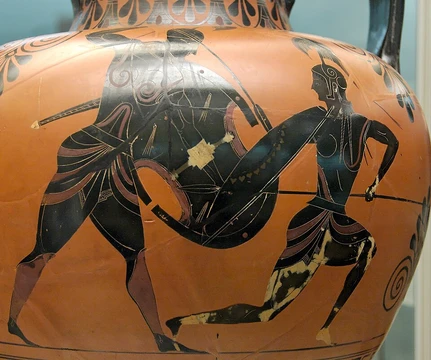
In a less common tradition, Nemesis—not the Spartan queen Leda—is the mother of Helen of Troy. This story first appears in the lost epic *Cypria*, the prelude to the *Iliad*, by Stasinus of Cyprus. Zeus fell in love with Nemesis, possibly his own daughter, and pursued her as she fled in shame, taking several forms to escape.
- Field
- Greek mythology and religion
- Nationality
- Greek
- Known for
- Personification of retribution for hubris; mother of Helen of Troy in some traditions; goddess of Rhamnous
- Parents
- Nyx (alone, per Hesiod); Oceanus (per Pausanias); Erebus and Nyx (in De astronomia); Zeus (by an unnamed mother, in some traditions)
- Siblings
- Moros, Ker, Eris, Hypnos, Apate, Thanatos, Oneiroi, Momos, Moirai, Oizys (per Hesiod)
- Children
- Helen of Troy (by Zeus); Castor and Pollux (by Zeus); Telchines (by Tartarus, per Bacchylides via Tzetzes)
Lore & Background
Nemesis was originally the distributor of fortune, giving each what was deserved. Over time, she came to represent the resentment caused by disturbance of this proportion and the justice that punishes hubris. In Greek tragedies, she appears as the avenger of crime, akin to Atë and the Erinyes, and was sometimes called Adrasteia, meaning 'one from whom there is no escape.' Her epithet Erinys was applied to Demeter and Cybele.
In some traditions, Nemesis was the mother of Helen of Troy by Zeus. According to the lost epic Cypria, Zeus pursued Nemesis, who fled in shame, transforming into various forms. He eventually raped her, producing an egg that was given to Leda, who raised Helen. In another version, Zeus turned into a swan and Nemesis, pitying him, offered refuge and was raped while asleep.
Nemesis enacted retribution on Narcissus for his vanity, luring him to a pool where he fell in love with his reflection and died. She also punished the virgin Aura at Artemis' request, causing Dionysus to rape her after she boasted of her superiority.
Reader's Guide
Nemesis held a significant role in Greek religion as a regulator of justice and moral balance, not merely a punisher of hubris. Her cult at Rhamnous in Attica featured a statue by Pheidias made from Parian marble brought by Persians after the Battle of Marathon. She was depicted as a winged goddess with a whip, dagger, measuring rod, bridle, scales, sword, and scourge, often riding a chariot drawn by griffins. At Smyrna, two manifestations of Nemesis existed, possibly representing kindly and implacable aspects. In Rome, she was a tutelary deity of the drill-ground and appeared on imperial coinage as Nemesis-Pax. Her festival, the Nemeseia, was held at Athens to avert the nemesis of the dead. The poet Mesomedes wrote a hymn to her, addressing her as the 'winged balancer of life.' Nemesis's legacy endures as a symbol of retributive justice and the restoration of cosmic order when moral boundaries are violated.
Did You Know?
- Her statue at Rhamnous was crafted by Pheidias from Parian marble brought by Persians expecting victory at Marathon.
- The poet Mesomedes wrote a hymn to Nemesis in the early second century AD.
Spotted an error? Know more?
Reader corrections go straight into our review queue. Suggest an edit · How this site is sourced