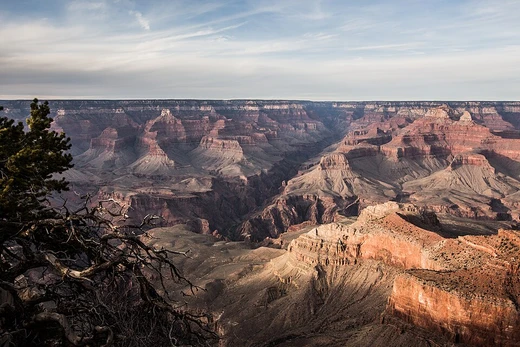
Geological history of Earth
Earth's geological history spans 4.54 billion years of change.

The geological history of Earth chronicles the planet's evolution from its formation approximately 4.54 billion years ago through accretion from the solar nebula. It is based on the geologic time scale, a system of chronological measurement derived from the study of rock layers (stratigraphy). This history encompasses major events such as the formation of the Moon, the development of continents and supercontinents, and the onset of ice ages.
Earth initially existed as a molten body due to extreme volcanism and frequent collisions with other celestial bodies. As the outer layer cooled, a solid crust formed, and water began to accumulate in the atmosphere. The Moon likely originated soon after from a giant impact, possibly involving a protoplanet; more recent potassium isotopic studies suggest a smaller, high-energy collision that cleaved off a significant portion of Earth, with some material merging and the rest forming the Moon. Outgassing and volcanic activity created the primordial atmosphere, while condensing water vapor, supplemented by ice from asteroids, produced the oceans—though research in 2020 indicated that sufficient water may have been present since Earth’s initial formation.
Over hundreds of millions of years, the surface continually reshaped itself. Continents formed, broke apart, and migrated, occasionally combining into supercontinents. The earliest known supercontinent, Rodinia, began to break apart roughly 750 million years ago, followed by the assembly and breakup of Pannotia around 600 million years ago, and finally Pangaea, which fragmented about 200 million years ago. The current pattern of ice ages began around 2.58 million years ago, intensifying at the end of the Pliocene, with polar regions undergoing repeated cycles of glaciation and thawing every 40,000 to 100,000 years; the Last Glacial Period ended approximately 10,000 years ago.
The Precambrian encompasses about 90% of geologic time, from 4.6 billion years ago to the start of the Cambrian Period around 539 million years ago, including the Hadean, Archean, and Proterozoic eons. Major volcanic events altering Earth’s environment and causing extinctions may have occurred ten times in the past three billion years. During the Hadean Eon (4.6 to 4 billion years ago), the Solar System formed from a large cloud of gas and dust around the Sun. The Hadean is not formally recognized b
- formed
- ~4.54 billion years ago
- earliest_supercontinent
- Rodinia, ~750 million years ago
- current_eon
- Phanerozoic
- major_ice_age_start
- ~40 million years ago
Lore & Background
Earth formed approximately 4.54 billion years ago through accretion from the solar nebula, a disk-shaped mass of dust and gas remaining from the formation of the Sun. Initially, Earth was molten due to extreme volcanism and frequent collisions with other bodies. Eventually, the outer layer cooled to form a solid crust when water began accumulating in the atmosphere. The Moon formed soon afterwards, possibly as a result of the impact of a protoplanet with Earth. Outgassing and volcanic activity produced the primordial atmosphere, and condensing water vapor, augmented by ice delivered from asteroids, produced the oceans.
Reader's Guide
The geological history of Earth is fundamental to understanding the planet's past and present. It provides the framework for the geologic time scale, which organizes Earth's 4.54-billion-year history into eons, eras, and periods based on stratigraphy. This history reveals how Earth transformed from a molten body to a planet with solid crust, oceans, and an atmosphere. The formation and breakup of supercontinents like Rodinia, Pannotia, and Pangaea illustrate the dynamic nature of Earth's surface. The record of ice ages, including the current pattern that began about 40 million years ago, informs climate science. The Precambrian, comprising about 90% of geologic time, includes the Hadean, Archean, and Proterozoic eons, during which the Moon formed, the magnetic field was established, and the first glaciations occurred. Disputes, such as whether the Late Heavy Bombardment occurred or whether plate tectonics was always active, highlight ongoing scientific inquiry. This history is essential for geology, paleontology, and understanding Earth's future.
Did You Know?
- Earth formed approximately 4.54 billion years ago through accretion from the solar nebula.
- The earliest-known supercontinent Rodinia began to break apart roughly 750 million years ago.
- The present pattern of ice ages began about 40 million years ago and intensified at the end of the Pliocene.
More in Geology 1-24
Spotted an error? Know more?
This is a living reference — every entry is fact-audited, and reader corrections feed straight into our audit queue. Suggest an edit · See this site's audit record