
Earth's inner core
Solid iron-nickel sphere at Earth's center, studied via seismic waves.

Edgar Rice Burroughs · Public domain
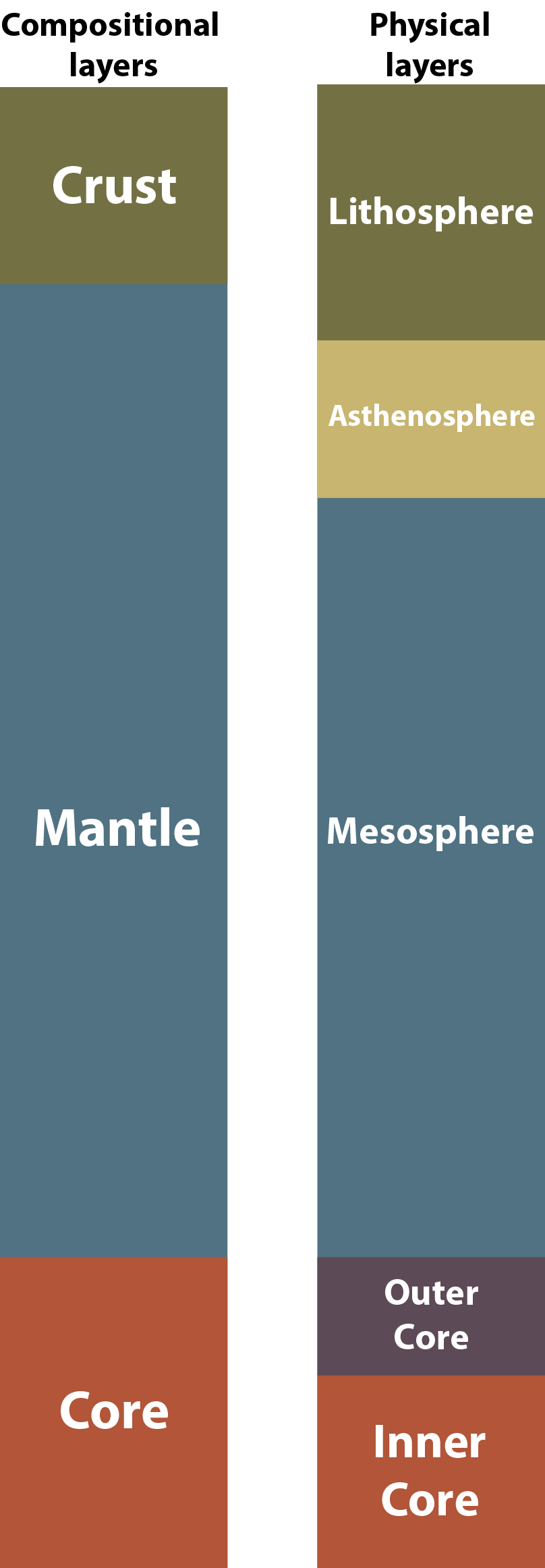
Deep beneath our feet lies Earth’s innermost geologic layer: the inner core. It’s a solid ball roughly 1,230 km (760 mi) in radius—about 20% of Earth’s total radius, or 70% of the Moon’s radius. As of February 2025, new evidence suggests this sphere, long thought to be a rigid iron-nickel alloy, may actually be partially deformable and undergoing viscous changes. No direct samples exist, unlike the mantle; instead, scientists rely on seismic waves and the planet’s magnetic field to infer its properties. The inner core is believed to be an iron-nickel alloy with trace elements, and its surface temperature is estimated at about 5,700 K (5,430 °C; 9,800 °F)—roughly as hot as the Sun’s surface. Despite this extreme heat, the core stays solid due to immense pressure, as described by the Simon-Glatzel equation.
The discovery of a solid inner core, distinct from the molten outer core, came in 1936. Danish seismologist Inge Lehmann studied seismograms from New Zealand earthquakes, recorded by sensitive surface instruments, and noticed seismic waves reflecting off an inner boundary. She calculated the inner core’s radius at about 1,400 km (870 mi)—close to today’s accepted value of 1,221 km (759 mi). In 1938, Beno Gutenberg and Charles Richter analyzed more data, estimating the outer core’s thickness at 1,950 km (1,210 mi) with a gradual 300 km (190 mi) transition to the inner core, implying a radius between 1,230 and 1,530 km (760 and 950 mi). By 1940, the inner core was hypothesized to be solid iron; in 1952, Francis Birch concluded it was likely crystalline iron. The boundary between inner and outer cores is sometimes called the “Lehmann discontinuity,” though that name usually refers to another boundary. The term “Bullen” or “Lehmann-Bullen discontinuity” (after Keith Edward Bullen) has been proposed but is rarely used. The inner core’s rigidity was confirmed in 1971. Adam Dziewonski and James Freeman Gilbert later showed that Earth’s normal-mode vibrations from large earthquakes matched a liquid outer core. In 2005, shear waves were detected passing through the inner core—initially controversial but now widely accepted.
Most physical data come from seismic waves. Deep earthquakes (30 km or deeper in the relatively homogeneous mantle) generate waves recorded by seismographs worldwide. P-waves (compressional) travel through solids and liquids; S-waves (shear) only through rigid solids. They move at different speeds and dampen differently. Key signals include “PKiKP” waves—P-waves that cross the mantle-core boundary, travel through the outer core (K), reflect off the inner core boundary (i), cross the outer core again, and return as P-waves. “PKIKP” waves instead travel through the inner core (I). These signals are clearest when the source and detector are nearly aligned—PKiKP when the receiver is just above the source, PKIKP when antipodal. Although S-waves can’t enter or leave the inner core directly, P-waves can convert to S-waves (and vice versa) when hitting the inner-outer core boundary at an angle. “PKJKP” waves enter the inner core as P-waves, convert to S-waves (J) inside, then revert to P-waves upon exit—confirming the inner core is solid.
Other clues come from Earth’s magnetic field, generated mainly by fluid currents in the outer core but strongly influenced by the solid inner core and its heat flow (though the core is above the Curie temperature, so not ferromagnetic). The planet’s mass, gravitational field, and angular inertia also reflect the density and dimensions of inner layers. Large earthquakes make Earth “ring” like a bell, and those natural oscillation frequencies depend on the inner layers’ density, size, and shape.
Seismic wave velocities vary smoothly through the inner core: S-waves from about 3.7 km/s at the center to 3.5 km/s at the surface—much slower than in the lower crust (4.5 km/s) and less than half the deep mantle’s 7.3 km/s. P-waves range from about 11.4 km/s at the center to 11.1 km/s at the surface, then drop abruptly to 10.4 km/s at the inner-outer core boundary. Based on seismic data, the inner core’s size and shape are well constrained, though no specific numbers beyond those already given are provided here.
- composition
- iron–nickel alloy with some other elements
- density_range
- about 13.0 kg/L at center to 12.8 kg/L at surface
- mass
- about 10^23 kg (1.7% of Earth's mass)
Lore & Background
The inner core is the deepest geological layer of Earth, a solid sphere with a radius of approximately 1221 km—about 20% of Earth’s total radius and 70% of the Moon’s radius. Its surface temperature is estimated to be roughly equal to that of the Sun’s surface. Despite being solid at such high heat, it remains solid due to immense pressure, as described by the Simon-Glatzel equation. The core is believed to be composed primarily of an iron-nickel alloy, with some other elements. No direct samples exist; its properties are inferred from seismic waves and Earth’s magnetic field. Seismic data reveal that P-wave velocity within the inner core decreases smoothly from about 11.4 km/s at the center to 11.1 km/s at its surface, then drops abruptly to 10.4 km/s at the boundary with the outer core. S-wave velocity ranges from about 3.7 km/s at the center to 3.5 km/s at the surface, confirming the core is solid because S waves can only travel through rigid elastic solids. The inner core was discovered in 1936 by Inge Lehmann, who analyzed seismograms from New Zealand earthquakes and inferred its radius. In 1971, its rigidity was confirmed. As of February 2025, there are indications that this previously assumed solid iron-nickel sphere may be partially deformable and undergoing viscous changes.
Reader's Guide
The inner core is the deepest geologic layer of Earth, a solid sphere roughly 20% of Earth’s radius. Its properties are inferred almost entirely from seismic waves and magnetic field data, as no direct samples exist. Seismic studies reveal that the inner core transmits shear waves, confirming its solid state, and that its P-wave velocity decreases smoothly from about 11.4 km/s at the center to 11.1 km/s at its surface, where it drops abruptly to 10.4 km/s in the outer core. S-wave velocity within the inner core is around 3.7 km/s at the center, decreasing to 3.5 km/s at the boundary. The inner core is composed primarily of an iron-nickel alloy, and its surface temperature is estimated to be near that of the Sun’s surface. It remains solid despite this heat because of the immense pressure, consistent with the Simon-Glatzel equation. Its existence was first deduced in 1936 by Inge Lehmann from seismic wave reflections; later work by Gutenberg and Richter refined the boundary’s thickness, and in 1952 Francis Birch proposed it was crystalline iron. The rigidity of the inner core was confirmed in 1971. The inner core influences Earth’s magnetic field by affecting fluid motions in the outer core, and its mass and density shape Earth’s gravitational field and rotational dynamics. Notably, as of February 2025, evidence suggests the inner core may be partially deformable and undergoing viscous changes, challenging the long-held view of a purely rigid sphere.
Did You Know?
- The inner core's radius is about 70% of the Moon's radius.
The Discovery of a Solid Heart
In 1936, Danish seismologist Inge Lehmann made a discovery that reshaped our understanding of Earth's interior. By studying seismograms from earthquakes in New Zealand, recorded by sensitive instruments on the surface, she noticed that seismic waves were reflecting off an internal boundary. From this, she inferred the existence of a solid inner sphere distinct from the molten outer layer, estimating its radius at roughly 1,400 km—remarkably close to the currently accepted value of about 1,221 km. Two years later, Beno Gutenberg and Charles Richter analyzed a more extensive dataset and proposed a 300 km transition zone between the two core layers, placing the inner core's radius between 1,230 and 1,530 km. By 1940, the idea that this inner sphere was solid iron had gained traction, and in 1952 Francis Birch published a thorough analysis concluding it was probably crystalline iron. The inner core's rigidity was formally confirmed in 1971, and in 2005 the detection of shear waves traversing it—initially controversial—further solidified its status as a solid body.
Reading the Planet Through Its Vibrations
Since no drill has ever reached the inner core and no direct samples exist, scientists rely almost entirely on seismic waves to characterize it. Deep earthquakes, originating 30 km or more below the surface where the mantle is relatively uniform, generate waves that travel through the planet and are recorded by seismographs worldwide. P-waves, or compressional waves, can pass through both solid and liquid materials, while S-waves, or shear waves, propagate only through rigid solids. The most informative signals include PKiKP waves, which reflect off the inner core boundary, and PKIKP waves, which pass straight through the inner core. Crucially, when P-waves strike the inner-outer core boundary at an oblique angle, they can convert into S-waves, travel through the inner core as shear waves, and convert back to P-waves upon exit. These PKJKP waves provide direct evidence that the inner core is solid enough to support shear motion, confirming what had long been suspected.
A Forging Under Extreme Pressure
The inner core is a solid ball with a radius of approximately 1,230 km, making it about 20% of Earth's total radius and roughly 70% the size of the Moon. Its volume is around 7.6 billion cubic kilometers, accounting for less than one percent of Earth's total volume. Despite sitting at a temperature near 5,700 K—comparable to the Sun's surface—it remains solid because of the immense pressure at Earth's center, a relationship described by the Simon-Glatzel equation. Its composition is believed to be an iron-nickel alloy with trace additional elements, though it is not ferromagnetic because it sits above the Curie temperature. Seismically, P-wave velocities range from about 11.4 km/s at the center to 11.1 km/s at the surface, dropping abruptly to 10.4 km/s at the inner-outer boundary. S-wave velocities shift from roughly 3.7 km/s centrally to 3.5 km/s at the boundary—both considerably slower than in the deep mantle. Its shape is thought to be a slightly flattened oblate ellipsoid, with a flattening ratio between 1/400 and 1/410.
A Shifting Paradigm and Broader Influence
For decades the inner core was treated as a static, perfectly rigid iron-nickel sphere. Yet as recently as February 2025, new indications have emerged suggesting it is partially deformable and undergoing viscous changes—a development that challenges the long-held picture of an immutable solid ball. Beyond its own physical properties, the inner core exerts a profound influence on Earth's magnetic field. Although that field is generated primarily by fluid and electric currents in the outer core, those currents are strongly shaped by the solid inner core's presence and the heat flowing outward from it. The core's density, dimensions, and shape also affect Earth's gravitational field, angular inertia, and the natural oscillation frequencies that cause the planet to ring like a bell after large earthquakes. Because no direct samples are accessible, every understanding of the inner core remains an inference drawn from seismic wave behavior, magnetic field measurements, and the planet's bulk mechanical properties—a remarkable feat of indirect science.
Gallery


Frequently Asked Questions
What is Earth's inner core made of?
The inner core is composed primarily of an iron-nickel alloy with trace amounts of other elements. Its density spans roughly 13.0 kg/L at the very center down to about 12.8 kg/L near its outer boundary.
How do scientists study Earth's inner core if they can't reach it?
No physical samples exist from the core, so researchers depend on indirect evidence such as how seismic waves propagate through it and observations of Earth's magnetic field. These measurements have allowed them to infer composition, density, and temperature without ever drilling to the center.
More in Geology 1-24
Spotted an error? Know more?
This is a living reference — every entry is fact-audited, and reader corrections feed straight into our audit queue. Suggest an edit · See this site's audit record