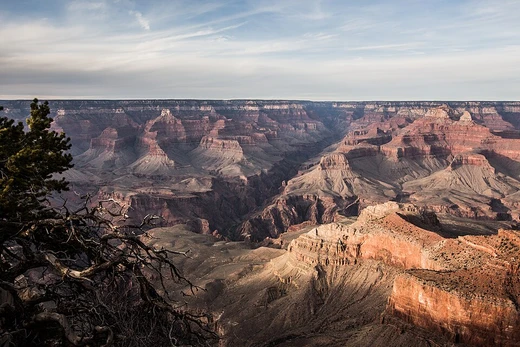
Erosion
Natural removal and transport of Earth's surface materials by agents like water and wind.

Erosion is the movement of soil, rock, or dissolved materials across the Earth's surface by forces like wind or flowing water, which then deposit these materials elsewhere. This sets it apart from weathering, where materials break down but stay put. Erosion can be physical, involving the removal of solid fragments, or chemical, where materials are dissolved away. The transported sediment or dissolved matter may travel only a few millimeters or thousands of kilometers.
The main forces driving erosion include rainfall, river currents, coastal waves, glacial scraping and plucking, floods, wind, groundwater, and mass movements like landslides. How fast erosion happens depends on the landscape, with steep slopes typically eroding fastest. Climate also plays a role, as factors like rainfall amount, storm frequency, wind speed, wave energy, and temperature (especially for ice-related processes) can speed up or slow down erosion. There are feedback loops too—for instance, the amount of sediment already carried by a river or glacier can affect how much more it erodes. After transport, the eroded material is deposited at a new location.
Although erosion occurs naturally, human actions have boosted global soil erosion rates by 10 to 40 times. In the Appalachian Mountains, intensive farming has caused erosion up to 100 times the natural rate. This excessive erosion creates both on-site and off-site problems. On-site, it strips away nutrient-rich topsoil, reducing farm productivity and potentially causing ecological collapse or desertification. Off-site, it leads to sediment clogging waterways, eutrophication of water bodies, and damage to roads and buildings. Water and wind erosion together account for about 84% of global land degradation, making unchecked erosion a major environmental issue.
Key human activities that worsen erosion include intensive agriculture, deforestation, road building, climate change, and urban sprawl. However, many prevention and remediation methods can limit erosion of vulnerable soils.
**Physical processes**
**Rainfall and surface runoff** Rainfall and the runoff it creates cause four main types of soil erosion: splash, sheet, rill, and gully erosion. Splash erosion is the mildest stage, where raindrop impacts throw soil particles up to 0.6 meters high and 1.5 meters sideways on flat ground. When the ground is saturated or rain falls faster than it can soak in, surface runoff occurs. If the runoff is strong enough, it carries loosened soil downhill—this is sheet erosion. Rill erosion forms small, temporary flow paths that both supply and transport sediment, especially on disturbed uplands where water erosion is greatest. Rill flow is only a few centimeters deep but can be quite steep, behaving differently from deeper river channels. Gully erosion happens when runoff gathers and cuts narrow channels during heavy rain or snowmelt, removing soil to significant depth. A gully is defined by a cross-section of at least one square foot, meaning it can’t be erased by normal tilling. Extreme gully erosion can create badlands, which form on easily eroded bedrock in erosion-friendly climates, especially where vegetation is limited.
**Rivers and streams** Stream erosion occurs as water flows along a linear path, cutting downward to deepen valleys and headward to extend them into hillsides, creating steep banks and headcuts. Early on, erosion is mostly vertical, producing V-shaped valleys with steep gradients. Once a base level is reached, erosion shifts to lateral widening, creating a flat valley floor and a narrow floodplain. The stream gradient becomes nearly flat, and sediment deposition becomes important as the river meanders. Floods cause the most erosion, as faster, larger water flows carry heavier sediment loads.
- field
- Geology, Geomorphology, Environmental Science
- known_for
- Removal and transport of soil and rock by water, wind, ice, and gravity; primary cause of land degradation
- primary_agents
- Rainfall, rivers, coastal waves, glaciers, wind, groundwater, mass movements
- human_impact
- Increases erosion rates 10–40 times globally; up to 100 times natural rate in Appalachian agriculture sites
- land_degradation_share
- 84% of global degraded land due to water and wind erosion
Lore & Background
Erosion is the removal of soil, rock, or dissolved material from one location on the Earth’s crust by surface processes such as water flow or wind, followed by transport to another site where it is deposited. It is distinct from weathering, which involves no movement. Physical or mechanical erosion removes material as clastic sediment, while chemical erosion removes material by dissolution. Eroded sediment or solutes may travel only a few millimetres or thousands of kilometres. Agents of erosion include rainfall, bedrock wear in rivers, coastal erosion by sea and waves, glacial plucking and abrasion, areal flooding, wind abrasion, groundwater processes, and mass movements like landslides. Physical erosion proceeds fastest on steep slopes, and rates are sensitive to climatically controlled properties such as water supply, storminess, wind speed, wave fetch, and atmospheric temperature. Feedbacks occur between erosion rates and the amount of material already carried by a river or glacier. Splash erosion, the first stage, is caused by raindrop impact ejecting soil particles up to 0.6 metres vertically and 1.5 metres horizontally on level ground. Sheet erosion follows, then rill erosion—small ephemeral flow paths with depths of a few centimetres—and finally gully erosion, defined by a channel cross-section of at least one square foot that cannot be erased by normal tillage. Extreme gully erosion can form badlands under conditions of high relief on easily eroded bedrock where protective vegetation is limited.
Reader's Guide
Erosion is a fundamental geological process shaping landscapes, but its acceleration by human activities—such as intensive agriculture, deforestation, roads, anthropogenic climate change, and urban sprawl—has made it a critical environmental concern. On-site impacts include loss of nutrient-rich topsoil, reduced agricultural productivity, ecological collapse, and desertification. Off-site effects include sedimentation of waterways, eutrophication, and damage to infrastructure. Water and wind erosion together account for about 84% of global land degradation. While erosion is natural, excessive erosion is largely preventable through remediation practices. Understanding erosion's mechanisms—from raindrop impact to river meandering and coastal bioerosion—is essential for managing soil loss and protecting ecosystems and human settlements.
Did You Know?
- Splash erosion can eject soil particles up to 0.6 m vertically and 1.5 m horizontally on level ground.
- A gully is defined by a critical cross-sectional area of at least one square foot, beyond which normal tillage cannot erase it.
- Human activities have increased the global rate of soil erosion by 10 to 40 times, and up to 100 times the natural rate in Appalachian Mountain agriculture sites.
More in Geology 1-24
Spotted an error? Know more?
This is a living reference — every entry is fact-audited, and reader corrections feed straight into our audit queue. Suggest an edit · See this site's audit record