
Aromatic L-amino acid decarboxylase deficiency
Rare genetic disorder impairing dopamine and serotonin synthesis.

Tessa Wassenberg, Marta Molero-Luis, Kathrin Jeltsch, Georg F. Hoffmann, Birgit · CC BY 4.0
Aromatic L-amino acid decarboxylase deficiency (AADC deficiency) is a rare genetic disorder caused by mutations in the DDC gene, which encodes the enzyme aromatic L-amino acid decarboxylase. This enzyme is involved in the synthesis of dopamine and serotonin, both important neurotransmitters. The condition is autosomal recessive, meaning an individual must inherit two faulty copies of the DDC gene, one from each parent, to be affected.
- field
- Medical genetics
- known_for
- Rare genetic disorder affecting neurotransmitter synthesis
- inheritance
- Autosomal recessive
- gene
- DDC
Lore & Background
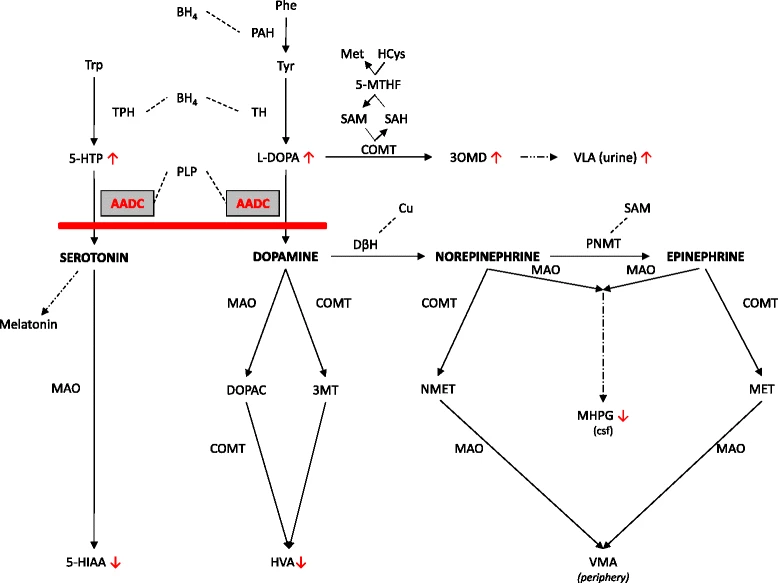
Babies with severe AADC deficiency usually present to clinicians during the first few months of life. Symptoms include hypotonia (floppiness), developmental delay, oculogyric crises, difficulty with initiating and controlling movements, dystonia and dyskinesia, gastrointestinal dysmotility (vomiting, reflux, diarrhea, constipation), and autonomic symptoms such as difficulties controlling temperature and blood sugar, excessive sweating, and nasal congestion. Some individuals may develop cerebral folate deficiency due to O-methylation of excessive L-DOPA depleting methyl donors like S-adenosyl methionine and levomefolic acid; this can be detected by measuring levomefolic acid in cerebrospinal fluid and corrected with folinic acid.
Reader's Guide
Diagnosis of AADC deficiency relies on three core tools: molecular genetics (proving compound heterozygous or homozygous disease-causing variants in the DDC gene), CSF examination (low 5-HIAA, HVA, MHPG; increased 3-OMD, L-DOPA, 5-HTP; normal pterins), and serum examination (decreased AADC enzyme activity). A patient must have positive genetic testing and fulfill one of the other two criteria. Elevated 3-OMD in serum serves as a simple screening test, requiring confirmation by diagnostic criteria. There is no cure, but medical and multidisciplinary treatment can relieve symptoms. Therapies include physiotherapy, occupational therapy, speech and language therapy, and enteral feeding for swallowing difficulties. Medications such as dopamine agonists (rotigotine, pramipexole) and monoamine oxidase inhibitors (selegiline) help compensate for missing neurotransmitters. In July 2021, a small gene therapy phase I study reported dopamine restoration in seven participants aged 4 to 9 years. In July 2022, the gene therapy product eladocagene exuparvovec was approved in the European Union for patients aged 18 months or older.
Did You Know?
- AADC deficiency is caused by mutations in the DDC gene, which encodes the enzyme aromatic L-amino acid decarboxylase.
- The condition is autosomal recessive, requiring two faulty copies of the DDC gene.
- Elevated 3-OMD levels in serum can be used as a simple and sensitive screening test for AADC deficiency.
- In July 2022, the gene therapy product eladocagene exuparvovec was approved in the European Union for patients aged 18 months or older.
Optical Signatures and Analytical Utility
Aromatic amino acids carry a distinctive optical fingerprint that makes them invaluable tools in biochemical research. With the notable exception of histidine, these ring-bearing residues absorb ultraviolet radiation at wavelengths exceeding 250 nanometers and emit fluorescence when exposed to such light. This dual behavior—absorption followed by re-emission—has become a cornerstone of quantitative analytical methods, allowing researchers to measure the precise concentrations of individual aromatic residues dissolved in solution. In the broader context of protein biochemistry, the collective absorption of tyrosine and tryptophan residues is what gives most proteins their characteristic peak at 280 nanometers. Among the aromatic group, tryptophan stands out with the highest extinction coefficient, reaching its absorption maximum right at that 280-nanometer mark, while tyrosine peaks slightly lower at 274 nanometers. These well-defined spectral properties mean that a simple spectrophotometric reading can reveal the aromatic composition of a protein sample, making these residues indispensable markers in both research and clinical laboratories.
Structural Anchors in Protein Architecture
Beyond their analytical convenience, aromatic amino acids play a fundamental architectural role in the three-dimensional organization of proteins. The planar, hydrophobic character of their ring systems makes them particularly effective at stabilizing the folded conformations of many proteins. In globular proteins, these residues are predominantly tucked away within the hydrophobic cores, where they contribute to the compact, tightly packed interior that distinguishes a properly folded molecule from a disordered chain. Yet their influence does not stop at the core. Aromatic residues frequently appear at the surface of proteins, where they form critical contact points in protein-to-protein interactions and in the binding of small-molecule ligands. In these interface roles, the flat ring surfaces provide an ideal geometry for stacking and hydrophobic contacts that lock two molecules together with high specificity. This dual positioning—buried in the interior for structural integrity and exposed at the surface for molecular recognition—makes aromatic residues among the most versatile building blocks in the protein universe, bridging the gap between a protein's shape and its functional interactions with other biological molecules.
Precursors to Essential Biochemicals
One of the most remarkable aspects of aromatic amino acids is their role as starting materials for a vast array of biologically critical compounds. Histidine serves as the direct precursor to histamine, a mediator of inflammatory and allergic responses. Tryptophan feeds into a cascade that produces 5-hydroxytryptophan, which is then converted into serotonin, tryptamine, auxin, kynurenines, and melatonin—molecules governing mood, sleep, plant growth, and immune signaling. Tyrosine occupies an especially central position: it is converted into L-DOPA, then dopamine, norepinephrine, and epinephrine, the catecholamine neurotransmitters and hormones that regulate mood, alertness, and the stress response. Tyrosine also gives rise to thyroxine, the principal thyroid hormone, and in numerous organisms it contributes to the synthesis of octopamine and melanin. Phenylalanine, meanwhile, is the upstream source of tyrosine itself, making it the root of an entire biochemical tree. This precursor relationship means that the four aromatic amino acids collectively underpin neurotransmission, hormonal regulation, pigment production, and plant physiology, linking a simple dietary input to an extraordinary breadth of biological output.
Biosynthesis, Nutrition, and Clinical Relevance
The origin of aromatic amino acids differs fundamentally between kingdoms of life. Plants and many microorganisms must synthesize them through the metabolically expensive shikimate pathway, which first generates chorismate before branching into phenylalanine, tyrosine, and tryptophan. This pathway is a well-known target for herbicides such as glyphosate, which blocks the enzyme 5-enolpyruvylshikimate-3-phosphate synthase, halting aromatic amino acid production and disrupting gut microbiota in host organisms. Animals, by contrast, lack this pathway and must obtain histidine, phenylalanine, and tryptophan directly from their diet, classifying them as essential amino acids. Tyrosine is semi-essential, derivable from phenylalanine via the enzyme phenylalanine hydroxylase; a genetic absence of that enzyme causes phenylketonuria. Tryptophan deficiency can stunt skeletal growth, while excessive aromatic amino acid intake may contribute to hypertension. In individuals taking monoamine oxidase inhibitors, trace amines like tyramine can displace norepinephrine from peripheral vesicles to a life-threatening degree. Blue diaper syndrome, an autosomal recessive condition, reflects impaired tryptophan absorption, further underscoring how tightly human health depends on the proper handling of these four ring-bearing molecules.
Gallery
Frequently Asked Questions
Who is Aromatic L-amino acid decarboxylase deficiency?
AADC deficiency is an ultra-rare genetic condition in which the body fails to produce a functional copy of the aromatic L-amino acid decarboxylase enzyme, leaving dopamine and serotonin levels critically low. It is catalogued under medical genetics and is triggered by mutations in the DDC gene.
What are Aromatic L-amino acid decarboxylase deficiency's powers/role?
In a healthy individual, the DDC gene directs cells to build the enzyme that converts precursor amino acids into the neurotransmitters dopamine and serotonin. When both copies of the gene carry a mutation, that conversion step collapses, producing the profound neurological and developmental symptoms that define the disorder.
How is Aromatic L-amino acid decarboxylase deficiency inherited?
The condition follows an autosomal recessive pattern, meaning a person must inherit a defective DDC copy from each parent to be affected. Individuals carrying only one faulty copy are asymptomatic carriers and can pass the mutation to their children without showing any signs themselves.
How does Aromatic L-amino acid decarboxylase deficiency's story end?
No definitive cure exists yet, so long-term management relies on multidisciplinary supportive care and investigational therapies that aim to restore neurotransmitter production. Early diagnosis and tailored intervention can meaningfully improve an affected person's quality of life, though outcomes still vary widely.
Why is Aromatic L-amino acid decarboxylase deficiency important?
Its extreme rarity makes every confirmed case a valuable window into how the DDC enzyme and the broader monoamine synthesis pathway function. It also stands as a key reference point for studying autosomal recessive disorders that disrupt neurotransmitter production.
More in Genetic diseases and disorders 1-24
Spotted an error? Know more?
This is a living reference — every entry is fact-audited, and reader corrections feed straight into our audit queue. Suggest an edit · See this site's audit record