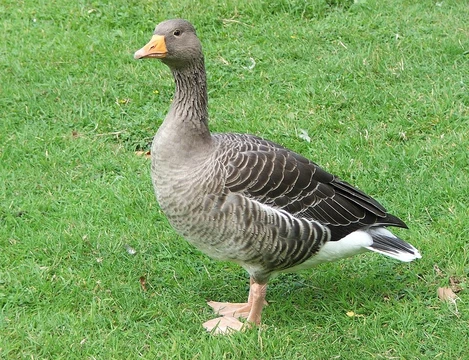
Cackling goose
Last updated
The cackling goose (Branta hutchinsii) is a species of goose native to North America and East Asia. It was long considered part of the Canada goose species until a formal split in 2004 and 2005 by major ornithological unions. Its recognition as a distinct species resolved long-standing taxonomic confusion.
Scientific classification
- KingdomAnimalia
- PhylumChordata
- ClassAves
- OrderAnseriformes
- FamilyAnatidae
- GenusBranta
- SpeciesBranta hutchinsii
Named by (Richardson, 1832)
Close relatives
Other species of Branta with a Codexery entry.
- Barnacle goose Branta leucopsis
- Aleutian cackling goose Branta hutchinsii leucopareia
- Nene (bird) Branta sandvicensis
- Nēnē-nui Branta hylobadistes
- Red-breasted goose Branta ruficollis
- Brant (goose) Branta bernicla
Sources: Wikipedia taxobox: Cackling goose (CC BY-SA 4.0) · order, family and genus agree with WoRMS AphiaID 422569 (CC BY 4.0)
Conservation status
Least Concern (LC)
- LC▲ this species
- NT
- VU
- EN
- CR
- EW
- EX
Source: IUCN Red List assessment · GBIF copy of the Red List category
Where the cackling goose has been recorded
Each dot is a place where the species has been observed and reported (945,789 records, half-degree grid) — not a modelled range. 270 inland records left out (institution coordinates).
Map: drawn by Codexery. Data: GBIF occurrence search (records CC0 / CC BY) · Natural Earth basemap (public domain) · place coordinates: Wikipedia (CC BY-SA 4.0)
Quick Facts
- Genus
- Branta
- Species
- hutchinsii
Facts from the source article.
Systematics
The genus name Branta comes from a Latinised form of Old Norse Brandgás, meaning "burnt (black) goose." The specific epithet hutchinsii honors Thomas Hutchins, an English surgeon employed by the Hudson's Bay Company. The cackling goose was originally treated as the same species or a subspecies of the Canada goose. In July 2004, the American Ornithologists' Union split the two into separate species, giving the cackling goose full species status as Branta hutchinsii.
The British Ornithologists' Union followed in June 2005. The AOU assigned several subspecies to the cackling goose: Richardson's cackling goose (B. h. hutchinsii), Aleutian cackling goose (B. h. leucopareia), small cackling goose (B. h. minima), Taverner's cackling goose (B. h. taverneri), and the extinct Bering cackling goose (B. h. asiatica), whose distinctness from B. h. leucopareia is doubtful. Confusion between the two goose species persists, especially because small Canada geese overlap in size with larger cackling geese.
The old "lesser Canada geese" were thought to be partly hybrid, with taverneri once considered a mix of minima and certain Canada goose subspecies, but it is actually one of the larger cackling goose subspecies. The barnacle goose (B. leucopsis) is a derivative of the cackling goose lineage, while the Hawaiian goose (B. sandvicensis) is an insular representative of the Canada goose. In 2007, Harold C. Hanson proposed splitting Canada and cackling geese into six species and 200 subspecies, a radical suggestion that met with caution from Richard Banks of the AOU. No further redesignation has been adopted by either union.
Description
The cackling goose is set apart by its black head and neck with a white chinstrap, a look shared only with the larger Canada goose and the barnacle goose of similar size. Up to five subspecies exist, differing in size and feather patterns. Females are nearly identical but a bit lighter and with a distinct call.
The smallest subspecies, B. h. minima, weighs just 1.4 kg, far less than any Canada goose, while B. h. hutchinsii can reach 3 kg, matching some Canada geese. The extinct B. h. asiatica from the Komandorski and Kuril Islands has a debated status. The barnacle goose is distinct with a black breast and grey, not brownish, body plumage.
Range
This species breeds in Northern Canada and Alaska in various tundra habitats, typically nesting in an elevated area near water. The nest is a shallow depression lined with plant materials and down. Because nests are on or close to the ground, eggs, lone nesting females, and newly-hatched goslings are vulnerable to predation by mammals such as foxes, coyotes, rats, and free-ranging domestic cats and dogs, as well as some snakes. Nesting pairs become highly aggressive in defense of the site, sometimes chasing people.
Pairs may mate for life, up to about 20 years, and adults often lead goslings in a line with one parent at the front and the other at the back. The cackling goose is naturally migratory, overwintering across most of the U.S., locally in Western Canada, the West Coast of the U.S., and northern Mexico. Large flocks fly in V-shaped formations, and their calls mark seasonal transitions. Migration routes can shift with changes in habitat, environment, and food sources.
As vagrants, cackling geese have reached Western Europe, as confirmed by ringing recoveries and sightings, with at least the subspecies hutchinsii involved. They also occur naturally as vagrants around the Kamchatka Peninsula in Far Eastern Russia, East China, and throughout Japan. The IUCN considers the species extirpated from Japan, where it once had a non-breeding winter population, but birds have recently been reintroduced to both Japan and Siberia.
Status
Over-hunting and habitat loss in the late 19th and early 20th centuries caused a serious decline in numbers. Improved game laws and habitat restoration have allowed populations to recover across most of the range, though some local populations, especially of the subspecies minima and leucopareia, may still be declining. The Komandorski and Kuril Islands populations, which used to winter in Japan, disappeared around 1929, though their taxonomic distinctness remains controversial.
Did You Know?
- These birds feed mainly on plant material, sometimes tipping forward like a dabbling duck to reach aquatic plants.
- Flocks often feed on leftover cultivated grains in fields, especially during migration or in winter.
- They also eat some insects, molluscs and crustaceans.
More in Geese
Sources
Compiled from Wikipedia and the sources listed below. Text from Wikipedia is available under CC BY-SA 4.0; this entry is adapted from it.
- Wikipedia: Cackling goose (CC BY-SA 4.0).
- Classification: the source article's taxobox; order, family and genus checked against WoRMS, the World Register of Marine Species (CC BY 4.0).
- Conservation status: IUCN Red List assessment.
- Occurrence records: GBIF (CC0 / CC BY). Basemap: Natural Earth (public domain).
- Word definitions: the Codexery glossary, each quoted from its Wikipedia article.
Spotted an error? Know more?
Reader corrections go straight into our review queue. Suggest an edit · How this site is sourced