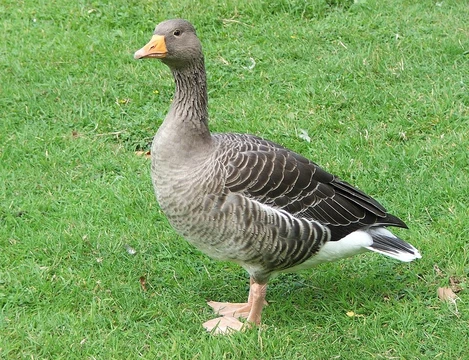
Bar-headed goose
Last updated
This goose, Anser indicus, nests in large colonies on the ground near Central Asian mountain lakes, laying three to eight eggs. It winters in South Asia, reaching as far as peninsular India. Its migration across the Himalayas is famous for the extreme altitudes it attains.
Scientific classification
Named by (Latham, 1790)
Close relatives
Other species of Anser with a Codexery entry.
- Greylag goose Anser anser
- Pink-footed goose Anser brachyrhynchus
- Snow goose Anser caerulescens
- Sushkin's goose Anser neglectus
- Swan goose Anser cygnoides
- Emperor goose Anser canagicus
- Greater white-fronted goose Anser albifrons
- Lesser white-fronted goose Anser erythropus
Sources: Wikipedia taxobox: Bar-headed goose (CC BY-SA 4.0) · order, family and genus agree with WoRMS AphiaID 1037301 (CC BY 4.0)
Conservation status
Least Concern (LC)
- LC▲ this species
- NT
- VU
- EN
- CR
- EW
- EX
Source: IUCN Red List assessment · GBIF copy of the Red List category
How big is it?
Largest length in the source, 0.76 m, next to a 1.8 m person.
Diagram: drawn by Codexery, schematic shapes to scale (not a likeness). Length: Wikipedia: Bar-headed goose
Where the bar-headed goose has been recorded
Each dot is a place where the species has been observed and reported (153,233 records, half-degree grid) — not a modelled range. 163 inland records left out (institution coordinates).
Map: drawn by Codexery. Data: GBIF occurrence search (records CC0 / CC BY) · Natural Earth basemap (public domain) · place coordinates: Wikipedia (CC BY-SA 4.0)
Ecology
The summer habitat of the bar-headed goose consists of high-altitude lakes in central Asia, where it grazes on short grass. The species migrates south from Tibet, Kazakhstan, Mongolia and Russia before crossing the Himalayas. It has been an early victim of highly pathogenic avian influenza (HPAI) at Qinghai. Predators include crows, foxes, ravens, sea eagles, gulls and others.
The bar-headed goose is one of the world's highest-flying birds, having been heard flying across Mount Makalu (8,481 m) and reportedly seen over Mount Everest (8,848 m), though the latter is unverified. This demanding migration has puzzled physiologists and naturalists, as lower-altitude passes exist and are used by other migrating bird species. For a long time, direct tracking had not recorded the geese flying higher than 6,540 m, and it is now believed they take the high passes.
The northward migration from lowland India to the Tibetan Plateau is undertaken in stages, with the flight across the Himalayas from sea level being completed non-stop in as little as seven hours. Despite predictable tail winds blowing up the Himalayas in the same direction as the geese, bar-headed geese wait for these winds to die down overnight, then undertake the greatest rates of climbing flight ever recorded for a bird, sustaining these rates for hours. A 2011 study found the geese peaking at around 6,400 m.
Physiology and morphology
The main physiological challenge for bar-headed geese is extracting oxygen from hypoxic air and transporting it to aerobic muscle fibres to sustain flight at high altitudes. Flight is metabolically costly at high altitudes because birds must flap harder in thin air to generate lift. Studies show bar-headed geese breathe more deeply and efficiently under low-oxygen conditions, increasing oxygen uptake. Their haemoglobin has a higher affinity for oxygen than that of low-altitude geese, due to a single amino acid point mutation that causes a conformational shift to the high-oxygen affinity form.
The left ventricle of the heart has significantly more capillaries than in lowland birds, maintaining oxygenation of cardiac muscle cells. Mitochondria in the flight muscle are significantly closer to the sarcolemma, decreasing the intracellular diffusion distance of oxygen. Bar-headed geese have a slightly larger wing area for their weight than other geese, which helps them fly at high altitudes, though they still need to flap harder than lowland birds.
Captivity and naturalisation
The bar-headed goose is often kept in captivity for its appearance and ready breeding. A small naturalised population of between 5 and 20 pairs now breeds in Germany, derived from escaped captive birds. Sightings in Great Britain are frequent and generally relate to escapes or illegal releases; escaped birds bred on several occasions between 1996 and 2016, with around five pairs in 2002 but only a single pair in 2015 and 2016, and no successful breeding since then. In Florida, U.S., bar-headed geese have escaped or been deliberately released, but there is no evidence of breeding, and the population may persist only through continuing escapes or releases.
Did You Know?
- The bar-headed goose has been suggested as the model for the Hamsa of Indian mythology.
- Ludwig Reichenbach placed the bar-headed goose in the monotypic genus Eulabeia in 1852.
- The bar-headed goose is basal in the grey goose genus Anser.
More in Geese
Sources
Compiled from Wikipedia and the sources listed below. Text from Wikipedia is available under CC BY-SA 4.0; this entry is adapted from it.
- Wikipedia: Bar-headed goose (CC BY-SA 4.0).
- Classification: the source article's taxobox; order, family and genus checked against WoRMS, the World Register of Marine Species (CC BY 4.0).
- Conservation status: IUCN Red List assessment.
- Occurrence records: GBIF (CC0 / CC BY). Basemap: Natural Earth (public domain).
Spotted an error? Know more?
Reader corrections go straight into our review queue. Suggest an edit · How this site is sourced