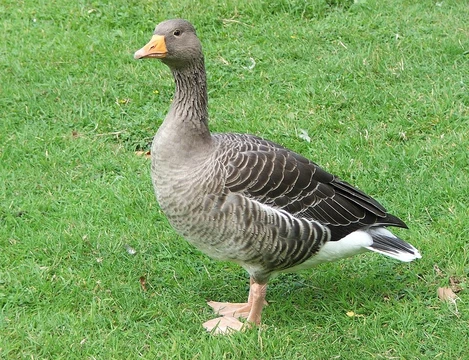
Greylag goose
Last updated
The greylag goose (Anser anser) is a large waterfowl and the original wild species behind most domestic goose breeds, domesticated by at least 1360 BCE. It has grey and white mottled feathers, an orange beak, and pink legs. Found across Europe and Asia, northern populations often migrate south for winter, while others stay put year-round.
Scientific classification
Named by (Linnaeus, 1758)
Close relatives
Other species of Anser with a Codexery entry.
- Pink-footed goose Anser brachyrhynchus
- Bar-headed goose Anser indicus
- Snow goose Anser caerulescens
- Sushkin's goose Anser neglectus
- Swan goose Anser cygnoides
- Emperor goose Anser canagicus
- Greater white-fronted goose Anser albifrons
- Lesser white-fronted goose Anser erythropus
Sources: Wikipedia taxobox: Greylag goose (CC BY-SA 4.0) · order, family and genus agree with WoRMS AphiaID 416682 (CC BY 4.0)
Conservation status
Least Concern (LC)
- LC▲ this species
- NT
- VU
- EN
- CR
- EW
- EX
Source: IUCN Red List assessment · GBIF copy of the Red List category
How big is it?
Largest length in the source, 1.8 m, next to a 1.8 m person.
Diagram: drawn by Codexery, schematic shapes to scale (not a likeness). Length: Wikipedia: Greylag goose
Where the greylag goose has been recorded
Each dot is a place where the species has been observed and reported (5,099,977 records, half-degree grid) — not a modelled range. 193 inland records left out (institution coordinates). 1 isolated far-off record not drawn.
Map: drawn by Codexery. Data: GBIF occurrence search (records CC0 / CC BY) · Natural Earth basemap (public domain) · place coordinates: Wikipedia (CC BY-SA 4.0)
Description
The greylag is the largest and bulkiest of the grey geese in the genus Anser, yet more lightly built than domestic forms. It has a rotund body, thick neck, large head and bill, pink legs and feet, and an orange or pink bill with a white or brown nail. Length ranges from 74 to 91 cm, wing length 41.2 to 48 cm, tail 6.2 to 6.9 cm, bill 6.4 to 6.9 cm, and tarsus 7.1 to 9.3 cm. Weight varies from 2.16 to 4.56 kg, averaging about 3.3 kg, with a wingspan of 147 to 180 cm.
Males are generally larger, with more pronounced dimorphism in the eastern subspecies A. a. rubirostris. Plumage is greyish brown with a darker head, paler breast and belly, and variable black spotting. A pale grey forewing and rump are visible in flight, and a white line borders the upper flanks. Wing coverts are light, contrasting with darker flight feathers.
Juveniles lack black speckling on breast and belly and have greyish legs. Adults show a distinctive concertina pattern of neck feather folds.
The call is a loud cackling "aahng-ung-ung", with variations; individual geese recognize known others by voice. A flock sounds like baying hounds. Goslings chirp or whistle, and adults hiss when threatened.
Distribution and habitat
The greylag goose has a Palearctic distribution. The nominate subspecies breeds in Iceland, Norway, Sweden, Denmark, Finland, the Baltic States, northern Russia, Poland, eastern Hungary, Romania, Germany, the Netherlands, and locally in the United Kingdom, Belgium, Austria, the Czech Republic, Slovakia, North Macedonia, and other European countries. The eastern subspecies extends across Asia to China. Historically, European birds migrated south to southern Europe and North Africa, but many now overwinter near their breeding range, even in Scandinavia.
Asian birds migrate to Azerbaijan, Iran, Pakistan, northern India, Bangladesh, and east to China. Rare winter migrants occur in South Korea and Japan. In North America, feral domestic geese similar to greylags and occasional vagrants appear. Feral birds in New Zealand and Australia likely originated from escaped farmyard geese.
Breeding habitats include moors with scattered lochs, marshes, fens, peat-bogs, lakes, and coastal islands, with dense ground cover of reeds, rushes, heather, bushes, and willow thickets. Winter quarters include salt marshes, estuaries, freshwater marshes, steppes, flooded fields, bogs, and pasture near water. They also visit agricultural land, feeding on crops and moving at night to shoals, sand-banks, or secluded lakes. Large immature flocks moult on the Rone Islands near Gotland.
Since the 1950s, rising winter temperatures have led to breeding in northern and central Europe, reducing migration distances or causing residency.
Behaviour
Greylag geese are largely herbivorous, feeding chiefly on grasses, especially short actively growing grass, and often graze in pastures with sheep or cows. They feed for much of the day due to low nutrient content, with herbage passing rapidly through the gut. They also take tubers of sea clubrush, fruits, and water plants such as duckweed and floating sweetgrass. In winter they eat grass, leaves, and glean grain on cereal stubbles, sometimes feeding on growing crops at night.
Known crop foods include oats, wheat, barley, buckwheat, lentils, peas, and root crops. Acorns and coastal seagrass are occasionally consumed. Since the 1940s they have fed on waste potatoes in ploughed fields. They also consume small fish, amphibians, crustaceans, molluscs, and insects.
Pairs bond in long-term monogamous relationships, mostly lifelong, though 5 to 8% separate and re-mate. Heterosexual pairs may engage in promiscuous behavior despite mate opposition.
Homosexual pairs are common (14 to 20% of pairs may be ganders), with bonds appearing closer based on display intensity. Same-sex pairs court and have sexual relations, often assuming high-ranking flock positions due to superior strength and courage, possibly serving as guardians. Sexual preference is flexible; over half of widowers re-pair with opposite-sex birds.
In human culture
Geese are important in multiple culinary traditions, with meat, liver, organs, fat, skin, and blood used in various cuisines. The greylag goose was revered across Eurasia over 5,000 years ago, linked to the goddess of healing Gula, a forerunner of Ishtar, in the Tigris-Euphrates delta. In Ancient Egypt, geese symbolized the sun god Ra. In Ancient Greece and Rome, they were associated with Aphrodite, and goose fat was used as an aphrodisiac.
Sacred geese kept on Rome's Capitoline Hill raised the alarm during the Gaulish attack in 390 BCE. The goose's fertility role survives in the nursery rhyme Goosey Goosey Gander, with sexual overtones, and the verb "to goose" retains a sexual meaning. The tradition of pulling a wishbone derives from eating roast goose at Michaelmas, when the bone was believed to have oracular powers. At that festival, geese were driven in thousand-strong flocks from East of England farms to London's Cheapside market, covering 8 or 9 miles per day; some farmers painted geese's feet with tar and sand for protection.
Greylag geese were domesticated by at least 1360 BCE, with images of domesticated birds resembling the eastern subspecies in Ancient Egypt. Goose feathers were used as quill pens, the best being left-wing primary feathers, and also to fletch arrows. The greylag goose was the subject of Konrad Lorenz's pioneering studies of imprinting behavior.
Did You Know?
- The greylag goose sometimes hybridises with the barnacle goose, Canada goose, and occasionally the mute swan.
- The specific epithet anser is Latin for 'goose'.
- In the USA, the name has been spelled 'graylag'.
More in Geese
Test yourself
Three questions drawn from this entry’s sources. Pick an answer to check it.
Answers checked against the source article
Sources
Compiled from Wikipedia and the sources listed below. Text from Wikipedia is available under CC BY-SA 4.0; this entry is adapted from it.
- Wikipedia: Greylag goose (CC BY-SA 4.0).
- Classification: the source article's taxobox; order, family and genus checked against WoRMS, the World Register of Marine Species (CC BY 4.0).
- Conservation status: IUCN Red List assessment.
- Occurrence records: GBIF (CC0 / CC BY). Basemap: Natural Earth (public domain).
- Word definitions: the Codexery glossary, each quoted from its Wikipedia article.
Spotted an error? Know more?
Reader corrections go straight into our review queue. Suggest an edit · How this site is sourced