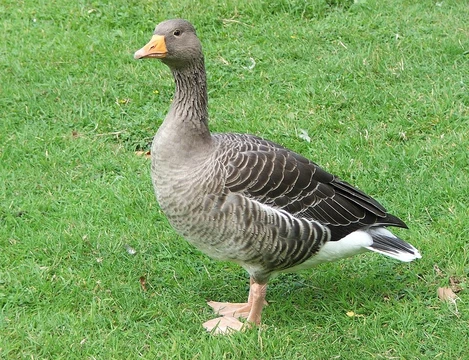
Egyptian goose
Last updated
The Egyptian goose (Alopochen aegyptiaca) is an African member of the Anatidae family, which includes ducks, geese, and swans. It has been introduced to Europe, the United States, and other regions outside its natural range, primarily as an ornamental bird. The species was regularly depicted in ancient Egyptian art.
Scientific classification
- KingdomAnimalia
- PhylumChordata
- ClassAves
- OrderAnseriformes
- FamilyAnatidae
- GenusAlopochen
- SpeciesAlopochen aegyptiaca
Named by (Linnaeus, 1766)
Close relatives
Other species of Alopochen with a Codexery entry.
- Mauritius sheldgoose Alopochen mauritiana
Sources: Wikipedia taxobox: Egyptian goose (CC BY-SA 4.0) · order, family and genus agree with WoRMS AphiaID 416680 (CC BY 4.0)
Conservation status
Least Concern (LC)
- LC▲ this species
- NT
- VU
- EN
- CR
- EW
- EX
Source: IUCN Red List assessment · GBIF copy of the Red List category
How big is it?
Largest length in the source, 0.73 m, next to a 1.8 m person.
Diagram: drawn by Codexery, schematic shapes to scale (not a likeness). Length: Wikipedia: Egyptian goose
Where the egyptian goose has been recorded
Each dot is a place where the species has been observed and reported (2,278,382 records, half-degree grid) — not a modelled range. 131 inland records left out (institution coordinates).
Map: drawn by Codexery. Data: GBIF occurrence search (records CC0 / CC BY) · Natural Earth basemap (public domain) · place coordinates: Wikipedia (CC BY-SA 4.0)
Taxonomy
The Egyptian goose was formally described by Carl Linnaeus in 1766 under the name Anas aegyptiaca, partly based on Mathurin Jacques Brisson's 1760 description of "L'oye d'Egypte." Brisson's Latin name Anser Egyptiatiacus does not conform to the binomial system and is not recognized by the International Commission on Zoological Nomenclature. The species is now placed in the genus Alopochen, introduced by Leonhard Stejneger in 1885, which also includes the extinct Mauritius sheldgoose and Reunion sheldgoose. It is monotypic, with no subspecies. The generic name means "fox-goose," referring to its ruddy back, and the species name means "Egyptian." The Egyptian goose is believed to be most closely related to shelducks (genus Tadorna) and is placed in the subfamily Tadorninae. mtDNA cytochrome b data suggest that the relationship between Alopochen and Tadorna needs further investigation.
Description
The Egyptian goose swims well and appears heavy in flight, more like a goose than a duck. It averages 63–73 cm in length and weighs 1500–2348 g. The sexes have identical plumage, though males are usually larger; plumage tone varies from grey to brown without apparent sex or age correlation. Mature birds have white wings hidden by coverts at rest, displayed when alarmed or aggressive.
Wild individuals may live up to 15 years, captives up to 35. The male has a hoarse, subdued quack and a louder, breathy call resembling a steam engine; the female has a noisier, raucous quack used in aggression. The male attracts a mate with an elaborate courtship display involving honking, neck stretching, and feather displays.
Distribution
The Egyptian goose is native to Sub-Saharan Africa and the Nile Valley, where it is widespread and common, though scarce in the northern Nile Valley. It inhabits open or semi-open habitats near fresh water, from lowlands to 4000 m in the Ethiopian Highlands, and is largely absent from dense forests and deserts. Outside the breeding season it disperses, sometimes migrating north into the Sahel and occasionally reaching Algeria and Tunisia. It was found in southeastern Europe until the early 1700s and in parts of Turkey and the western Middle East until the early 1900s, with re-establishment through escaped captives; the reasons for its historical disappearances are unknown.
Introduced to British estates and parks in the 17th century, it was formally added to the British bird list in 1971. In Great Britain it is mainly in East Anglia and along the River Thames, breeding at sites with open water, short grass, and suitable nesting locations. In 2009 it was declared a non-native species in the UK, where it may be shot without special permission if it causes problems.
Behaviour
The Egyptian goose is a highly adaptable nester, often choosing a hollow in a mature parkland tree. The female constructs the nest using reeds, leaves, and grass, and both parents share the duty of incubating the eggs for 28 to 30 days. These birds typically form lifelong pair bonds, and both mother and father tend to the young, though the goslings are able to find their own food from the moment they hatch. The adult diet consists mainly of cereal crops, leaves, and grasses, with the occasional addition of locusts, worms, or other small creatures.
Goslings, however, rely heavily on small aquatic invertebrates, such as freshwater plankton. This feeding habit can prove deadly if anoxic conditions create botulinum toxin that moves up the food chain through unaffected worms and insect larvae, potentially wiping out entire broods while the parents, who rarely eat such prey, stay healthy. During breeding season, both sexes become fiercely territorial, chasing rivals into the air for aerial dogfights and even attacking drones.
Neighbouring pairs may kill each other's offspring to benefit their own young. In their native range, natural predators include leopards, lions, cheetahs, hyenas, crocodiles, and Old World vultures.
More in Geese
Test yourself
Three questions drawn from this entry’s sources. Pick an answer to check it.
Answers checked against the source article
Sources
Compiled from Wikipedia and the sources listed below. Text from Wikipedia is available under CC BY-SA 4.0; this entry is adapted from it.
- Wikipedia: Egyptian goose (CC BY-SA 4.0).
- Classification: the source article's taxobox; order, family and genus checked against WoRMS, the World Register of Marine Species (CC BY 4.0).
- Conservation status: IUCN Red List assessment.
- Occurrence records: GBIF (CC0 / CC BY). Basemap: Natural Earth (public domain).
- Word definitions: the Codexery glossary, each quoted from its Wikipedia article.
Spotted an error? Know more?
Reader corrections go straight into our review queue. Suggest an edit · How this site is sourced