Elite (video game)
A pioneering space trading game with wire-frame 3D graphics.
Last updated

Bsivko · CC BY-SA 4.0
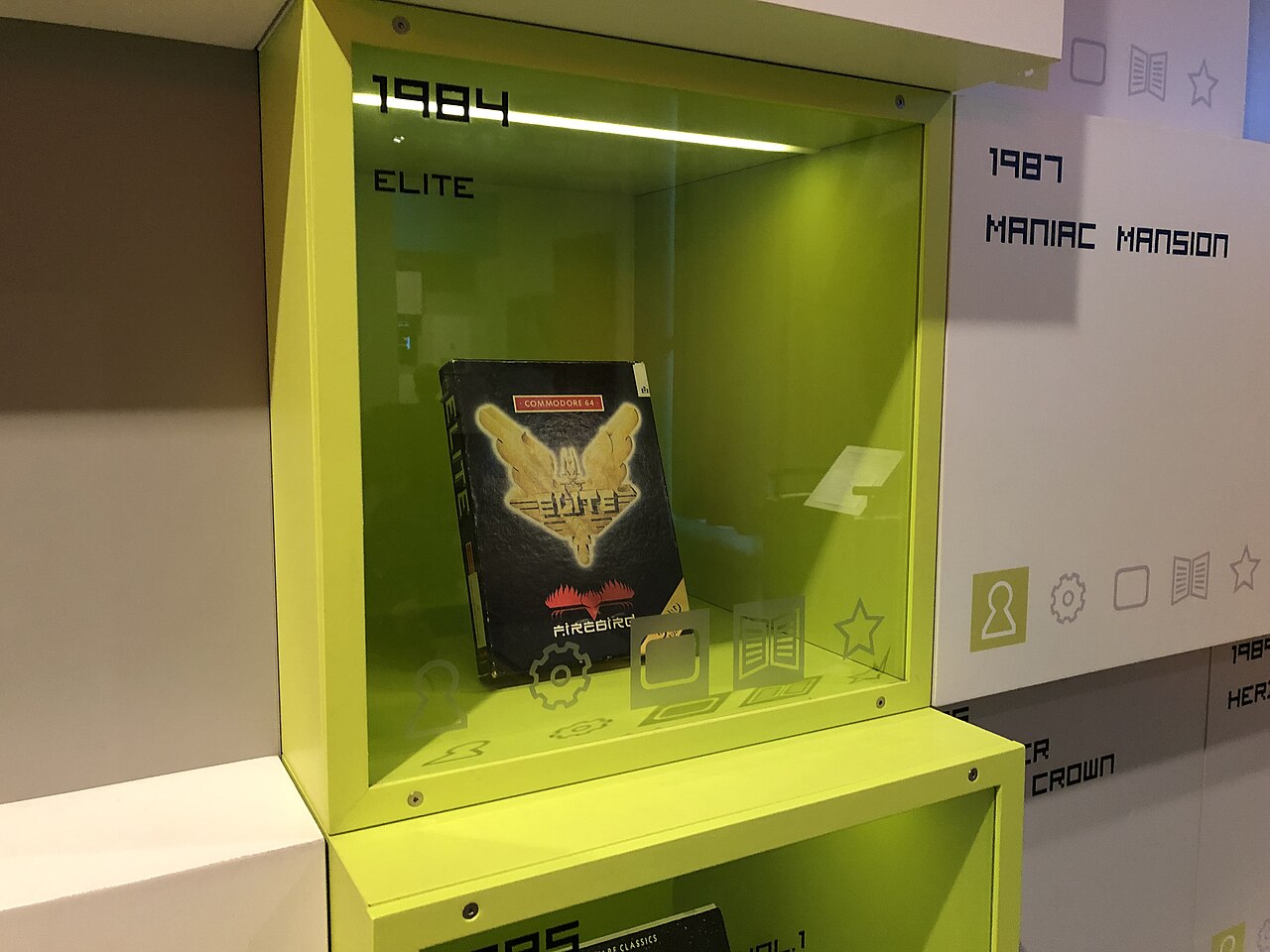
Elite is a space trading video game created by David Braben and Ian Bell, first released by Acornsoft for the BBC Micro in September 1984. Its open-ended gameplay and groundbreaking wire-frame 3D graphics—among the first on home computers to include hidden-line removal—led to versions on nearly every home computer of the era, cementing its status as a classic and a genre-defining title. The name comes from the player’s goal of reaching the highest combat rank, "Elite."

Gameplay
The game added fast-paced action to the trading concept established by the 1974 game Star Trader. It also included The Dark Wheel, a novella by Robert Holdstock that gave players background on the game’s moral and legal codes. Players start as "Commander Jameson" (a name changeable on save) at Lave Station with 100 credits and a Cobra Mark III ship. Credits come from piracy, trade, military missions, bounty hunting, or asteroid mining, and can be spent on upgrades like better weapons, extra cargo space, an auto-docking system, or an energy bank.

Each star has one planet with an orbiting space station. Travel between stars uses hyperspace jumps limited by fuel range (max 7 light years); sublight travel uses no fuel. Docking requires matching the station’s rotation—a task avoidable with a docking computer.
A fuel scoop lets players skim stars for energy, and free-floating cargo or escape pods can be collected after ship destruction. During hyperspace jumps, the hostile Thargoid race may intercept the player in "witch-space," forcing combat. If fuel runs out mid-jump, the player may be stranded unless they have an escape capsule.

A one-time galactic hyperspace upgrade allows travel between eight galaxies, which are largely similar but have different planetary layouts and trade routes. Some versions include Galactic Navy missions: hunting a stolen ship or delivering intelligence on the Thargoids’ home planet, with rewards like cash, gems, or a cloaking device.
The game was followed by Frontier: Elite II (1993) and Frontier: First Encounters (1995), which added Newtonian physics, realistic star systems, and seamless planetary landings. Elite Dangerous launched on 16 December 2014, introducing massively multiplayer play, an ongoing narrative, first-person on-foot gameplay, and space colonization.

Lore & Background
Elite was inspired by sources including 2001: A Space Odyssey, Star Wars, The Hitchhiker's Guide to the Galaxy, and Battlestar Galactica, as well as works by Larry Niven, Jerry Pournelle, Arthur C. Clarke, Robert L. Forward, Isaac Asimov, and Orson Scott Card. The default commander name Jameson was inspired by the Traveller tabletop role-playing game.
Braben and Bell met at Jesus College, Cambridge, where Bell was working on a game called Freefall and Braben on a game called Fighter; they decided to collaborate after comparing notes and seeing Star Raiders on the Atari 800. They first approached Thorn EMI, which rejected the game as too complicated, then met with Acornsoft, whose managing director David Johnson-Davies was impressed by the demo. Acornsoft agreed to publish, giving the programmers a £1,000 advance and a 7.5% royalty rate.
Did You Know?
- The game's universe contains eight galaxies, each with 256 procedurally generated planets.
- The developers removed an entire galaxy after finding a planet named 'Arse'.
- The original BBC version used a split-screen approach to show four colors simultaneously.
Frequently Asked Questions
Who created Elite (1984) and what is it?
Elite is a space trading simulation designed by David Braben and Ian Bell, published by Acornsoft for the BBC Micro in September 1984. It combines open-ended exploration, interplanetary commerce, and combat across a procedurally generated galaxy.
What made Elite's 3D graphics revolutionary for its time?
The game rendered wire-frame 3D environments using hidden-line removal, a technique that was nearly unheard of on home computers in 1984. This gave players a convincing sense of flying through three-dimensional space on very modest hardware.
What is the player's ultimate goal in Elite?
You advance by trading goods between planets and engaging in combat until you earn the highest rank in the game, which is literally called 'Elite.' There is no fixed ending; the open-ended structure lets you keep exploring and trading indefinitely.
How did Elite build on earlier space trading games?
It took the basic trading loop established by the 1974 title Star Trader and layered fast-paced 3D combat and open-world exploration on top of it. That blend of economic simulation and action became the template for the entire space-sim genre.
On which platforms was Elite released?
Originally launched on the BBC Micro, it was quickly ported to virtually every other home computer available in the mid-1980s. That widespread availability helped cement it as a defining classic of the era.
More in Gaming Mechanics & Design
Sources
Compiled from Wikipedia and the sources listed below. Text from Wikipedia is available under CC BY-SA 4.0; this entry is adapted from it.
- Wikipedia: Elite (video game) (CC BY-SA 4.0).
Spotted an error? Know more?
Reader corrections go straight into our review queue. Suggest an edit · How this site is sourced