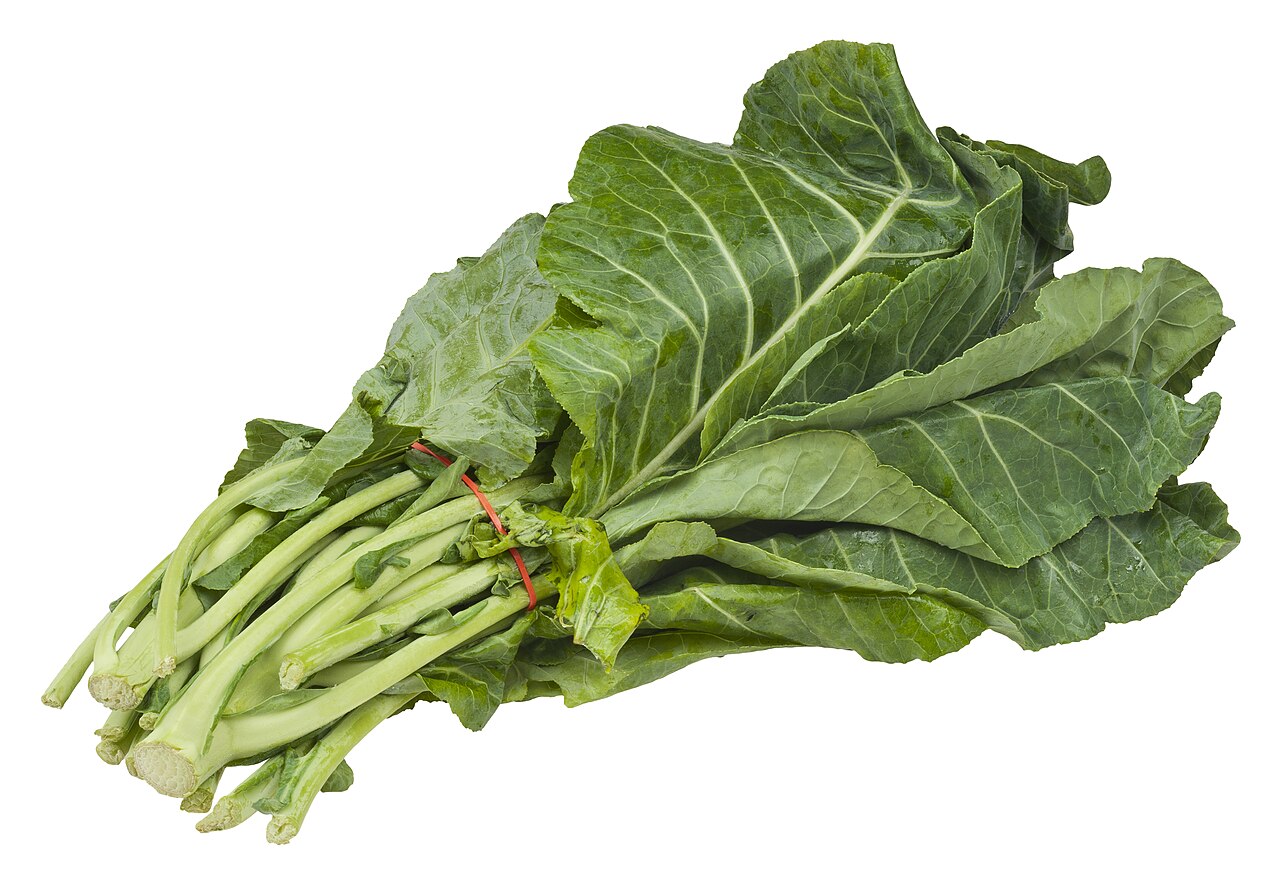
Collard (plant)
A leafy green cultivated since classical antiquity.

Vegan Feast Catering · CC BY 2.0
People have grown collard as a food crop since ancient times, with Greek and Roman sources from the 1st century CE mentioning it.[1][2] An upright stalk characterizes this plant; it commonly exceeds two feet in height, and Portuguese cultivars can reach six feet.[3]
Quick Facts
- Species
- Brassica oleracea
- Group
- Acephala Group
- Origin
- Greece
Facts from the source article.
Key facts and history
Acephala is Greek for "without a head," referring to a lack of a close-knit core of leaves as in cabbage.[4] The Greeks and Romans cultivated collard.[5] Collard seeds may have been brought from Portugal in the 18th century or from the British Isles to the early colonies.[6] During medieval times, the word "colewort" referred to non-heading brassica crops.[7]
Many non-heading Brassica oleracea crops have been grouped under the term "collard."[3] During the era of U.S. slavery, collards were among the plants most frequently grown in kitchen gardens.[8]
What the cited sources add
The Heirloom Collard Project works for recognition and respect of collards as a key component of American food culture.[9] Historian John Egerton declared that "from Africa with the people in bondage came new foods," including collard greens.[6] Edward Davis and John Morgan traversed the South to collect rare heirloom collards between 2003 and 2007.[6] The pair published a book on their quest, "Collards: A Southern Tradition from Seed to Table," in 2015.[6]
In Zimbabwe, the Ndebele language calls collard greens umbhida, while in Shona they are called muriwo.[10]
Gallery
References
- Wikipedia, "Collard (plant)" (CC BY-SA 4.0), which cites: "Greeks and Romans Grew Kale and Collards | Archives | Aggie Horticulture", Texas A&M University (original not read by us) en.wikipedia.org
- Wikipedia, "Collard (plant)" (CC BY-SA 4.0), which cites: "Greeks and Romans Grew Kale and Collards", Aggie Horticulture (original not read by us) en.wikipedia.org
- Wikipedia, "Collard (plant)" (CC BY-SA 4.0), which cites: Pelc, "Genetic Diversity and Population Structure of Collard Landraces and their Relationship to Other Brassica oleracea Crops", The Plant Genome, 2015, p. eplantgenome2015.04.0023 (original not read by us) en.wikipedia.org
- Wikipedia, "Collard (plant)" (CC BY-SA 4.0), which cites: "Brassica oleracea var. acephala", Floridata, 2007-02-06 (original not read by us) en.wikipedia.org
- "The "African" vegetable that lifts the weak", The Zimbabwean, 2006-05-25. facts only, no text reused. thezimbabwean.co
- Freeman, "The Farmers and Gardeners Saving the South's Signature Green", Atlas Obscura, 19 March 2021. facts only, no text reused. atlasobscura.com
- Wikipedia, "Collard (plant)" (CC BY-SA 4.0), which cites: ; "Greeks and Romans Grew Kale and Collards", Texas A&M Agricultural Extension (original not read by us) en.wikipedia.org
- Wikipedia, "Collard (plant)" (CC BY-SA 4.0), which cites: Wortman, "Greens", Southwest Review, 2012, p. 400–407; Wortman, "Greens", Southwest Review, 2012, p. 400–407 (original not read by us) en.wikipedia.org
- "The Heirloom Collard Project", The Heirloom Collards Project. facts only, no text reused. heirloomcollards.org
- Wikipedia, "Collard (plant)" (CC BY-SA 4.0), which cites: "The "African" vegetable that lifts the weak", The Zimbabwean, 2006-05-25; "Food in Zimbabwe", Food by Country (we also read that source) en.wikipedia.org
Each numbered sentence above was checked against the source it cites before publication. Sentences citing Wikipedia adapt text from the English Wikipedia article Collard (plant) (contributors), used under CC BY-SA 4.0; this entry is available under the same licence. Other sources were used for facts only; no text or images are copied from them.
More in Fruits & Vegetables
Spotted an error? Know more?
Reader corrections go straight into our review queue. Suggest an edit · How this site is sourced