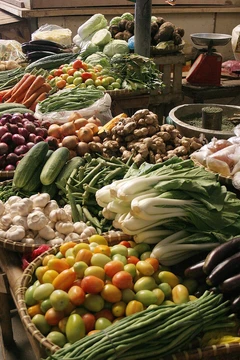
Cucurbita
Genus of gourds including squash and pumpkin, native to the Americas.
Cucurbita fruits are classified botanically as a pepo, a type of berry with a thick outer rind and fleshy interior.[1] Belonging to the gourd family Cucurbitaceae, the genus Cucurbita consists of herbaceous fruits whose native range includes the Andes and Mesoamerica.[2] Each plant in this genus carries both male and female flowers, which are unisexual and emerge singly from the leaf axils.[3]
Quick Facts
- Field
- Botany
- Native to
- Andes and Mesoamerica
- Domesticated species
- 5 (C. argyrosperma, C. ficifolia, C. maxima, C. moschata, C. pepo)
- Chromosome count
- 20 pairs
- Fruit type
- Pepo (a type of berry)
Facts from the source article.
Key facts and history
Cucurbita species fall into two main groups: mesophytic annuals or short-lived perennials requiring continuous water, and xerophytic perennials that tolerate dry conditions.[4] All Cucurbita species have 20 pairs of chromosomes.[5] The genus was formally described by Linnaeus in his 1754 Genera Plantarum, with Cucurbita pepo as the type species.[6] The earliest known domestication evidence was found in Guilá Naquitz cave in Oaxaca, Mexico.[7]
Tendrils produced by the stem allow the plant, which reaches 5 to 15 m in length or height, to climb or sprawl across the ground.[4] Domestication evidence for Cucurbita stretches back more than 8,000 years, which is roughly 4,000 years earlier than the domestication of maize and beans in that area.[8][7] Wild Cucurbita species contain cucurbitacin, a steroid that is toxic to mammals and gives them a bitter flavor.[9][10]
What the cited sources add
The Flora of China account describes male flowers as having a campanulate calyx tube, three stamens with anthers connected into a head, and female flowers with an oblong or globose ovary containing 3–5 placentas.[11] The same source lists three Cucurbita species for China: C. maxima, C. moschata, and C. pepo.[11] A 2013 book on toxic plants of North America notes that cucurbitacin makes wild Cucurbita and most ornamental gourds bitter, and that ingesting too much can cause stomach cramps, diarrhea, and collapse.[12][10] A 1996 CAB International book on cucurbits states that C. moschata is closely related to C. argyrosperma and that a variety known as the Seminole Pumpkin has been cultivated in Florida since before Columbus.[13][14]
References
- Wikipedia, "Cucurbita" (CC BY-SA 4.0), which cites: Mabberley, "The Plant Book: A Portable Dictionary of the Vascular Plants", Cambridge University Press, 2008, p. 235 (we also read that source) en.wikipedia.org
- Wikipedia, "Cucurbita" (CC BY-SA 4.0), which cites: Burrows, "Toxic Plants of North America", Wiley-Blackwell, 2013, p. 389–391; Gledhill, "The Names of Plants", Cambridge University Press, 2008, p. 127 (we also read that source) en.wikipedia.org
- Wikipedia, "Cucurbita" (CC BY-SA 4.0), which cites: Mabberley, "The Plant Book: A Portable Dictionary of the Vascular Plants", Cambridge University Press, 2008, p. 235; Lu, "Cucurbita Linnaeus", Flora of China; Saade, "Cucurbits", Purdue Horticulture; "Cucurbitaceae – Fruits for Peons, Pilgrims, and Pharaohs", University of California at Los Angeles; Saade, "Cucurbits", Purdue Horticulture; Saade, "Cucurbits", Purdue Horticulture (we also read that source) en.wikipedia.org
- Wikipedia, "Cucurbita" (CC BY-SA 4.0), which cites: Nee, "The Domestication of Cucurbita (Cucurbitaceae)", Economic Botany, 1990, p. 56–68; Decker-Walters, "Diversity in Free-Living Populations of Cucurbita pepo (Cucurbitaceae) as Assessed by Random Amplified Polymorphic DNA", Systematic Botany, 2002, p. 19–28; Millán, "Variaciones del Zapallito Amargo Cucurbita andreana y el Origen de Cucurbita maxima", Revista Argentina de Agronomía, 1945, p. 86–93; Decker-Walters, "Diversity in Free-Living Populations of Cucurbita pepo (Cucurbitaceae) as Assessed by Random Amplified Polymorphic DNA", System en.wikipedia.org
- Wikipedia, "Cucurbita" (CC BY-SA 4.0), which cites: Rhodes, "A Numerical Taxonomic Study of Cucurbita", Brittonia, 1968, p. 251–266 (original not read by us) en.wikipedia.org
- Wikipedia, "Cucurbita" (CC BY-SA 4.0), which cites: Linnaeus, "Genera Plantarum", Impensis Laurentii Salvii via Biodiversity Heritage Library, 1754, p. 441; Linnaeus, "Species Plantarum", Impensis Laurentii Salvii via Biodiversity Heritage Library, 1753, p. 1010; Linnaeus, "Species Plantarum", Impensis Laurentii Salvii via Biodiversity Heritage Library, 1753, p. 1010; "Cucurbita", The Linnaean Plant Name Typification Project, 2022; "Cucurbita", The Plant List (original not read by us) en.wikipedia.org
- Wikipedia, "Cucurbita" (CC BY-SA 4.0), which cites: Nee, "The Domestication of Cucurbita (Cucurbitaceae)", Economic Botany, 1990, p. 56–68; Wilson, "What is Cucurbita texana?", Free-living Cucurbita pepo in the United States Viral Resistance, Gene Flow, and Risk Assessment; Gibbon, "Archaeology of Prehistoric Native America: An Encyclopedia", Routledge, 1998, p. 238; Roush, "Archaeobiology: Squash Seeds Yield New View of Early American Farming", Science, 9 May 1997, p. 894–895; Schoenwetter, "Pollen Records of Guila Naquitz Cave", American Antiquity, April 1974, p. 292–303; Benz, "Archaeologic en.wikipedia.org
- Wikipedia, "Cucurbita" (CC BY-SA 4.0), which cites: Nee, "The Domestication of Cucurbita (Cucurbitaceae)", Economic Botany, 1990, p. 56–68 (original not read by us) en.wikipedia.org
- Wikipedia, "Cucurbita" (CC BY-SA 4.0), which cites: Tallamy, "Variation and Function of Cucurbitacins in Cucurbita: An Examination of Current Hypotheses", The American Naturalist, 1989, p. 766–786 (original not read by us) en.wikipedia.org
- Wikipedia, "Cucurbita" (CC BY-SA 4.0), which cites: Burrows, "Toxic Plants of North America", Wiley-Blackwell, 2013, p. 389–391; Andres, "Cucurbita fraterna, the Closest Wild Relative and Progenitor of C. pepo", Cucurbit Genetics Cooperative Report, 1987, p. 69–71; "Western Corn Rootworm: Ecology and Management", CAB International, 2005, p. 67–71; Chen, "Cucurbitacins and Cucurbitane Glycosides: Structures and Biological Activities", Natural Product Reports, 2005, p. 386–399; Merrick, "Natural Hybridization of Wild Cucurbita sororia Group and Domesticated C. mixta in Southern Sonora, Mexi en.wikipedia.org
- Lu, "Cucurbita Linnaeus", Flora of China. facts only, no text reused. efloras.org
- Open Library record, ISBN 9780813820347 ("Toxic plants of North America"). CC0 (metadata); book content not read. openlibrary.org
- Open Library record, ISBN 9780851991337 ("Cucurbits"). CC0 (metadata); book content not read. openlibrary.org
- Wikipedia, "Cucurbita" (CC BY-SA 4.0), which cites: Saade, "Cucurbits", Purdue Horticulture; Robinson, "Cucurbits", CAB International, 1997, p. 71–83 (we also read that source) en.wikipedia.org
Each numbered sentence above was checked against the source it cites before publication. Sentences citing Wikipedia adapt text from the English Wikipedia article Cucurbita (contributors), used under CC BY-SA 4.0; this entry is available under the same licence. Other sources were used for facts only; no text or images are copied from them.
More in Fruits & Vegetables
Spotted an error? Know more?
Reader corrections go straight into our review queue. Suggest an edit · How this site is sourced