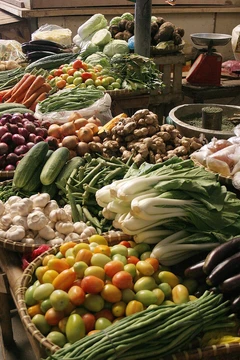
Choy sum
A leafy green with yellow flowers, prized in Chinese cuisine.
Choy sum, also known as choi sum or caixin, is a leafy green from the Brassica genus in the mustard family. Its Cantonese name translates to "heart of the vegetable." This plant, also called yu choy or Chinese flowering cabbage, is a staple in Chinese cooking. It resembles gai lan and is identified by its yellow flowers. The entire plant, which rarely grows as a perennial or subshrub, is an annual herb. It is often eaten in soups, blanched, or stir-fried.
Quick Facts
- Scientific name
- Brassica rapa var. parachinensis or Brassica chinensis var. parachinensis
- Family
- Brassicaceae
- Height range
- 10 to 40 cm (4 to 16 in / 40.6 cm)
- Flower color
- yellow
- Seed pod seed count
- 4 to 46 seeds per pod
Facts from the source article.
Lore & Background
Choy sum is highly valued as a vegetable in China and Japan.
Reader's Guide
Choy sum is a green leafy vegetable similar to gai lan, and can be characterized by the distinct yellow flowers which it bears. Each flower has four yellow, oval to round petals with six stamens on fleshy, erect stems which are 0.5 to 1 cm in diameter and 15 to 20 cm tall with light to dark green, oval leaves with slightly serrated margins, which never forms compact heads like the cabbage. The height of the plant varies from 10 to 40 cm. Flowering usually appears when there are about 7 to 8 leaves on the plant or about 20 cm tall. The bulk of the root system is found within a depth of 12 cm and is confined to a radius of 12 cm. The whole plant is an annual, herbaceous plant, rarely perennial, rarely growing into subshrubs. It grows best in soil with a minimum pH level of 5.6, maximum pH level of 7.5. It is commonly consumed in soup, blanched, or stir-fried.
More in Fruits & Vegetables
Spotted an error? Know more?
Reader corrections go straight into our review queue. Suggest an edit · How this site is sourced