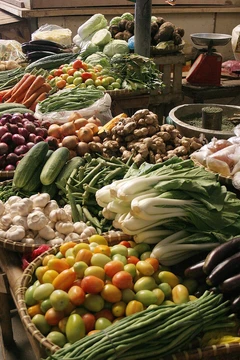
Cucumber
A widely-cultivated creeping vine plant with cylindrical fruits.
The cucumber is an annual climbing or spreading vine that produces crisp, green fruit.[1] From a botanical standpoint, the cucumber is categorized as a pepo, which is a type of berry containing seeds and having a tough outer rind, though in cooking it is treated as a vegetable.[2] Water makes up 95% of the composition of cucumber fruits.[2]
Quick Facts
- Genus
- Cucumis
- Species
- sativus
Facts from the source article.
Key facts and history
Cucumis sativus was domesticated in India from wild C. sativus var. hardwickii over 3,000 years ago.[3] Carl Linnaeus described the species in 1753 in his Species Plantarum.[4] Pliny the Elder recorded that Emperor Tiberius ensured cucumbers were on his table every day by employing artificial cultivation techniques that involved mirrorstone.[5] During the 8th and 9th centuries, Charlemagne had cucumbers cultivated in his gardens.[6]
In 1494, cucumbers were brought to Haiti by the Spaniards.[6] At the location of present-day Montreal in 1535, Jacques Cartier discovered "very great cucumbers" being grown.[6] Self-incompatibility is a trait of most cucumber cultivars that require pollination, meaning they need pollen from a different plant.[7]
What the cited sources add
The North Carolina State University Extension Gardener notes that cucumber plants can grow 8 to 18 inches high and 3 to 8 feet wide.[1] Cucumbers grown vertically on a trellis increase air circulation and grow straighter fruits.[1] The European Food Information Council explains that cucumbers are botanically fruit because they contain seeds and grow from the flower of the plant.[8] The Old Farmer's Almanac describes that slicing cucumbers are usually picked when 6 to 8 inches long, while pickling cucumbers are best at 2 to 3 inches.[9]
The Old Farmer's Almanac notes that cucumbers are over 90% water and wrapping them in plastic helps them stay fresh longer.[9]
References
- "Cucumis sativus", North Carolina State University, Extension Gardener, 2025. facts only, no text reused. plants.ces.ncsu.edu
- Wikipedia, "Cucumber" (CC BY-SA 4.0), which cites: "Is a Cucumber a Fruit or a Vegetable and Why?", European Food Information Council, 4 March 2020; "Is a Cucumber a Fruit or a Vegetable and Why?", European Food Information Council, 4 March 2020 (we also read that source) en.wikipedia.org
- Wikipedia, "Cucumber" (CC BY-SA 4.0), which cites: Chomicki, "Origin and domestication of Cucurbitaceae crops: insights from phylogenies, genomics and archaeology", New Phytologist, June 2020, p. 1240–1255; Weng, "Plant Breeding Reviews", Wiley, 7 January 2021, p. 79–111; Bisht, "Distribution and genetic diversity of Cucumis sativus var. hardwickii (Royle) Alef in India", The Journal of Horticultural Science and Biotechnology, January 2004, p. 783–791; Asian News International. 21 July 2010. "Cucumber, melon's common ancestor originated in Asia." NewsTrack India. Retrieved on 4 June 2020. (ori en.wikipedia.org
- Wikipedia, "Cucumber" (CC BY-SA 4.0), which cites: Linnaeus, "Species Plantarum", 1753, p. 1012; "Cucumis L..", Plants of the World Online (original not read by us) en.wikipedia.org
- Wikipedia, "Cucumber" (CC BY-SA 4.0), which cites: "Ancient Inventions", Ballantine Books, 1995, p. 563; Pliny the Elder. [77–79 AD] 1855. "Vegetables of a Cartilaginous Nature—Cucumbers. Pepones ." Ch. 23 in The Natural History XIX, translated by J. Bostock and H.; "Ancient Inventions", Ballantine Books, 1995, p. 563 (we also read that source) en.wikipedia.org
- Wikipedia, "Cucumber" (CC BY-SA 4.0), which cites: "A Brief History of Cucumbers, From Producing Vegetable Crops by Swiader et al; and A History of Horticulture in America to 1860 by U.P. Hedrick.", B's Cucumber Pages (original not read by us) en.wikipedia.org
- Wikipedia, "Cucumber" (CC BY-SA 4.0), which cites: Nonnecke, I.L., "Vegetable Production", Springer, 1989; Nonnecke, I.L., "Vegetable Production", Springer, 1989 (we also read that source) en.wikipedia.org
- "Is a Cucumber a Fruit or a Vegetable and Why?", European Food Information Council, 4 March 2020. facts only, no text reused. eufic.org
- "Cucumbers: Planting, growing, and harvesting cucumbers", Old Farmer's Almanac, Yankee Publishing, Inc., Dublin, NH, 2016. facts only, no text reused. almanac.com
Each numbered sentence above was checked against the source it cites before publication. Sentences citing Wikipedia adapt text from the English Wikipedia article Cucumber (contributors), used under CC BY-SA 4.0; this entry is available under the same licence. Other sources were used for facts only; no text or images are copied from them.
More in Fruits & Vegetables
Spotted an error? Know more?
Reader corrections go straight into our review queue. Suggest an edit · How this site is sourced