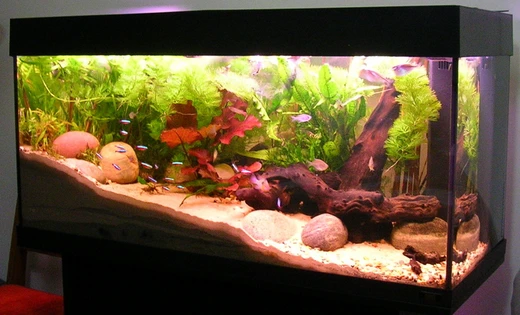
Neon tetra
One of the most widely kept tropical fish in the world.

The neon tetra (Paracheirodon innesi) is a small freshwater fish from the Amazon basin in South America. It belongs to the American characin family and lives in blackwater and clearwater streams. Its vivid colors help other neon tetras spot it in dark waters, and this same brightness has made it one of the most popular tropical fish among aquarium keepers worldwide.
**Range and habitat** These fish are found in the western and northern Amazon, across parts of Colombia, Peru, and Brazil. They prefer temperatures between 20 and 28 °C and a pH of 4 to 7.5. They mostly inhabit acidic blackwater streams but also turn up in clearwater streams. They are absent from whitewater rivers. The UN Food and Agriculture Organization lists them as introduced in Singapore and the United States, noting the introduction to Singapore as ecologically and socioeconomically beneficial, though the species is not established there.
**Description** The neon tetra has a light-blue back and a silver-white belly. A bright, iridescent blue stripe runs along each side from the nose to the base of the adipose fin, and a red stripe starts at midbody and extends to the base of the tail fin. The body and fins are partly transparent except for these markings. Males and females look similar, but females have a slightly larger belly and a bent blue stripe instead of a straight one. At night, the blue and red stripes fade to gray or black while the fish rests, then brighten again in the morning. This color change happens because guanine crystals in the cells reflect light differently depending on lighting conditions—blue-green in light, indigo in darkness. The fish grows to about 4 cm long.
**Economics** First imported from South America, the neon tetra was described by ichthyologist George S. Myers in 1936 and named after William T. Innes. It is one of the most popular aquarium fish, with around 2 million sold in the United States each month. Most of these are imported from fish farms in Southeast Asia, though some are still wild-caught in Colombia, Peru, and Brazil. Commercial breeding in the U.S. is rare, limited to a few experimental farms and home aquarists.
**In the aquarium** In the wild, neon tetras live in very soft, acidic water (pH 4.0 to 4.8). In an aquarium, a pH of 7.0 is ideal, but 6.0 to 8.0 is acceptable.
Quick Facts
- Taxon
- Paracheirodon innesi
Facts from the source article.
Lore & Background
The neon tetra was first imported from South America and was described by renowned ichthyologist George S. Myers in 1936, and named after William T. Innes. It is the type species of its genus. The fish has a light-blue back over a silver-white abdomen, with a bright iridescent blue horizontal stripe along each side from its nose to the base of the adipose fin, and an iridescent red stripe that begins at the middle of the body and extends posteriorly to the base of the caudal fin. The fish is partially transparent except for these markings. Sexual dimorphism is slight, with the female having a slightly larger belly and a bent iridescent stripe rather than the male's straight stripe. During the night, the blue and red become gray or black as the fish rests, reactivating once it becomes active in the morning. This change is produced by guanine crystals in their cells that reflect light.
Reader's Guide
The neon tetra is one of the most popular aquarium fish, with about 2 million sold in the US each month. Most neon tetras available in the United States are imported from Southeast Asia, where they are farm-raised, or to a lesser extent from Colombia, Peru, and Brazil, where they are collected from the wild. With the exception of home aquarists and a few commercial farms that breed neon tetras experimentally, captive breeding on a commercial scale is nonexistent in the USA. In the aquarium, they are considered easy to keep in a tank of at least 10 US gallons with a temperature range of 72–76 °F, pH 6.0–7.0, GH below 10 dGH, KH 1–2 dKH, and under 20 ppm of nitrate. They are shoaling fish and must be kept in groups of at least six, but will be more active in groups of eight to 12 or more. They are best kept in a densely planted tank to resemble their native Amazon environments. Neon tetras are omnivores and will accept most flake foods, but should also have small foods such as brine shrimp, daphnia, freeze-dried bloodworms, tubifex, and micropellet food. Breeding is considered difficult in home aquariums, requiring dim lighting, DH less than one, pH about 5.5, temperature 75 °F, and a lot of tannins in the water. Neon tetras are old enough to breed at 12 weeks. They are occasionally afflicted by neon tetra disease (NTD), a sporozoan disease caused by Pleistophora hyphessobryconis, which is generally incurable and often fatal but preventable. A so-called 'false neon disease', which is bacterial, shows very similar symptoms and is impossible for the home aquarist to distinguish without laboratory backup.
Did You Know?
- During the night, the neon tetra's blue and red stripes become gray or black as the fish rests, then reactivate in the morning.
- The UN FAO considers P. innesi an introduced species in Singapore and the United States, with its introduction to Singapore considered ecologically and socioeconomically beneficial.
- Neon tetras can have a lifespan of as long as ten years, but normally just two to three years in an aquarium.
More in Fishkeeping, Part 3 1-24
Spotted an error? Know more?
Reader corrections go straight into our review queue. Suggest an edit · How this site is sourced