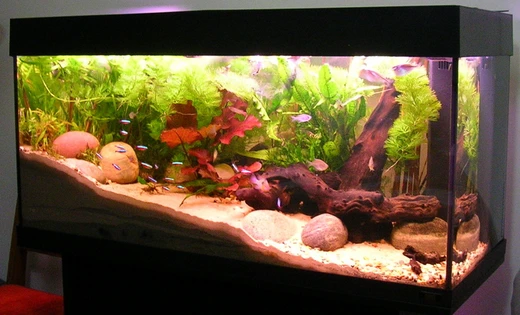
Live rock
Live rock is a biological filter and habitat from ocean reefs.

Live rock is ocean rock placed into a saltwater aquarium. Along with live sand, it gives a closed marine system several advantages that saltwater hobbyists look for. The name can be confusing: the rock itself isn’t alive. It’s made from aragonite skeletons of long-dead corals or other calcareous organisms, which in the wild make up most coral reefs. When collected from the ocean, it’s usually covered in coralline algae and hosts many marine creatures. The tiny and larger life forms living on and inside the rock—which serves as a perfect home—are why it’s called “live rock.”
**Origin**
Live rock is taken from reefs for aquarium use, coming from either natural breakage or human-caused damage. It can also be “seeded” by placing small coralline rocks in warm ocean water, then harvested later by an aquaculturalist. Another way to seed live rock is to add base rock to an active reef aquarium that already has live rock. When collected, live rock contains a wide range of corals, algae, sponges, and other invertebrates. Corals added to the tank later often attach themselves to the rock.
**Purpose**
Live rock is prized in the aquarium trade. It brings many types of bacteria, algae, and invertebrates into the closed marine environment and works as an excellent biological filter, hosting both aerobic and anaerobic nitrifying bacteria needed for the nitrogen cycle that handles waste. It becomes the main biological nitrification base—or biological filter—of a saltwater aquarium. Harmful substances dissolved in the tank water, such as ammonia, phosphates, and nitrates, are processed with help from the organisms introduced by the live rock. Excess ammonia, nitrate, and phosphate are removed by algae and corals growing on the rock’s surface, while other bacteria aid the process and restore balance to the water chemistry. Live rock also helps stabilize water chemistry, especially by releasing calcium carbonate to keep pH steady. Finally, live rock—particularly when coated with various species of coralline algae in different colors—becomes a key decorative element in the aquarium and offers shelter for its inhabitants. It’s often used to build caves, arches, overhangs, and other structures, a practice called aquascaping.
In J.
- Origin regions
- Southern Pacific (Fiji, Tonga, Marshall Islands) and Caribbean
- Collection ban status
- CITES banned collection from Tonga, Marshall Islands, and Cook Islands; ban in effect as of late 2021
- Curing duration
- up to several weeks
- Base rock materials
- aragonite rock, aragocrete (crushed aragonite, sand, Portland cement)
Lore & Background
Live rock is harvested for use in the aquarium from reefs, either from natural or human breakage. It may also be 'seeded' from small coralline rocks by an aquaculturalist in warm ocean water, to be harvested later. Live rock can also be seeded by adding base rock to an active reef aquarium that already has live rock. Live rock harbors a wide variety of corals, algae, sponges, and other invertebrates, when they are collected. Corals added to the aquarium later will often become attached to the rock.
There are many different types of live rock, each named after the area from which it originated. A large amount of live rock comes from the Southern Pacific region, in areas such as Fiji, Tonga, and the Marshall Islands, as well as from the Caribbean. Each has its own distinct qualities: for instance, live rock from the Fiji region is often porous and large, and rock from the Tonga region is often dense and elongated.
Base rock, or dry rock, is a generic term for aragonite rock that has no organisms growing in or on the rock. Base rock is often used as filler rock in the aquarium as it is much cheaper to purchase than live rock. In time, base rock will become colonized by living organisms. Recently base rock that is mined from inland ancient reefs has become a popular way to keep the aquarium trade going sustainably. This rock is either maricultured and sold as live rock, or can be purchased and grown in the home aquarium. Base rock can also be made from artificial rock called aragocrete, which is a hand made concrete from combining crushed aragonite, sand, and Portland cement.
Reader's Guide
Live rock is highly valued in the aquarium trade. It introduces a diverse array of bacteria, algae, and invertebrates to the closed marine environment and functions as a superior biological filter that hosts aerobic and anaerobic nitrifying bacteria required for the nitrogen cycle that processes waste. Live rock becomes the main biological nitrification base or biological filter of a saltwater aquarium. Harmful elements dissolved in the water of the aquarium, including ammonia, phosphates, and nitrates, are processed with the help of the organisms that are introduced from the live rock into the aquarium's ecosystem. Excess ammonia, nitrate, and phosphates are eliminated with the help of the algae and corals growing on the live rock's surface, while other bacteria supplement the process and restore balance in the water chemistry. Additionally, live rocks have a stabilizing effect on the water chemistry, in particular on helping to maintain constant pH by release of calcium carbonate. Lastly, live rock, especially when encrusted with multiple species of coralline algae (producing differing colors), becomes a major decorative element of the aquarium and provides shelter for the inhabitants. It is often used to build caves, arches, overhangs, or other structures in the tank, a practice known as aquascaping. Live rock must however be cured prior to aquarium installation. Many of the organisms that previously lived in the rock would have died off during the harvesting and transportation process posing a risk to an immature aquarium of rapid ammonia production due to the dead organisms decomposing. To combat this a curing process must be carried out involving leaving the rock to sit in water for up to several weeks to ensure all dead organisms have decomposed and no longer pose a threat to water quality.
Did You Know?
- Live rock functions as a biological filter hosting aerobic and anaerobic nitrifying bacteria for the nitrogen cycle.
- CITES banned collection of live rock from Tonga, the Marshall Islands, and the Cook Islands due to over-collecting.
- Base rock, or dry rock, can be made from aragocrete, a hand made concrete of crushed aragonite, sand, and Portland cement.
Ancient Pools and Sacred Waters
Fish have been held in human care for millennia, long before the concept of a leisure hobby existed. The Sumerians, around 2500 BCE, are among the earliest documented keepers, holding wild-caught specimens in ponds before preparing them for the table. In Egypt, artistic depictions reveal sacred fish of Oxyrhynchus housed in rectangular temple pools, suggesting a spiritual dimension to captivity. Across Asia, rice paddies were deliberately stocked with edible freshwater species like catfish and cyprinids, blending agriculture with a kind of early aquaculture. What began as functional husbandry gradually shifted toward aesthetic appreciation: over two thousand years ago, selective breeding in China and Japan transformed common carp into the ornamental fancy goldfish and koi we recognize today. By the Song dynasty, Chinese keepers had moved goldfish indoors into large ceramic vessels. In medieval Europe, carp pools dotted estates and monasteries, offering a permissible protein source during meatless feast days. Even wealthy Romans maintained saltwater pools for lampreys and prized mullets, with writers like Cicero and Tertullian noting the emotional attachments and social posturing of these early fish-breeders.
From Trial and Error to Scientific Mastery
Early fishkeepers operated largely without understanding the biological needs of their aquatic charges. The Sumerians and their contemporaries kept fish in ponds without grasping the environmental conditions required to sustain marine and freshwater life. Over centuries, accumulated observation and improved knowledge of aquatic biology transformed the practice. Keepers began designing specialized tanks tailored to individual species rather than housing everything in generic pools. The deliberate incorporation of aquatic plants into these systems marked a turning point, creating more balanced and naturalistic habitats that mimicked the ecosystems fish evolved within. A landmark figure in this progression was Pierre Carbonnier, who in 1850 established one of the oldest public aquaria in Paris. In 1869 he successfully bred imported Macropods, known as Paradise fish, in European waters for the first time. His broader work in introducing exotic freshwater species to France earned him the Gold Medal of the Imperial French Acclimatization Society in 1875, cementing his reputation as a pioneer of tropical fish breeding on the continent.
Three Worlds of Water
The practice divides into three principal disciplines based on the salinity of the water in which the fish naturally live. Freshwater keeping is the most accessible and widespread, with even small retail shops stocking species like goldfish, guppies, and angelfish. Community tanks mixing compatible species are common, though dedicated breeding setups for cichlids, catfish, characins, and killifish are equally popular. Garden ponds extend this discipline outdoors, where goldfish, koi, and orfe thrive in temperate climates. Marine keeping demands far more precise environmental control and typically involves pricier livestock, drawing in more experienced hobbyists. The visual appeal of corals and reef fish is a major draw, and aquarists often build elaborate reef tanks using living rock—porous calcareous stones encrusted with coralline algae, sponges, worms, and other microorganisms. Brackish water systems occupy a middle ground, requiring salinity levels between freshwater and seawater, suited to species from mangroves and estuaries that cannot survive permanently in either extreme.
The Aquarist as Artist
Practitioners of this hobby are commonly called aquarists, a term that reflects a broader devotion to aquatic life rather than a narrow focus on fish alone. The discipline encompasses the art of sustaining a self-contained aquatic ecosystem, with enormous variety across different water systems, each carrying its own unique characteristics and demands. In freshwater aquascaping, the emphasis shifts toward plant design as much as animal life. Dutch-style aquaria, named for the European aquarists who first developed them, feature dense arrangements of contrasting stem plants. The Japanese aquarist Takashi Amano became one of the most prominent advocates of heavily planted systems, using his photographic work to share complex aquarium compositions with a global audience. In 1982 he founded Aqua Design Amano, a company producing aquarium products of high quality and design to extend his vision to other keepers. In the marine realm, the artistry manifests differently: aquarists painstakingly construct reef environments layer by layer, beginning with living rock and gradually introducing larger corals, shrimps, crabs, echinoderms, mollusks, and small fish once the system has matured.
Frequently Asked Questions
What exactly is live rock?
Despite the name, the rock itself isn't living tissue—it's composed of aragonite skeletons left behind by long-dead corals and other calcareous organisms. It earns the 'live' label because it's typically coated in coralline algae and teeming with tiny marine organisms that use it as shelter.
Where does live rock originally come from?
It is harvested from ocean reefs in the Southern Pacific (including Fiji, Tonga, and the Marshall Islands) as well as the Caribbean. Some commercially available versions are made from aragocrete, a blend of crushed aragonite, sand, and Portland cement.
Is it legal to collect live rock from the ocean?
CITES has banned the collection of live rock from Tonga, the Marshall Islands, and the Cook Islands, a restriction that has been in effect since late 2021. Hobbyists in those regions must now rely on alternative sources or cultivated products.
How long does the curing process take?
Curing live rock can take up to several weeks, during which unstable organisms die off and beneficial bacteria establish themselves. The exact timeline depends on the rock's initial condition and the tank's parameters.
Why do saltwater hobbyists use live rock?
It functions as both a biological filter and a natural habitat, hosting countless micro-organisms that help process waste. Alongside live sand, it provides the foundational ecosystem services that make a closed marine system viable.
More in Fishkeeping, Part 3 1-24
Spotted an error? Know more?
Reader corrections go straight into our review queue. Suggest an edit · How this site is sourced