Jewel cichlid
Brightly colored African cichlids with complex taxonomy and aggressive temperament.

Jewel cichlids are fishes of the genus Hemichromis, part of the cichlid family, native to Africa. They are known in the aquarium trade for their bright coloration, which is especially vivid during breeding, and for their highly developed brood care.
Quick Facts
- Taxon
- Hemichromis
- Type Species
- Hemichromis fasciatus
- Type Species Authority
- W. K. H. Peters, 1857
Facts from the source article.
Lore & Background
The genus Hemichromis includes two distinct groups: the five-spotted cichlids (Hemichromis sensu stricto) and the true jewel cichlids (Rubricatochromis), which in 2022 were described as a separate genus. The species-level taxonomy is not fully resolved; several widespread species have unclear status, and distinct color forms exist. For example, Hemichromis fasciatus from the Nile basin and West Africa may be separate species, and Hemichromis elongatus from the Congo River basin and upper Zambezi may be distinct from other populations. Taxonomic confusion is compounded by frequent misidentification, hybridization, and selective breeding in the aquarium trade. Introduced populations in Florida, originally identified as Hemichromis bimaculatus, are likely Hemichromis letourneuxi or hybrids.
Reader's Guide
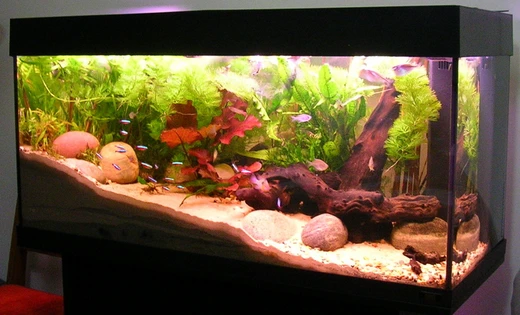
Jewel cichlids are notable for their bright coloration, which is most intense during breeding, and for their limited sexual dimorphism—males are typically more brightly colored and may have more pointed fins, though in some species females are equally bright. They form monogamous breeding pairs and exhibit highly developed brood care: the female spawns on a flat surface such as a leaf or stone, and both parents guard the eggs and raise the fry. In the aquarium trade, they are considered neither suited to beginners nor to the usual community tank due to their innate aggression. They can be kept in a spacious monospecies aquarium with stones and wood for cover, especially until a pair forms before breeding. Their care depends on factors like swimming space, territory, tank layout, diet, and feeding frequency. They are omnivorous, accepting both live foods and fish flakes. The genus contains 13 recognized species, though taxonomic disputes remain unresolved, and the aquarium trade has contributed to misidentification and hybridization.
Did You Know?
- Maximum sizes in aquaria tend to be slightly smaller than in the wild.
- In 2022, the new genus Rubricatochromis was described for the true jewel cichlids.
- The introduced population in Florida was identified as Hemichromis bimaculatus until the 1990s, but likely are Hemichromis letourneuxi or hybrids.
- Hemichromis species are found in a variety of water qualities, including brackish-water lagoons.
Radiant Coloration and Body Structure
The jewel cichlid earns its common name from a striking visual display that has captivated observers for generations. Adults of Hemichromis bimaculatus reach a maximum length of roughly fifteen centimeters, or about six inches, making them a moderate-sized member of the cichlid family. Their bodies blaze in a vivid red hue, overlaid with delicate blue speckles that shimmer like tiny jewels scattered across the skin. Three distinct dark markings punctuate the sides of the fish: one sits on the opercle, a second anchors the middle of the flanks, and the third marks the base of the tail. This triad of spots is a key identifying feature that separates the true African jewelfish from close relatives. The combination of fiery red, sparkling blue, and bold black spots creates a color palette that is immediately recognizable and has made this species a perennial favorite in the ornamental fish world.
Temperament and the Challenge of Keeping Them
Despite their dazzling appearance, the jewel cichlid carries a reputation that complicates its place in the aquarium hobby. Fishkeepers are drawn to the species for its brilliant coloration, yet the fish's temperament presents a serious challenge. Hemichromis bimaculatus is notably aggressive and fiercely territorial, traits that intensify dramatically during the breeding season. This makes the species fundamentally unsuitable for a typical community aquarium, where multiple species share a single tank in relative peace. A jewelfish will defend its chosen territory with intensity, and the presence of a breeding pair can turn what might otherwise be a calm setup into a hostile environment for tankmates. For hobbyists who do choose to keep them, the key consideration is providing a dedicated space where the fish's natural territorial instincts can be expressed without causing stress or harm to other inhabitants. The species belongs to the family Cichlidae, a group well known for behavioral complexity, and the jewel cichlid is a vivid example of why appearance alone should not dictate aquarium planning.
West African Waterways: A Native Home
The jewel cichlid is a creature of West African freshwater systems, and its name reflects that geographic origin. In its native range, Hemichromis bimaculatus inhabits rivers, streams, and canals, with a particular preference for forested areas where dense vegetation drapes over the water's surface. This overhanging canopy likely provides the dim, sheltered conditions the species favors, offering both protection and a rich environment for foraging. The species is confirmed to occur throughout West Africa, and it is the only Hemichromis member whose presence in that region is beyond serious doubt. However, reports placing the true African jewelfish in Middle Africa and along the Nile Basin carry a caveat: taxonomic uncertainty means those populations may actually belong to other, closely related Hemichromis species rather than H. bimaculatus itself. The forested, vegetated waterways of West Africa remain the most reliable indicator of where this particular jewelfish truly belongs, and it is in those shaded, slow-moving channels that the fish's natural history is best understood.
Taxonomic Tangles and Accidental Introductions
One of the most persistent challenges in understanding the jewel cichlid is the web of taxonomic confusion that surrounds it. Hemichromis species have been introduced to regions far from their African homeland, and in many cases the exact species involved has never been definitively confirmed. A prominent example is the United States, where a jewelfish population has established itself in Florida and is reportedly spreading. While this introduction is often attributed to H. bimaculatus, the evidence points instead to the closely related H. letourneuxi, a species that differs in subtle but important ways. Similarly, in the aquarium trade, the popular H. lifalili is frequently encountered, yet it can be distinguished from the true African jewelfish by the absence of the dark spot at the base of the tail. These mix-ups extend back to the species' native range, where populations in Middle Africa and the Nile Basin may represent different Hemichromis species altogether. The result is that the jewel cichlid's identity, both in the wild and in captivity, remains entangled in questions that taxonomists have yet to fully resolve.
Frequently Asked Questions
What is a Jewel cichlid?
Jewel cichlids are a group of African freshwater fish in the genus Hemichromis, part of the cichlid family. They are a favorite in the aquarium hobby for their striking coloration and their notably devoted parental care of offspring.
How big do Jewel cichlids get?
Adults range from roughly 6.5 cm to 26.5 cm (about 2.5 to 10.5 inches) in total length, so the size you'll see depends heavily on which of the thirteen recognized species you keep.
What do Jewel cichlids eat in a home tank?
They are omnivorous and will happily take both live foods and quality fish flakes, which makes them straightforward to feed in captivity.
How do Jewel cichlids breed and care for their young?
They form monogamous pairs and show highly developed brood care, with both parents actively tending the eggs and fry. Males are usually the more vividly colored sex, though in a few species females can rival the male's brightness.
Where are Jewel cichlids native to and how many species exist?
They come from a broad swath of West Africa, living in creeks, streams, rivers, lakes, and even brackish-water lagoons. Thirteen distinct species are currently recognized within the genus.
More in Fishkeeping, Part 3 1-24
Spotted an error? Know more?
Reader corrections go straight into our review queue. Suggest an edit · How this site is sourced