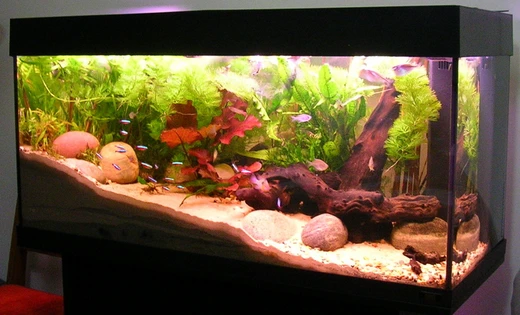
Nannostomus unifasciatus
The original pencilfish, named for its single black stripe.

Nannostomus unifasciatus, commonly known as the one-lined pencilfish, is a freshwater species of the genus Nannostomus in the characin family Lebiasinidae. It is popular in the aquarium trade due to its small size, beautiful color pattern, unique swimming posture, and relative hardiness. Its long, pencil-shaped profile, single jet black stripe, and eraser-colored caudal fin are the features for which the popular name 'pencilfish' was first coined in the 1920s.
Quick Facts
- Taxon
- Nannostomus unifasciatus
Facts from the source article.
Lore & Background
Steindachner first described the species in 1876, making it the second of what are now nineteen species in the genus to be described. The taxonomy of the entire genus was for many decades the subject of heated debate, resulting in numerous conflicting revisions, leaving the genus for long periods in a state described as 'chaotic.' N. unifasciatus was often at the center of this controversy due to its broad distribution and polychromatic nature, with many geographic populations manifesting subtle differences in color pattern. Over the years, some color morphs were erroneously described as separate species, and various authors erected other genera for N. unifasciatus and its congeners. Dutch naturalist J. J. Hoedeman published a paper in 1950 in The Amsterdam Naturalist that put forth that N. unifasciatus and N. eques were the same species. Consensus was finally achieved when Dr. Stanley Howard Weitzman, in his seminal 1975 paper on the genus Nannostomus, restored Steindachner's taxonomy and reaffirmed the status of N. unifasciatus and N. eques as distinct species, placing all congeners in one genus. As a result, names such as Poecilobrycon ocellatus and Nannobrycon unifasciatus are now junior synonyms.
Reader's Guide
Nannostomus unifasciatus has long been considered a most desirable aquarium species, with Dr. William T. Innes describing them as possessing 'a marked elegance' and 'that indefinable something known as class' in 1935. Though it has gone through periodic episodes of scarcity in the trade, it remains an appropriate community aquarium species if tankmates are of similar size and demeanor. It thrives in soft, mildly acidic water with low nitrate levels and temperatures between 72°F and 82°F. Males establish and defend small territories, and unlike its congener N. eques, which prefers the upper strata, N. unifasciatus tends to congregate in the middle to lower reaches. Notably, this is the only species of Nannostomus in the aquarium trade for which there is no recorded account of a successful spawning in captivity to date, despite being widely kept since the 1920s. Two reports of purported spawnings in the 1950s—one in the Belgian magazine Notre Aquarium and the other in the American magazine The Aquarium—involved misidentification of the species, the spawnings having occurred for N. eques and N. harrisoni respectively.
Did You Know?
- The common name 'pencilfish' was first coined for this species in the 1920s.
- It is one of the largest species of Nannostomus, reaching up to 7 cm.
- It postures itself at an oblique, snout-up angle, a trait shared only with Nannostomus eques.
- No successful captive spawning has been recorded for this species, despite decades of keeping.
More in Fishkeeping, Part 3 1-24
Spotted an error? Know more?
Reader corrections go straight into our review queue. Suggest an edit · How this site is sourced