Nannostomus trifasciatus
A small, hardy pencilfish with distinct day and night color patterns.

Nannostomus trifasciatus, called the three-lined or three-stripe pencilfish, is a small freshwater fish in the characin family Lebiasinidae. Its name comes from Greek and Latin roots meaning "small," "mouth," and "three bands." Hobbyists value it for its small size, attractive colors, and resilience.
First described by Steindachner in 1876, it was one of the earliest four species in its genus. Because it lives across a wide area, the species shows different color forms, and some were mistakenly labeled as separate species in the past. Two such names, Poecilobrycon erythrurus and Poecilobrycon vittatus, are now considered junior synonyms.
This fish prefers slow-moving, slightly acidic water and is found in several habitat types. Its range covers much of the Amazon basin, including Brazil, Colombia, Peru, northern Bolivia, and the Guianas. In the Rio Negro, it lives in large swamps where tributaries meet the main river. During floods, it moves into flooded rainforest; in the dry season, it often ends up in isolated lakes or stays near wooded shorelines. At night, it rests near the surface; by day, it swims in the middle to upper water layers.
Adults grow to no more than 6 cm. They have a small terminal mouth, and an adipose fin may or may not be present. Like many pencilfish, this species changes color between day and night. By day, three black stripes run along the body. At night, three large dark spots appear on each side, stretching from back to belly. This shift is caused by the pineal hormone melatonin acting on pigment cells in different skin areas. The daytime pattern may warn predators or help fish recognize each other; the nighttime pattern may hide them from nocturnal hunters. Between the dark markings, the back and sides are greenish-gold, and the belly is silver. The gill cover and dorsal, pelvic, anal, and caudal fins have red blotches that vary in size by population. It is often confused with Nannostomus marginatus, another three-striped pencilfish, but that species is smaller and has a blockier body shape.
Sexual differences are subtle compared to other Nannostomus species. The male’s anal fin is not modified or more colorful. Some males have an extra row of red spots in the gold area between the middle and top stripes, but this varies even within the same population. Males may be slimmer and more colorful, but again, this is not consistent.
Quick Facts
- Taxon
- Nannostomus trifasciatus
Facts from the source article.
Lore & Background
Steindachner first described the species in 1876, making it one of the first four species in the genus to be described. As a result of its broad distribution, N. trifasciatus is polymorphic, and some color morphs have been erroneously described as separate species; Poecilobrycon erythrurus and Poecilobrycon vittatus are now known to be junior synonyms.
The species inhabits slow-moving, slightly acidic waters throughout the Amazon basin, Brazil, Colombia, Peru, northern Bolivia, and the Guianas. It rests near the water surface at night and inhabits the middle to upper water layers during the day. During the day, it has three black longitudinal stripes; at night, three large dark spots appear on its sides, a change due to the differential action of the pineal hormone melatonin. The fish is greenish-gold on its back and sides, silver underneath, and has red blotches on the gill cover and fins.
Sexual dimorphism is the least evident among Nannostomus species. Males may have an additional row of red spots between the middle and uppermost stripes, and are sometimes slimmer and more colorful, but these traits are variable.
Reader's Guide
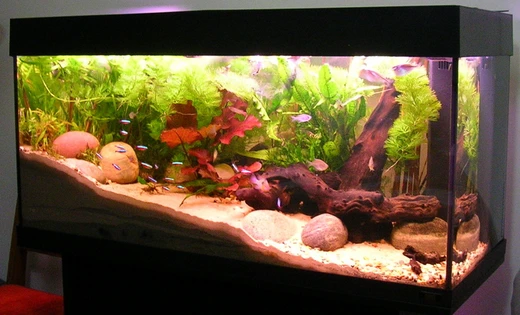
N. trifasciatus is a popular community aquarium species, suitable if tankmates are of similar size and demeanor. It thrives in soft, mildly acidic water at 72–82 °F and should be fed baby brine shrimp and other small foods. Males establish and defend small territories. The species spawns during the daytime among plant leaves, producing 30–100 adhesive eggs that hatch in 24–72 hours. If well-fed and provided sufficient plant cover, breeders will not eat eggs, and fry will be found among floating plants. Despite its popularity, this species is seldom spawned in captivity and has never been commercially raised in fisheries; the aquarium trade relies exclusively on wild-caught specimens. Its notable day and night color patterns, driven by melatonin, serve aposematic or recognition functions during the day and camouflage at night.
Did You Know?
- The species name trifasciatus means 'three bands' in Latin.
- N. trifasciatus has distinct daytime and nighttime color patterns controlled by the pineal hormone melatonin.
- It is one of the first four species in the genus Nannostomus to be described.
- The aquarium trade relies exclusively on wild-caught specimens, as the species has never been commercially raised in fisheries.
More in Fishkeeping, Part 3 1-24
Spotted an error? Know more?
Reader corrections go straight into our review queue. Suggest an edit · How this site is sourced