S.T.A.L.K.E.R.: Call of Pripyat
Third main game in the S.T.A.L.K.E.R. series, set in Chernobyl's Zone.

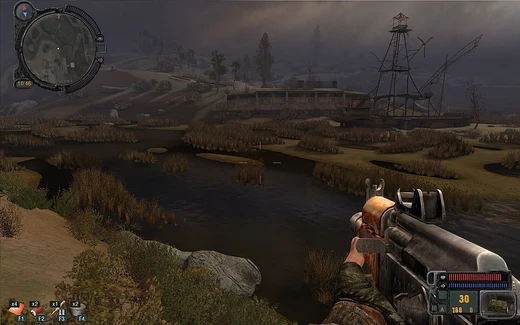
S.T.A.L.K.E.R.: Call of Pripyat is a 2009 first-person shooter survival horror game from GSC Game World, released on Microsoft Windows. As the third main installment in the S.T.A.L.K.E.R. series, it follows *Shadow of Chernobyl* and *Clear Sky*, with its story picking up after the events of the former. The game blends post-apocalyptic horror with tactical role-playing action, all set inside the Chernobyl exclusion zone in Ukraine.
The playable area splits into three large zones: Zaton, Yanov (which includes Jupiter and Kopachy), and the ghost city of Pripyat. Taking damage often causes bleeding, which the player must treat with medical supplies. Weapons and gear degrade with use, shown by a gauge in the inventory; a red HUD icon appears when an item is severely damaged or broken. The Zone has a limited economy where traders and inhabitants exchange goods for money or items. Unlike earlier games, weapons and armor that have degraded too much cannot be sold until repaired, and repair costs usually cancel out any profit. Traders also sell mission information and buy valuable documents.
Bandits come to the Zone for various reasons—selling artifacts, hiding from the law, or trading weapons. They range from common thugs to serious criminals, usually belonging to gangs. While gangs often fight each other, bandits remain a threat to normal Stalkers and are generally hostile to anyone outside their group. In *Clear Sky*, bandits appeared as a united, territorial faction, but in *Shadow of Chernobyl* they mostly roam in scattered groups.
Weapon upgrades have three tiers, each requiring a specific toolkit. Basic tools unlock the first tier, fine tools the second, and calibration tool kits—found only in Pripyat—grant access to the final tier. The system resembles *Clear Sky* but removes the negative side effects of upgrades; choosing one upgrade path still blocks alternative options.
Mutant creatures roam the Zone, most hostile to Stalkers, attacking anyone who gets too close. Artificial intelligence has been overhauled, giving creatures more advanced and realistic behavior. New mutants include the Burer, a dwarf-like monster in a hooded cloak with telekinetic powers, and the Chimera, a Cerberus-like cat with deadly strength.
Several factions inhabit the Zone: Loners, Bandits, Mercenaries, Scientists, Zombified Stalkers, the Military, Monolith, Duty, and Freedom.
Quick Facts
- Title
- S.T.A.L.K.E.R.: Call of Pripyat
- Developer
- GSC Game World
- Publisher
- UKR · GSC World Publishing · NA · Deep Silver · EU · Deep Silver · WW · bitComposer Games
- Producer
- Serhii Hryhorovich
- Designer
- Andrii Verpakhovskyi
- Programmer
- Dmytro Iasieniev
- Artist
- Iurii Nehrobov · Illia Tolmachov
- Composer
- Oleksii Omelchuk
- Series
- S.T.A.L.K.E.R.
- Engine
- X-Ray Engine
- Platforms
- Microsoft Windows · PlayStation 4 · Xbox One · Nintendo Switch · PlayStation 5 · Xbox Series X/S
- Genre
- First-person shooter, survival horror
Facts from the source article.
Lore & Background
The game takes place inside the Chernobyl exclusion zone in Ukraine, divided into three areas: Zaton, Yanov (including Jupiter and Kopachy), and the ghost city of Pripyat. The majority of gameplay focuses on a combination of post-apocalyptic horror and tactical role-playing action. Damage causes bleeding that requires medical supplies, and unmaintained weapons degrade over time. The Zone features a limited economy where traders exchange goods for money and items; weapons and armor degraded past a certain point cannot be sold until repaired, with repair costs usually offsetting the sell price. Bandits are ruthless criminals generally hostile to anyone not in their gang, and various mutant creatures roam the Zone, including the Burer and Chimera. Factions include Loners, Bandits, Mercenaries, Scientists, Zombified Stalkers, the Military, Monolith, Duty, and Freedom. Emissions occur at random times, requiring the player to find shelter or use special drugs to survive. Artifacts are found in anomalies and can be sold or used to enhance abilities, though most emit harmful radiation.
Reader's Guide
S.T.A.L.K.E.R.: Call of Pripyat is significant as the third main release in the S.T.A.L.K.E.R. series, directly continuing the narrative of Shadow of Chernobyl. Its gameplay refines the series' trademark blend of survival horror and tactical role-playing, introducing an overhauled artificial intelligence system that gives creatures more advanced and realistic behavior. The upgrade system, similar to Clear Sky but without negative side effects, allows three tiers of improvement requiring specific toolkits. The game's plot follows Major Alexander Degtyarev investigating the crash of five Ukrainian Mil Mi-24 helicopters during Operation Fairway, leading to encounters with the protagonist of Shadow of Chernobyl, Strelok. The game offers multiple endings based on player actions, and a free-play mode after the main story. Technically, it utilizes the X-Ray Engine 1.6 with DirectX 11 support including real-time GPU tessellation, and is AMD Eyefinity validated. A Limited Special Edition was released only in Germany, featuring an A3-sized map.
Did You Know?
- The game is titled S.T.A.L.K.E.R.: Call of Prypiat on consoles.
- The X-Ray Engine 1.6 allows real-time GPU tessellation through DirectX 11.
- Emissions cause new artifacts to be spawned in anomaly fields.
- The player can survive an emission outside shelter by consuming special drugs that temporarily shut down the nervous system.
More in First-Person Shooters of the 2000s, Part 1 1-24
Spotted an error? Know more?
Reader corrections go straight into our review queue. Suggest an edit · How this site is sourced