Doom 3
A survival horror first-person shooter set on a Mars base invaded by demons.

Doom 3 is a first-person shooter with survival horror elements, released in 2004. It was created by id Software and published by Activision. The game first came out for Windows on August 3, 2004, with a Linux version later that year. Aspyr Media handled the Mac OS X port in 2005, and Vicarious Visions brought it to the Xbox worldwide on April 4, 2005. The story takes place on Mars in the year 2145. A military-industrial company runs a research facility there, working on teleportation, biology, and advanced weapons. A scientist named Doctor Betruger causes the teleportation experiments to open a gateway to Hell, leading to a demon invasion of the Mars base. The player controls a space marine who must fight through the base to stop the demons from reaching Earth. This was the first game to use the id Tech 4 engine. That engine was later licensed to other developers and released under the GNU General Public License v3.0 or later in November 2011. Doom 3 was both a critical and commercial hit. It sold over 3.5 million copies, making it id Software's most successful game at the time. Critics liked its graphics, presentation, and atmosphere, but opinions were split on whether the gameplay stuck too closely to the original Doom's focus on fighting large numbers of enemies. An expansion pack, *Resurrection of Evil*, came out in April 2005 from Nerve Software. A series of novelizations by Matthew J. Costello started in February 2008. An expanded remaster, *Doom 3: BFG Edition*, was released in late 2012. The game has been ported to many platforms, including some that support portable and virtual reality play.
**Single player** Doom 3 is a story-driven action game played from a first-person view, with occasional third-person cutscenes. Like earlier Doom games, the main goal is to move through levels and defeat enemies trying to kill the player. But Doom 3 takes a more story-focused approach, so the player often meets friendly non-player characters who give plot details, objectives, and items. There are ten weapons, including standard firearms like a submachine gun, shotgun, and grenades, plus experimental plasma weapons, and series staples like the BFG 9000 and chainsaw.
Quick Facts
- Title
- Doom 3
- Publisher
- ActivisionAspyr Media published the Xbox version. BFG version published by Bethesda Softworks.
- Designer
- Tim Willits
- Programmer
- John Carmack · Robert A. Duffy
- Artist
- Kenneth Scott · Kevin Cloud · Adrian Carmack
- Writer
- Matthew J. Costello
- Composer
- Ed LimaTheme music composed by Clint Walsh and produced by Chris Vrenna
- Series
- Doom
- Engine
- id Tech 4
- Genre
- First-person shooter, Survival Horror
- Modes
- Single-player, multiplayer
Facts from the source article.
Lore & Background
Doom 3 is set on Mars in 2145, where a military-industrial conglomerate has set up a scientific research facility into fields such as teleportation, biological research, and advanced weapons design. The teleportation experiments open a gateway to Hell conducted by Doctor Betruger, resulting in a catastrophic invasion of the Mars base by demons. The player controls a space marine who fights through the base to stop the demons attacking Mars and reaching Earth. The game incorporates ten weapons, including conventional firearms, experimental plasma weaponry, and the BFG 9000 and chainsaw. Enemies fall into two categories: zombies (possessed humans) and demons from Hell, whose corpses turn to ash upon death. The game emphasizes darkness and horror, forcing the player to choose between holding a weapon or a flashlight until the BFG Edition made the 'duct tape mod' a standard feature.
Reader's Guide
Doom 3 was a critical and commercial success, with more than 3.5 million copies sold, making it the most successful game by id Software up to that date. Critics praised the game's graphics, presentation, and atmosphere, though reviewers were divided on how closely the gameplay resembled the original Doom, focusing on fighting large numbers of enemies. The game was followed by the expansion pack Resurrection of Evil in April 2005, developed by Nerve Software. A series of novelizations by Matthew J. Costello debuted in February 2008. An expanded and remastered edition, Doom 3: BFG Edition, was released in the fourth quarter of 2012, and has been ported to various platforms including those enabling portable and virtual reality gameplay. The id Tech 4 engine was later licensed to other developers and released under the GNU General Public License v3.0 or later in November 2011. The Xbox Live service for the original Xbox game was shut down as of April 15, 2010, ending online multiplayer.
Roots in the First-Person Shooter Lineage
Doom 3 stands as a continuation of a lineage that traces back to Wolfenstein 3D in 1992 and was solidified by the original Doom in 1993. Those pioneering titles laid the groundwork for what would become the modern first-person shooter, and in the years following Doom's debut, so many imitators emerged that the entire style was colloquially called 'Doom clones' before the industry settled on the more formal term 'first-person shooter.' Subsequent milestones—Quake advancing 3D graphics, GoldenEye 007 refining multiplayer, and Halo bringing the genre to console audiences—each broadened the genre's reach and technical ceiling. Doom 3 occupies its place within this evolutionary chain, inheriting the combat-first design philosophy and the first-person vantage point that defined the genre from its earliest days, while also contributing to the ongoing pressure on hardware developers to deliver ever more convincing graphical experiences.
The Architecture of Immersion and Player Freedom
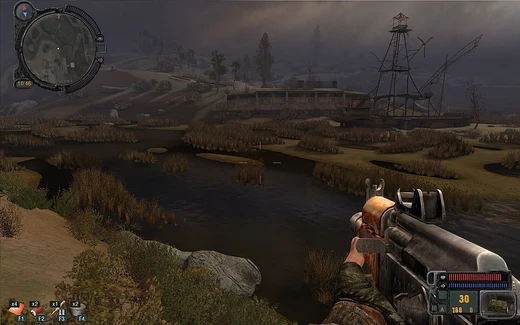
The first-person shooter genre is distinguished by one core principle: player-guided navigation through a three-dimensional space. This single feature sets it apart from light gun shooters, rail shooters, and shooting gallery games, which often rely on scripted movement or dedicated peripherals. In a true FPS, the player retains complete freedom to roam and orient within the environment using standard input devices. Doom 3 operates squarely within this framework, positioning the player directly behind the eyes of the character with combat as the primary design focus, centered on firearms and long-range weapons. The three-dimensional setting allows for more faithful representations of gravity, lighting, sound, and collision than two-dimensional predecessors ever could. The character's hands and current weapon are typically visible in the main viewport, supported by a heads-up display that tracks health, ammunition, and location, with an optional map overlay of the surrounding area available for navigation.
Combat as the Central Design Pillar
Fast-paced, dynamic firefights sit at the center of the first-person shooter experience, and Doom 3 participates fully in this combat-driven tradition. The genre conventionally offers players a broad arsenal of weapons, and the particular mix available can profoundly shape how a player approaches each encounter. Some titles simulate real-world firearms with precise rate of fire, magazine capacity, recoil, and accuracy, while others lean into imaginative variations such as futuristic prototypes, alien technology, or even magical armaments. Melee combat also features in many entries, sometimes as a powerful reward for the risk of closing to close range, and other times as a mere last resort. Within the wider family, tactical shooters emphasize squad command, teamwork, and strategic mission structure. Doom 3 belongs to the action-heavy end of this spectrum, where the firefight is the central point of the experience, though the genre as a whole also accommodates titles that weave in narrative, problem-solving, and logic puzzles.
Pushing Hardware and Stretching Genre Boundaries
Since the genre's earliest days, advanced three-dimensional and pseudo-three-dimensional graphics have been essential to achieving a reasonable level of immersion, and first-person shooters have consistently served as a driving force behind hardware innovation, challenging GPU developers worldwide to introduce new capabilities. Doom 3 is part of this long-running technological arms race, where the demand for more convincing 3D environments pushes graphics processing further. At the same time, the genre's boundaries remain a subject of ongoing debate. Titles like Deus Ex and BioShock blur the line between first-person shooting and role-playing, while Far Cry and Rage lean toward adventure with complex cinematic narratives. Even Portal, which uses a first-person perspective without any shooting, is occasionally grouped with the genre, and some commentators extend the definition to include combat flight simulators and space battles. Doom 3, as a combat-focused entry, represents the genre's core identity even as its outer edges continue to stretch.
Frequently Asked Questions
What is Doom 3?
Doom 3 is a 2004 first-person shooter developed by id Software and published by Activision that merges survival horror with traditional gunplay. The story follows a lone soldier trapped on a Mars research base after a teleportation experiment tears open a gateway to Hell.
What engine does Doom 3 run on?
The game is built on id Tech 4, id Software's in-house engine that introduced dynamic real-time lighting and shadow rendering as a core feature. This technology gave the game its signature dark, claustrophobic atmosphere that set it apart from its contemporaries.
Why is Doom 3 considered important in FPS history?
It demonstrated that a first-person shooter could sustain a slow-burn, horror-driven narrative while still delivering satisfying combat, selling over 3.5 million copies across platforms. The game proved id Software could push the genre beyond fast arena-style shooting and broaden its audience.
What sets Doom 3 apart from the original Doom games?
Rather than offering sprawling, multi-path levels, Doom 3 uses a tightly linear structure with limited ammo, jump scares, and a heavy emphasis on atmosphere and story. The player is a single UAC soldier on Mars instead of a space marine, and the pacing deliberately trades speed for dread.
More in First-Person Shooters of the 2000s, Part 1 1-24
Spotted an error? Know more?
Reader corrections go straight into our review queue. Suggest an edit · How this site is sourced