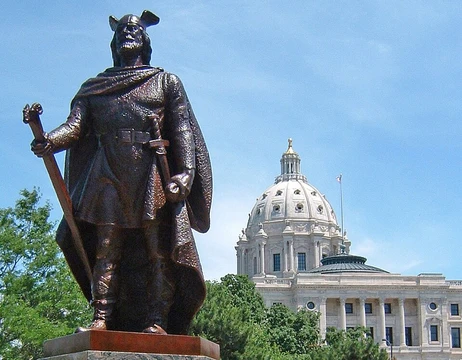
Hernando de Soto
Spanish explorer who crossed the Mississippi and led the first European expedition into the U.S. Southeast.
Hernando de Soto (c. 1497 – 21 May 1542) was a Spanish explorer and conquistador. He took part in expeditions through Nicaragua and the Yucatan Peninsula, and served as a key figure in Francisco Pizarro’s takeover of the Inca Empire in Peru. However, he is most famous for heading the first European expedition far into what is now the United States—traveling through Florida, Georgia, Tennessee, Alabama, North Carolina, South Carolina, Mississippi, and likely Arkansas. He is also recorded as the first European to cross the Mississippi River.
De Soto’s journey across North America was massive in scale. He and his men moved through the southeastern part of today’s U.S., searching for gold (which earlier coastal explorers and various Native tribes had mentioned) and looking for a route to China or the Pacific coast. De Soto died in 1542 along the Mississippi River; sources disagree on the exact spot, placing it either near present-day Lake Village, Arkansas, or Ferriday, Louisiana.
The scribe Garcilaso de la Vega and the translator Richard Hakluyt both wrote about de Soto’s voyage, but they handled the material differently. Each took unofficial accounts and gave them authority to serve their own empire’s interests. Their writings created overlapping yet distinct versions of the expedition, shaped by each author’s cultural and political background.
**Early life** De Soto was born around the late 1490s or early 1500s in Extremadura, Spain, to parents who were hidalgos—nobility with limited means. The region was poor, and many people struggled to get by; young people often looked elsewhere for fortune. He was born in what is now the province of Badajoz. Three towns—Badajoz, Barcarrota, and Jerez de los Caballeros—each claim to be his birthplace. Historian Ursula Lamb says the Barcarrota claim comes from Inca Garcilaso de la Vega and is probably wrong, written down 45 years after de Soto’s death. According to Lamb, his birthplace is most likely Jerez de los Caballeros. Although he spent time as a child in each place, de Soto stated in his will that his body should be buried in Jerez de los Caballeros, where other family members were laid to rest. Jerez de los Caballeros, which translates to “City of the Knights Templar,” gave de Soto an early taste of the conquistador life, as the town was known for its horse training and knightly history.
Quick Facts
- Occupation
- Explorer and conquistador
- Birth Date
- 27 October, c. 1500135
- Birth Place
- Jerez de los Caballeros, Crown of Castile
- Spouse
- Isabel de Bobadilla
- Death Date
- 1542-05-21 (aged about 41)
- Death Place
- Guachoya on the bank of the Mississippi River
Facts from the source article.
Lore & Background
Hernando de Soto was born around the late 1490s or early 1500s in Extremadura, Spain, to parents who were both hidalgos, nobility of modest means. Three towns—Badajoz, Barcarrota and Jerez de los Caballeros—each claim to be his birthplace; historian Ursula Lamb considers Jerez de los Caballeros most likely. He sailed to the New World with Pedro Arias Dávila in 1514 as a teenager, becoming a skilled soldier. He participated in the conquest of Nicaragua under Francisco Hernández de Córdoba, acquiring an encomienda and a public office in León. Brave leadership and ruthless schemes for extortion of native villages became his hallmarks. In 1530 he became a regidor of León and led an expedition up the Yucatán coast searching for a passage between the Atlantic and Pacific. He later joined Francisco Pizarro at Tumbes and became one of his captains.
In the conquest of Peru, de Soto led mounted soldiers at the Battle of Cajamarca, captured Atahualpa, and plundered his tents. During Atahualpa's captivity, de Soto taught him to play chess. After Atahualpa's execution, de Soto helped take Cuzco, receiving a share of the plunder that made him wealthy. He served as lieutenant governor of Cuzco. Returning to Spain in 1536, he was admitted into the Order of Santiago and granted the right to conquer Florida. He married Isabel de Bobadilla and was granted the governorship of Cuba. In 1539 he landed in the Tampa Bay area of Florida with 620 Spanish and Portuguese participants, including slaves of mixed-race African descent, and more than 500 head of livestock. He died in 1542 on the banks of the Mississippi River.
Reader's Guide
Hernando de Soto's significance lies in his role as the first European documented to have crossed the Mississippi River and led a major expedition into the interior of what is now the southeastern United States. His North American expedition, a vast undertaking, searched for gold reported by Native American tribes and earlier coastal explorers, as well as a passage to China or the Pacific coast. Although he failed to find these, his journey provided early European knowledge of the region's geography and peoples. The expedition's records, shaped by scribe Garcilaso and translator Hakluyt, created overlapping yet distinct portrayals influenced by each author's cultural and political context. De Soto's earlier participation in the conquest of the Inca Empire demonstrated his military skill and contributed to Spanish colonial expansion. His legacy is complex: he is remembered as a conquistador who advanced Spanish claims in the Americas, while his expeditions brought violence and disruption to indigenous societies. The exact location of his death remains disputed, reflecting the uncertainties that still surround his final journey.
Did You Know?
- De Soto is the first European documented as having crossed the Mississippi River.
- He taught the Inca emperor Atahualpa to play chess while Atahualpa was held captive.
- His North American expedition carried more than 500 head of livestock, including 237 horses and 200 pigs.
More in Explorers Of The Americas And Pacific 1-24
Spotted an error? Know more?
Reader corrections go straight into our review queue. Suggest an edit · How this site is sourced