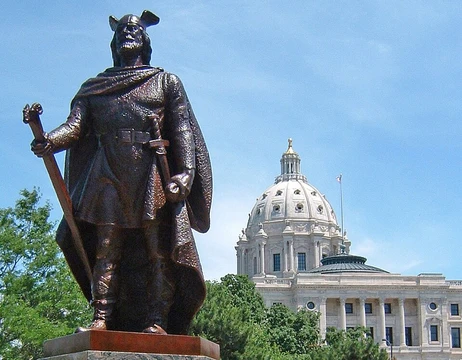
Diogo Cão
Portuguese explorer of the west African coast in the 1480s.
Diogo Cão (c. 1452–1486), also referred to as Diogo Cam, was a Portuguese sailor and a key explorer of the 1400s. During the 1480s, he led two expeditions along Africa's west coast, charting the Congo River and the shores of what are now Angola and Namibia.
Little is known about his early years. Tradition holds that he was born around 1452 in Vila Real, Portugal. His grandfather, Gonçalo Cão, had fought for Portuguese independence at the Battle of Aljubarrota. By 1480, Cão was sailing off Africa in service to King João II, and records show he returned to Portugal with captured Spanish ships.
After the Treaty of Alcáçovas (1480) gave Portugal exclusive rights to trade and explore along West Africa, João II acted quickly to strengthen his control. In 1481, ten ships were sent to the Gold Coast to build São Jorge da Mina, a fortress that served as a trading hub—including for slaves—and a resupply point for Portuguese voyages. The king also revived exploration southward along the African coast, which had been paused during the war with Spain. Cão was chosen to lead the first such voyage in 1482.
For his first expedition, likely launched around midsummer 1482, Cão stocked his ship with stone pillars called padrões, each topped with the cross of the Order of Christ and engraved with the Portuguese royal arms. He planned to plant these at key landmarks. The expedition stopped at São Jorge da Mina to restock. In August 1482, Cão reached the mouth of the Congo River and placed a padrão on Shark Point to mark Portuguese possession. That pillar stood until 1642, when the Dutch destroyed it during their occupation of the Congo.
Cão sailed a short way up the river and traded modestly with the Bakongo people. Told their king lived farther upstream, he sent four Christian native messengers to find him, then continued south along the coast of present-day Angola, erecting a second padrão at Cabo de Santa Maria—likely the endpoint of this voyage. Returning to the Congo, he was annoyed to find his messengers had not come back, so he seized four local natives from his ship and took them to Portugal. He reached Lisbon by 8 April 1484, where João II ennobled him, promoted him from esquire to cavalier of the royal household, granted him an annuity of eighteen thousand reals, and gave him a coat of arms featuring two padrões.
Quick Facts
- Pronunciation
- pt-PT · diˈoɣu ˈkɐ̃w · IPA
- Birth Date
- c. 1452
- Birth Place
- Vila Real, Kingdom of Portugal
- Death Date
- 1486 (aged around 33–34)
- Death Place
- Cape Cross (present-day Namibia)
- Occupation
- Navigator and explorer
- Known For
- First European to explore the Congo River and the west coast of Africa
Facts from the source article.
Lore & Background
Little is known about the early life of Diogo Cão. According to tradition, he was born in Vila Real, Portugal, around 1452. His grandfather, Gonçalo Cão, had fought for Portuguese independence at the Battle of Aljubarrota. By 1480, Cão was sailing off the coast of Africa in the service of João II, and there is a record that he returned to Portugal with captured Spanish ships.
When the Treaty of Alcáçovas (1480) confirmed Portugal's monopoly on trade and exploration along Africa's west coast, João II moved quickly to secure and expand his hold on the region. In 1481, a fleet of ten ships was dispatched to the Gold Coast to construct a fortress known as São Jorge da Mina. João II also re-instituted a program of exploration southward along the African coast, and Diogo Cão was selected to lead João's first voyage of exploration in 1482. On his first voyage, Cão filled his ship with stone pillars (padrões) surmounted by the cross of the Order of Christ and engraved with the Portuguese royal arms. In August 1482, he arrived at the Congo River mouth and marked it with a padrão on Shark Point. He sailed up the river, traded with the Bakongo kingdom, and sent four Christian native messengers to find the king. He then proceeded south along the coast of present-day Angola, erecting a second padrão at Cabo de Santa Maria. When he returned to the Congo, his messengers had not returned, so he abducted four local natives and returned with them to Portugal. He reached Lisbon by 8 April 1484, where John II ennobled him and granted him an annuity and a coat of arms.
On his second voyage of 1484–1486, Cão revisited the Congo and erected two more padrões: one at Cabo Negro, Angola, and another at Cape Cross. He also embarked the four indigenous ambassadors he had promised not to keep for more than fifteen moons. Cão sailed 170 kilometers up the Congo River to the Yellala Falls, where an inscription was engraved recording the passage of Cão and his men. Information regarding Cão's death is scanty and contradictory. A legend on Martin Behaim's globe reads 'hic moritur' (here he dies), indicating he lost his life on the coast of Africa in 1486 during his second voyage. However, sixteenth-century historian João de Barros never mentions Cão's death but wrote instead of his return to the Congo. A report from a 1525 conference stated his death happened near Serra Parda, and a 1489 map by Henricus Martellus Germanus indicated the location of a padrão with the legend 'et hic moritur' (and here he died).
Reader's Guide
Diogo Cão's significance lies in his pioneering voyages along the west coast of Africa during the 1480s, which extended Portuguese exploration south of the equator and laid groundwork for later voyages to the Indian Ocean. His use of stone padrões to mark territorial claims became a standard practice for Portuguese explorers. Cão's contact with the Bakongo kingdom initiated diplomatic and commercial relations that would shape Portuguese involvement in Central Africa. The padrões he erected have survived as historical artifacts, with four discovered at their original sites and preserved in museums. His explorations directly preceded Bartolomeu Dias's rounding of the Cape of Good Hope and helped establish Portugal's maritime empire. Despite uncertainties about his death, Cão is remembered as a key figure in the Age of Discovery, honored in place names, a plant genus, and literature such as Fernando Pessoa's poem 'Padrão'.
Did You Know?
- Diogo Cão's grandfather, Gonçalo Cão, fought for Portuguese independence at the Battle of Aljubarrota.
- The padrão Cão erected at the Congo River mouth in 1482 stood until 1642, when it was destroyed by the Dutch.
- A genus of plants from western central tropical Africa, Diogoa, was named in his honor in 1951.
- An undersea hole off the southern coast of Portugal was named the Diogo Cão Hole in 1999.
More in Explorers Of The Americas And Pacific 1-24
Spotted an error? Know more?
Reader corrections go straight into our review queue. Suggest an edit · How this site is sourced