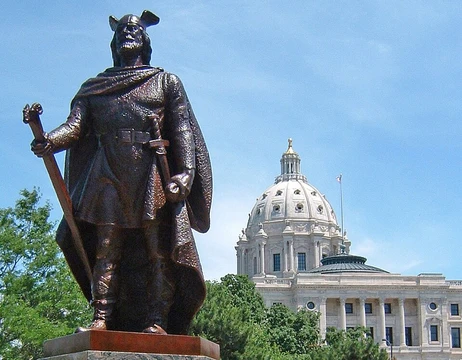
Giovanni da Verrazzano
Florentine explorer who mapped North America's east coast for France.
Giovanni da Verrazzano (1491–1528) was a Florentine explorer who carried out most of his later voyages, including his famous one to North America, under the French king Francis I. He is remembered as the first European to survey the Atlantic coastline from Florida up to New Brunswick, which he did in 1524, taking in New York Bay and Narragansett Bay.
He was born in the Val di Greve, south of Florence, in the Republic of Florence. Recent records show his birth date as July 20, 1491, to Frosino di Lodovico di Cece da Verrazzano and Lisabetta di Leonardo Daffi. An older theory, now discarded, placed his birth in 1485 to different parents. Other obsolete ideas suggested he was born in Lyon, France. Verrazzano always saw himself as Florentine, and his contemporaries agreed. He signed documents with the Latin name "Janus Verrazanus" and called himself "Jehan de Verrazane" in his will of May 11, 1526, kept in Rouen. Little is known for sure about his personal life beyond his detailed voyage accounts. After 1506, he settled in Dieppe, France, and began his sailing career. He likely first went to the American coast around 1508 with Captain Thomas Aubert on the ship *La Pensée*, funded by Jean Ango. He may have explored Newfoundland and the St. Lawrence River during a fishing trip, and he made many voyages to the eastern Mediterranean.
In September 1522, survivors of Magellan’s circumnavigation returned to Spain, heightening trade competition, especially with Portugal. French merchants pushed King Francis I to find new trade routes. In 1523, the king asked Verrazzano to explore for France the area between Florida and Newfoundland, hoping to find a sea passage to the Pacific. A group of Florentine merchants in Lyon and Rouen, including the Gondi, Rucellai, Nasi, and Albizzi families, funded the expedition. Over 20,000 écus were raised, with Verrazzano contributing as both captain and investor. Four ships set sail for the Grand Banks, but a storm sank two. The damaged *La Dauphine* and *La Normande* returned to Brittany. Repairs finished in late 1523, and the ships set out again, heading south into calmer waters controlled by Spain and Portugal. After stopping at Madeira, *La Normande* had to turn back, but *La Dauphine*, piloted by Antoine de Conflans, left on January 17, 1524, for North America.
Quick Facts
- Birth Place
- Val di Greve, Republic of Florence
- Death Place
- Unclear; possibly Guadeloupe / (uncolonized)
- Other Names
- Janus Verrazanus · Jehan de Verrazane
- Occupation
- Explorer
- Father
- Frosino da Verrazzano
- Mother
- Lisabetta Daffi
Facts from the source article.
Lore & Background
Verrazzano was born in Val di Greve, south of Florence, on July 20, 1491, to Frosino di Lodovico di Cece da Verrazzano and Lisabetta di Leonardo Daffi. After 1506, he settled in Dieppe, France, and began his career as a navigator, possibly exploring Newfoundland and the St. Lawrence River around 1508 with captain Thomas Aubert. He made numerous voyages to the eastern Mediterranean before his major expedition to North America.
In 1523, King Francis I commissioned Verrazzano to explore between Florida and Newfoundland to find a sea route to the Pacific. The expedition, funded by Florentine merchants, set out with four ships but lost two in a storm. After repairs, La Dauphine departed on January 17, 1524, reaching Cape Fear on March 21. Verrazzano explored the coast northward, encountering Native Americans in New York Bay and Narragansett Bay, and naming the region Francesca. He returned to France by July 8, 1524.
Verrazzano led a second voyage in 1527 to Brazil, harvesting brazilwood, and a final voyage in 1528. Conflicting accounts surround his death: one version states he was killed and eaten by Caribs on Guadeloupe; another theory identifying him with corsair Jean Fleury has been rejected by historians. His cannibalization by Caribs is considered plausible.
Reader's Guide
Verrazzano's 1524 voyage provided crucial geographic information that influenced 16th-century cartographers, yet his reputation remained overshadowed by contemporaries like Magellan and Cortés. He named the explored region Francesca (later Nova Gallia on his brother's map), but these names did not endure. In the 19th and early 20th centuries, debate raged over the authenticity of his letters to Francis I, but the discovery of the Cèllere Codex in 1909 largely confirmed their validity. In New York City, Henry Hudson's 1609 voyage long eclipsed Verrazzano's earlier exploration of the harbor. It took sustained efforts by the Italian-American community in 1909 and the 1940s–1950s to establish Verrazzano as the European discoverer of New York Bay, culminating in the naming of the Verrazzano–Narrows Bridge. His legacy endures through commemorations such as a bronze statue in Battery Park (1909) and numerous sites on Staten Island.
Did You Know?
- He did not notice the entrances to Chesapeake Bay or the Delaware River during his 1524 voyage.
- The 1527 map by Visconte Maggiolo includes the words 'Norman villa' near Angouleme (New York), likely named after a noble friend.
- Verrazzano's final voyage in 1528 ended with his possible cannibalization by Caribs on Guadeloupe.
More in Explorers Of The Americas And Pacific 1-24
Spotted an error? Know more?
Reader corrections go straight into our review queue. Suggest an edit · How this site is sourced