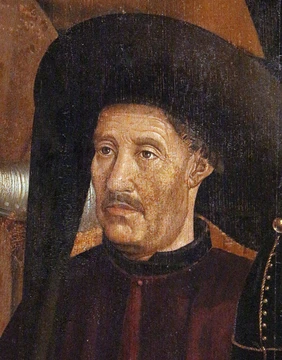
Daniel Boone
American pioneer and frontiersman who explored and settled Kentucky.
Last updated
Daniel Boone (November 2, 1734 – September 26, 1820) was an American pioneer whose exploits turned him into one of the country’s earliest folk heroes. He gained fame for exploring and settling Kentucky, a region that at the time lay beyond the western edge of the Thirteen Colonies.
Into Kentucky
In 1775, hired by Judge Richard Henderson’s Transylvania Company, Boone carved out the Wilderness Road through the Cumberland Gap and into Kentucky, despite opposition from local Native American tribes. He established Boonesborough, one of the first English-speaking settlements west of the Appalachian Mountains. By the late 1700s, over 200,000 people had entered Kentucky by following the path Boone had marked.
During the Revolutionary War, Boone served as a militia officer. In Kentucky, the conflict mainly pitted American settlers against British-allied Native Americans. In 1778, the Shawnee captured Boone. According to legend, the Shawnee chief adopted him and gave him the name Sheltowee, meaning Big Turtle.
Businessman and politician
After several months with the Shawnee, Boone escaped. While the war continued, he was elected to the Virginia General Assembly three times and fought at the Battle of Blue Licks in 1782, one of the Revolution’s final engagements. After the war, Boone worked as a surveyor and merchant but fell deep into debt as a Kentucky land speculator. He moved to Missouri in 1799 and spent most of his last twenty years there, frustrated by legal troubles tied to his land claims.
Legacy
Boone remains a legendary, if imperfectly remembered, figure in American history. He was celebrated in his own time, especially after a book about his adventures came out in 1784, making him famous in both America and Europe.
Commemoration and portrayals
After his death, he became the subject of many heroic tall tales and fictional works. His real and mythical adventures helped create the archetypal frontier hero in American folklore. In popular culture, Boone is remembered as one of the earliest and most important frontiersmen, even though mythology often overshadows the actual facts of his life.
Boone was born on October 22, 1734 (November 2 by the modern calendar), the sixth of twelve children in a Quaker family. His father, Squire Boone, emigrated from Bradninch in Devon, England, to colonial Pennsylvania around 1712. Squire, a weaver and blacksmith, married Sarah Morgan, whose family were Welsh Quakers.
Lore & Background
Boone was born the sixth of twelve children in a Quaker family in Pennsylvania. His father, Squire Boone, a weaver and blacksmith, immigrated from England.
Boone spent his early years on the Pennsylvania frontier, learning to hunt from local settlers and Native Americans; by age fifteen he had a reputation as one of the region's best hunters. He received little formal education, preferring to hunt, and was tutored by family members. He regularly read the Bible on his expeditions.
During the French and Indian War, Boone served as a teamster and blacksmith in a North Carolina Provincial company, accompanying General Edward Braddock's failed campaign in 1755.
Reader's Guide
Daniel Boone remains a legendary, if imperfectly remembered, figure in American history. He was celebrated in his own lifetime, especially after an account of his adventures was published in 1784, making him famous in America and Europe. By the end of the 18th century, more than 200,000 people had entered Kentucky by following the route marked by Boone. After his death, he became the subject of many heroic tall tales and works of fiction.
His adventures—real and mythical—helped create the archetypal frontier hero of American folklore. In American popular culture, Boone is remembered as one of the foremost early frontiersmen, though mythology often overshadows the historical details of his life. His legacy includes the Wilderness Road, the settlement of Kentucky, and his enduring status as a folk hero.
Did You Know?
- Boone regularly took the Bible and Gulliver's Travels on his hunting expeditions.
- A tree carving in Washington County, Tennessee reads 'D. Boon Cilled a. Bar on tree in the year 1760'.
More in Explorers & Navigators
Sources
Compiled from Wikipedia and the sources listed below. Text from Wikipedia is available under CC BY-SA 4.0; this entry is adapted from it.
- Wikipedia: Daniel Boone (CC BY-SA 4.0).
Spotted an error? Know more?
Reader corrections go straight into our review queue. Suggest an edit · How this site is sourced