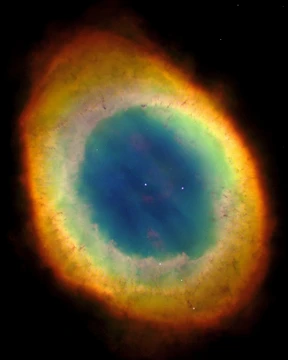
Reflection nebula
Interstellar dust clouds made visible by reflected starlight.
Last updated
Reflection nebulae are interstellar dust clouds made visible by starlight bouncing off their particles. The nearby stars lack enough energy to ionize the gas and create an emission nebula, but they do provide sufficient light scattering for the dust to be seen. As a result, the nebula’s spectrum closely matches that of the illuminating star.
These nebulae typically appear blue because dust grains scatter blue light more efficiently than red—the same process that makes Earth’s sky blue and sunsets red. Reflection and emission nebulae often appear together and are sometimes grouped under the term diffuse nebulae. About 500 reflection nebulae are known.
Quick Facts
- Number known
- 500
- Associated stars
- Rigel
- Merope
- Alcyone
- Antares
Facts from the source article.
Lore & Background
Analyzing the spectrum of the nebula associated with the star Merope in the Pleiades, Vesto Slipher concluded in 1912 that the source of its light is most likely the star itself, and that the nebula reflects light from the star (and that of the star Alcyone). Calculations by Ejnar Hertzsprung in 1913 lent credence to that hypothesis. Edwin Hubble further distinguished between emission and reflection nebulae in 1922. In 1922, Hubble published the result of his investigations on bright nebulae, including the Hubble luminosity law for reflection nebulae, which makes a relationship between the angular size (R) of the nebula and the apparent magnitude (m) of the associated star.
Among the microscopic particles responsible for the scattering are carbon compounds (e.g., diamond dust) and compounds of other elements such as iron and nickel. The latter two are often aligned with the galactic magnetic field and cause the scattered light to be slightly polarized.
Reflection nebulae may also be the site of star formation. A blue reflection nebula can be seen in the same area of the sky as the Trifid Nebula. The supergiant star Antares, which is very red (spectral class M1), is surrounded by a large, yellow reflection nebula.
Reader's Guide
Reflection nebulae are significant as they reveal the presence and properties of interstellar dust, which scatters light from nearby stars. The blue color of most reflection nebulae demonstrates the same scattering process that makes Earth's sky blue, providing a cosmic laboratory for studying light scattering by fine dust grains. The discovery history, beginning with Vesto Slipher's 1912 spectral analysis of the Merope nebula and Ejnar Hertzsprung's supporting calculations, established the reflection mechanism as distinct from emission nebulae. Edwin Hubble's 1922 classification and luminosity law provided a quantitative framework linking a nebula's angular size to the apparent magnitude of its illuminating star.
The presence of carbon compounds, diamond dust, iron, and nickel in the scattering particles, along with polarization from magnetic alignment, offers insights into interstellar chemistry and magnetic fields. Reflection nebulae are also potential sites of star formation, and their association with both blue and red stars (such as the yellow nebula around Antares) illustrates how dust scattering can produce varied colors. The known population of about 500 reflection nebulae represents a significant class of diffuse nebulae, often found alongside emission nebulae.
More in Emission, Dark and Reflection Nebulae
Sources
Compiled from Wikipedia and the sources listed below. Text from Wikipedia is available under CC BY-SA 4.0; this entry is adapted from it.
- Wikipedia: Reflection nebula (CC BY-SA 4.0).
- Word definitions: the Codexery glossary, each quoted from its Wikipedia article.
Spotted an error? Know more?
Reader corrections go straight into our review queue. Suggest an edit · How this site is sourced