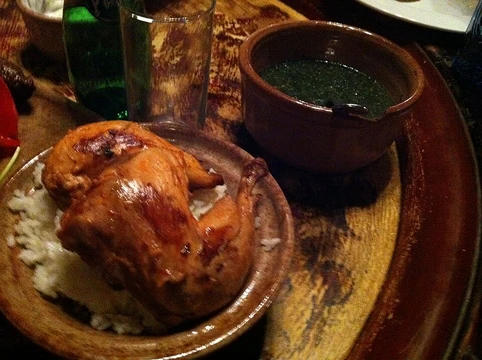
Okra stew
A stew of okra, lamb, and tomatoes across many cuisines.

Okra stew appears as a main dish across Middle Eastern, Balkan, North African, East African, Persian, and Central Asian cooking. Lamb, olive oil, and tomatoes are common additions, though versions without meat are also made. The dish goes by many names, including "okra stew," "okra with meat," or simply "bamia"—the word for okra itself. Onion, garlic, cilantro, pomegranate molasses, vegetable oil, cardamom, salt, and pepper may also be used.
In Arabic, it is called *al-bāmiya bil-laḥm* (okra with meat) or *šūrba al-bāmiya* (okra stew). Kurdish speakers say *bāmieh*, while Persian calls it *khoresh-e bâmiyeh*. Greek distinguishes meatless *mpámies laderés* (oil-cooked okra) from versions with chicken or meat. Turkish has *bamya yemeği* (okra dish), *et-li bamya* (with meat), and *zeytinyağlı bamya* (meatless, served cold). Romanian uses *mâncare de bame*. In South Slavic languages and Romanian, the short form *bamya* (with variant spellings) is common.
Early Persian sources mention *bâmiyeh* (okra with lamb) as an Egyptian recipe, but the dish’s exact origins are unclear. A recipe for okra and tomatoes appears in the 1893 Egyptian cookbook *Kitāb naṣīḥat al-anām fī ḥusn al-ṭaʻām*, written by Isma'il Pasha’s personal chef. Food historian Gil Marks notes that okra is first recorded in a 12th-century Egyptian recipe. The Moors introduced okra to Spain during the Middle Ages.
In Bosnia and Herzegovina, *bamija* or *bamja* is a slow-cooked stew of okra and veal, made year-round until the meat is very tender. Egyptian cooks typically stew lamb tendons with okra until soft, often serving it with *ta'aleya*, a garlic sauce. Across the Levant, okra stews are usually eaten over rice with vermicelli and seasoned with pomegranate molasses. *Bamyeh bil-zeyt* (okra cooked in oil) is a tomato-based version from Syria, Lebanon, and Palestine. Gazan *bamia* is traditionally spicy and paired with rice or bread.
In Iran, Afghanistan, and Tajikistan, *bâmiyeh* is a *khoresh* (stew) served with Persian rice, especially popular in southern Iran. The southern Iranian version includes turmeric, vinegar, potatoes, and red chili flakes. A similar Persian recipe adds yellow lentils (*khoresh-e bâmiyeh lapeh*). This Persian stew has been directly adopted into Gulf cuisine. Iraqi Jews prepare *kubbah bamia*, which includes semolina kibbeh.
Quick Facts
- Course
- Main course
- Main Ingredient
- Okra, lamb meat
Facts from the source article.
Lore & Background
Early Persian references mention bâmiyeh (okra with lamb) as an Egyptian recipe, but the exact history is unknown. A recipe of okra and tomatoes appears in the 1893 Egyptian cookbook by Isma'il Pasha's personal chef. According to food historian Gil Marks, okra is first attested in a 12th-century Egyptian recipe, and okra was introduced to Spain in the Middle Ages by the Moors.
In Egypt, lamb tendons are typically stewed with okra until tender, and ta'aleya, an Egyptian garlic sauce, is a common accompaniment. In the Levant, okra stews are usually served over rice and vermicelli and seasoned with pomegranate molasses. In Turkey, bamya is an Anatolian stew with a sweet and sour flavor, sometimes served as a palate cleanser between courses at ceremonial feasts.
In Iran, Afghanistan, and Tajikistan, bâmiyeh is served as a Persian khoresh along with rice, and the southern Iranian version includes turmeric, vinegar, potatoes, and red chili flakes. Iraqi Jews put semolina kibbeh in their version, kubbah bamia. In Bosnia and Herzegovina, bamija is a stew of okra and veal, slow cooked until the meat is tender.
Reader's Guide
Okra stew holds significance across a wide geographic range, from the Balkans to Central Asia, with each region adapting the dish to local tastes and ingredients. The article notes that early Persian references identify bâmiyeh as an Egyptian recipe, suggesting a long history of exchange. The dish appears in a 19th-century Egyptian cookbook, and okra itself is first attested in a 12th-century Egyptian recipe, indicating deep roots in Egyptian cuisine. The stew's legacy includes meatless versions, such as the Greek 'oil-cooked okra' and Turkish 'zeytinyağlı bamya', which are served cold. In the Levant, the use of pomegranate molasses and serving over rice and vermicelli marks a distinct tradition. The Persian khoresh-e bâmiyeh has influenced Gulf cuisine, where it has been directly adopted. The dish's many names—bamia, bamya, bamija—reflect its widespread adoption and adaptation, from ceremonial feasts in Turkey to everyday meals in Bosnia and Herzegovina.
Frequently Asked Questions
Who is Okra stew?
Okra stew, known in Arabic as al-bāmiya bil-laḥm, is a hearty main dish built around okra simmered with lamb, tomatoes, and aromatics like onion, garlic, and cilantro. It is one of the most recognizable stews in Egyptian and broader Middle Eastern home cooking.
What are Okra stew's powers/role?
The dish functions as a versatile centerpiece meal that can be prepared with or without meat, making it adaptable across dietary preferences. Its signature tang comes from pomegranate molasses, while cardamom and olive oil round out the flavor profile.
Why is Okra stew important?
It holds a cross-cultural role, appearing as a main dish in Middle Eastern, Balkan, North African, East African, Persian, and Central Asian kitchens. Its widespread presence makes it one of the few dishes that truly bridges multiple culinary traditions under a single concept.
What are Okra stew's aliases?
Depending on the language and region, the dish is called bāmieh in Kurdish, khoresh-e bâmiyeh in Persian, μπάμιες λαδερές in Greek, and bamya yemeği in Turkish. In Arabic it also appears as šūrba al-bāmiya when emphasizing its stewed form.
More in Egyptian Cuisine 1-22
Spotted an error? Know more?
Reader corrections go straight into our review queue. Suggest an edit · How this site is sourced