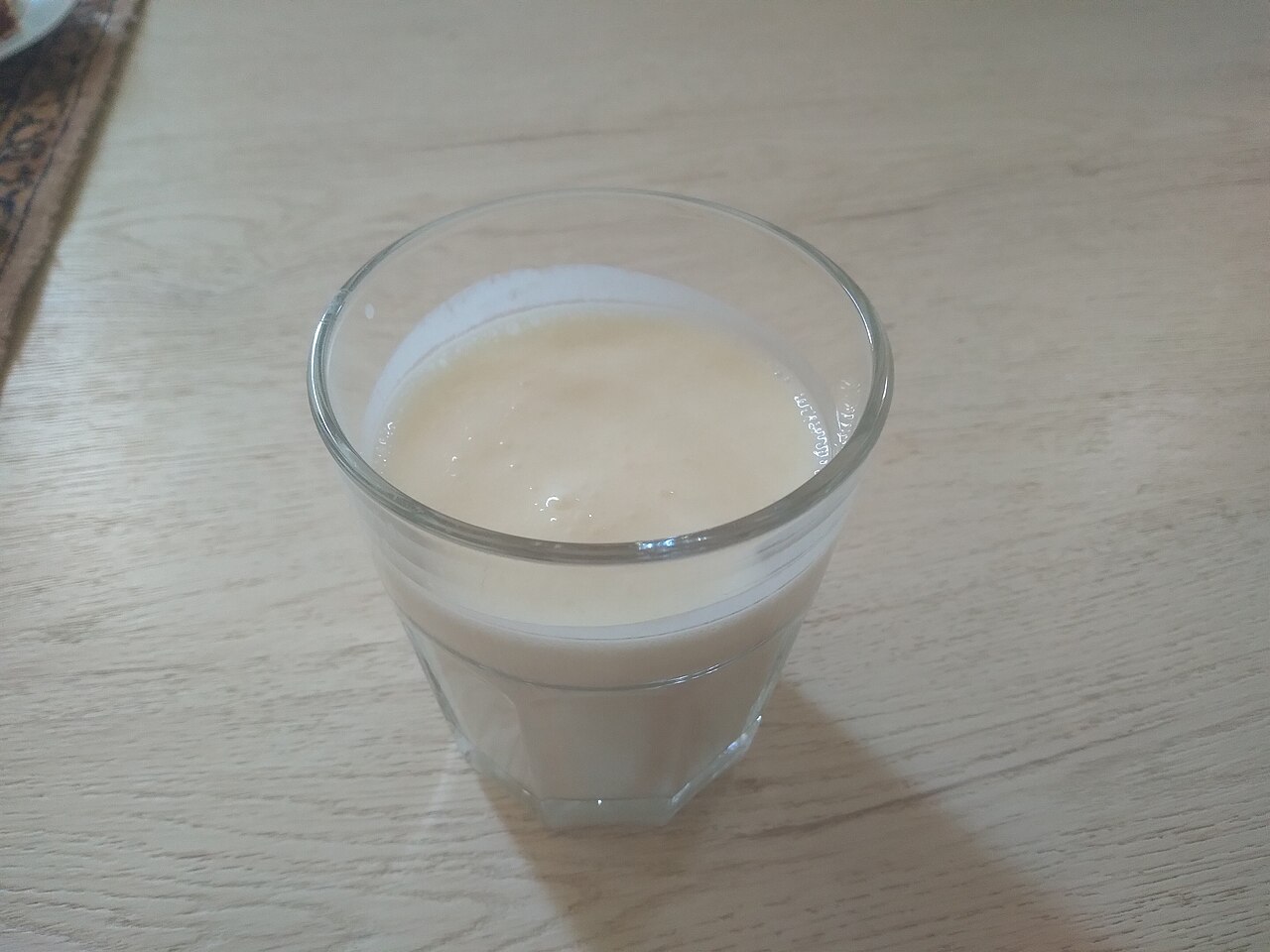
Laban rayeb
Curdled skim milk from Upper Egypt, fermented in earthenware pots.

Mint eggy93 · CC BY-SA 4.0
Laban rayeb is a fermented, skimmed milk product from Upper Egypt, with a slightly sour taste and a smell similar to buttermilk. It can be consumed fresh or turned into areesh cheese, which is then used to make mish.
To prepare it traditionally, cows are milked directly into earthenware pots. A new pot, called a matared, is first soaked in oil or a mixture of egg white and oil, then baked to seal its pores. After each use, the pot is washed and dried in a hot oven for two hours. The milk is left undisturbed for one to four days at 20–25 °C, allowing its natural microflora to cause fermentation. As the milk curdles, the fat rises to the top; this fat is skimmed off and used for butter, leaving the curd as laban rayeb.
Variants include laban khad, which is fermented in a goat pelt. Laban zeer is another version made in earthenware pots; it can be mixed with boiled, dried, and ground wheat, fermented for 24 hours, then sun-dried to create Kishk, a nutritious food that can last for years. In Sudan, a drink called goubasha is traditional. For laban rayeb made from buffalo milk, some cream is added and the mixture is diluted with water. Karish cheese is produced by pouring the curd onto a reed mat, letting it drain, spreading and squeezing it, then hanging it for two to three days. Shortly before it is finished, the cheese is dry-salted and hung in the mat for a few more hours.
Evidence suggests laban rayeb was made by the ancient Egyptians.
Quick Facts
- Country
- Egypt
- Region
- Nile Delta, Lower Egypt
- Pasteurised
- No
- Texture
- Liquid
Facts from the source article.
Lore & Background
Evidence indicates that laban rayeb was made by the ancient Egyptians. The traditional method begins with milking cows directly into partially sterilized shallow or deep earthenware pots. A newly made pot (matared) is soaked in oil or a mixture of egg white and oil, then baked in a kiln to close the pores; after each use it is washed and dried in a hot oven for two hours. The milk is left undisturbed for one to four days, depending on temperature, while the fat rises to the top and the milk below curdles. The fat is scooped out and used to make butter, and the remaining curd is the laban rayeb. It smells similar to buttermilk and has a slightly acid taste.
Reader's Guide
Laban rayeb is notable as a foundational ingredient in several Egyptian dairy products. It is used to make areesh cheese, which is then used to produce mish. Karish cheese is made from laban rayeb by pouring the curd onto a reed mat, letting it drain, spreading and squeezing it in the mat, then hanging it for two or three days; shortly before finishing, the cheese is dry-salted and hung for a few more hours. Variants include laban khad, fermented in a goat pelt, and laban zeer, made in earthenware pots. Laban zeer may be mixed with boiled, dried and ground wheat grains, fermented for twenty-four hours, then sundried to make Kishk, a very nutritious food that may keep for several years. Some cream is added to laban rayeb made from buffalo milk, and the mixture is diluted with water. Goubasha is a traditional drink in Sudan. The article notes evidence of its production by ancient Egyptians, underscoring its long history in the region.
Did You Know?
- Laban rayeb is made by milking cows directly into earthenware pots.
- The fat that rises during fermentation is scooped out and used to make butter.
- Karish cheese is made from laban rayeb by draining the curd on a reed mat.
- Laban zeer, a variant, can be used to make Kishk, which may keep for several years.
The Art of the Matared Pot
The preparation of laban rayeb is a slow, hands-on process rooted in earthenware craftsmanship. Cows are milked directly into shallow or deep clay vessels known as matared, which must first be partially sterilized. A newly crafted pot undergoes a specific seasoning ritual: its interior is soaked in oil or a blend of egg white and oil, then fired in a kiln to seal its porous surface. Between uses, each matared is washed and dried in a hot oven for a full two hours to maintain hygiene. Once the milk is poured in, it is left undisturbed for one to four days, with the exact duration governed by ambient temperature. The vessel is held at roughly twenty to twenty-five degrees Celsius, allowing the milk's own natural microflora to initiate fermentation without any added cultures. Over this period, the fat separates and rises to the surface, where it is carefully scooped out and pressed into butter. What remains beneath—the thick, curdled skim milk—is the finished laban rayeb, a product of patience, climate, and microbial life rather than industrial intervention.
From Curd to Cheese: A Family of Products
Laban rayeb serves as a foundational ingredient from which several distinct dairy products emerge. The most direct transformation is areesh cheese, which is itself the base for mish, a well-known prepared food in the region. Another route is karish cheese, produced by spreading the curd onto a reed mat and allowing it to drain naturally. The maker periodically spreads and squeezes the mass within the mat, then hangs it for two to three days. Near the end of the process, the cheese is dry-salted and given a final few hours of hanging before it is ready. Beyond simple cheese-making, laban rayeb branches into a wider family of regional variants. Laban khad is fermented inside a goat pelt rather than clay. In Sudan, a related drink called goubasha carries its own tradition. Buffalo-milk versions receive a touch of cream and are diluted with water for a lighter texture. Laban zeer, also made in earthenware, can be combined with boiled, dried, and ground wheat grains, fermented for twenty-four hours, and then sun-dried into kishk—a remarkably durable food that keeps for several years.
Taste, Texture, and the Table
Laban rayeb occupies a particular sensory niche in the Upper Egyptian kitchen. Its aroma is often compared to that of buttermilk, carrying a clean, slightly tangy fragrance that signals natural fermentation rather than added acid. The taste follows suit, registering as gently acidic with a mild sharpness that makes it refreshing when consumed straight from the pot. Because it is made from skim milk, the texture is lighter and less rich than whole-milk curds, yet still thick enough to be spooned or drunk. In daily practice, households in Upper Egypt treat it as both a beverage and a cooking ingredient. It may be poured into a bowl and eaten fresh, its cool acidity providing relief in warm weather, or it may be pressed and worked into areesh cheese, which then becomes the foundation for mish. The product's identity is inseparable from its terroir: the specific microflora present in the milk, the particular clay of the matared, and the ambient temperatures of Upper Egypt all shape the final flavor in ways that resist standardization.
Ancient Roots and Living Tradition
Evidence suggests that the production of laban rayeb stretches back to ancient Egypt, making it one of the oldest continuously practiced dairy traditions in the region. The methods described today—milking into clay pots, relying on ambient fermentation, separating fat by hand—echo techniques that would have been recognizable to a pharaonic farmer. What distinguishes this tradition is its resistance to industrialization: no commercial cultures are introduced, no mechanical equipment replaces the reed mat or the kiln-fired matared. The process remains governed by seasonal temperature, the quality of the milk, and the skill of the maker. The tradition also extends beyond Egypt's borders. The Sudanese goubasha, the goat-pelt fermentation of laban khad, and the multi-year shelf life of kishk all point to a broader cultural sphere in which fermented skim milk is valued not merely as food but as a practical technology for preservation. In an era of pasteurized, homogenized dairy, laban rayeb stands as a living link to millennia of pastoral knowledge.
Gallery
Frequently Asked Questions
What is Laban rayeb?
Laban rayeb is a traditional fermented dairy product made from skimmed milk, originating in Upper Egypt. It carries a mildly tangy flavor and a scent that many describe as reminiscent of buttermilk.
Where does Laban rayeb come from?
This fermented curdled milk product is rooted in the culinary traditions of Upper Egypt, where it has long been prepared using locally sourced milk and handcrafted earthenware vessels.
How is Laban rayeb traditionally prepared?
Cows are milked directly into a special pot called a matared, which is first sealed by soaking in oil or an egg-white-and-oil blend and then baked to close its pores. The milk is left undisturbed for one to four days at roughly 20–25 °C, allowing naturally occurring microflora to drive the fermentation.
What does Laban rayeb taste and smell like?
On the palate it registers as gently acidic with a subtle sourness. Its aroma is frequently compared to that of fresh buttermilk.
What can you do with Laban rayeb?
It can be enjoyed fresh, straight from the pot, or further processed into areesh cheese. That areesh cheese then serves as a key ingredient in making mish, another well-loved Egyptian preparation.
More in Egyptian Cuisine 1-22
Spotted an error? Know more?
Reader corrections go straight into our review queue. Suggest an edit · How this site is sourced