Old School Renaissance
A movement reviving early tabletop RPG play styles.
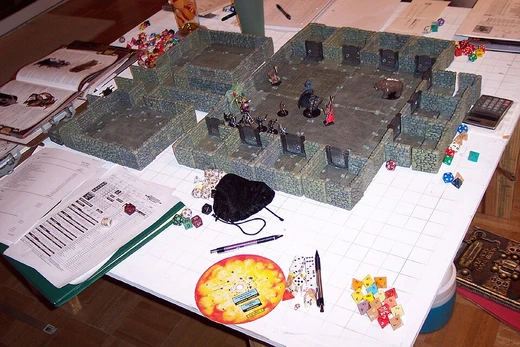
The movement grew out of a surviving player base dedicated to older, out-of-print editions of Dungeons & Dragons who were not interested in the then-current 3rd edition.[1] The OSR movement, which focuses on tabletop role-playing, takes its cues from the hobby's initial phase during the 1970s, particularly from Dungeons & Dragons.[2] This movement is made up of an informal collection of players and creators who are united by their preference for a specific gameplay approach and design philosophy.[2]
Quick Facts
- Year of old-school essentials
- 2019
Facts from the source article.
Key facts and history
In the early 2000s, games aimed at this older player base were released, including 2001's HackMaster and 2004's Castles & Crusades.[1] Discussion on internet forums about using Wizard of the Coast's Open Gaming License allowed independent creators to make new material that more closely hewed to older rules of D&D.[3] The first OSR games separate from original D&D were created by independent publishers, with the most notable retro-clones being BFRPG (2006), OSRIC (2006), Labyrinth Lord (2007), and Swords & Wizardry (2008).[4] Dragonsfoot forum posts from 2004 and 2005 contain the earliest known uses of the phrases "old school revival" and "old school renaissance".[5]
The magazines Fight On! and Knockspell, which focus on OSR material, first appeared in 2008.[4] From 2006 onward, independent publishers produced hundreds of supplementary items for these newly created games.[6] By the start of the 2020s, the OSR had generated such a wide range of new developments that labels like "BrOSR", "Classic OSR", "OSR-Adjacent", "Nu-OSR/NSR", and "Commercial OSR" came into use.[7]
What the cited sources add
The Simulacrum article states that the OSR was simply a rebirth of interest in old-school Dungeons & Dragons as its original designers intended it to be played.[8] Around 2007 began a renaissance rooted in mechanical compatibility with TSR-era D&D and sharing certain key design principles.[8] The Simulacrum article notes that the term "Old-School Renaissance" was in regular use from 2008 onwards but was still new enough that many felt it needed to be singled out.[8] By mid-2008 the big four initial retroclones had been released: BFRPG, OSRIC, Labyrinth Lord, and Swords & Wizardry.[8]
The Screen Rant article describes the Old School Revival as a design philosophy that hearkens back to 1970s Dungeons & Dragons emphasizing exploration, dungeon-crawling, and vulnerable player characters.[9] In his 2008 work A Quick Primer for Old School Gaming, Matthew Finch lists four OSR pillars: the gamemaster's rulings should take precedence over rulebooks; a player's own skill matters more than their character's stats; the focus should be on the heroic rather than the superheroic; and game balance is not a priority.[10]
References
- Wikipedia, "Old School Renaissance" (CC BY-SA 4.0), which cites: Maliszewski, "Full Circle: A History of the Old School Revival", The Escapist, 21 August 2009 (original not read by us) en.wikipedia.org
- Wikipedia, "Old School Renaissance" (CC BY-SA 4.0), which cites: "Old School Revival | The GeekPreacher", 30 June 2012; Maliszewski, "Full Circle: A History of the Old School Revival", The Escapist, 21 August 2009; Bebergal, "Old School Dungeons & Dragons: Wizards of the Coast's Problem Child", Boing Boing, 6 May 2013; "OSR survey: meaning", Necropraxis, 14 December 2018 (original not read by us) en.wikipedia.org
- Wikipedia, "Old School Renaissance" (CC BY-SA 4.0), which cites: "Simulacrum: Exploring OSR Design: A Historical Look at the OSR — Part IV", Simulacrum, 2021-03-15; Dancey, "The Most Dangerous Column in Gaming", Interview with Ryan Dancey, 2002-02-28; Cook, "The Open Game License as I See It"; Leonard, "Dungeons & Dragons to go open-source?", Salon, March 10, 2000 (original not read by us) en.wikipedia.org
- Wikipedia, "Old School Renaissance" (CC BY-SA 4.0), which cites: "A Historical Look at The OSR", Simulacrum: Exploring OSR Design, 16 December 2021; Maliszewski, "Full Circle: A History of the Old School Revival", The Escapist, 21 August 2009; "Fight On! magazine - Issue 01 Information Page", Fight On! Magazine; Finch, "Knockspell Magazine #1", Mythmere Games, p. 3; Maliszewski, "Full Circle: A History of the Old School Revival", The Escapist, 21 August 2009; "A Historical Look at The OSR", Simulacrum: Exploring OSR Design, 16 December 2021; Maliszewski, "Full Circle: A History of the Old Scho en.wikipedia.org
- Wikipedia, "Old School Renaissance" (CC BY-SA 4.0), which cites: Foster, "The long journey home...", Dragonsfoot; "Is True20 mustling in on Castles & Crusades' turf?", Dragonsfoot; Conley, "Where the hell The Old School Renaissance come from?", Bat in the Attic, 23 August 2009 (original not read by us) en.wikipedia.org
- Wikipedia, "Old School Renaissance" (CC BY-SA 4.0), which cites: "A Historical Look at The OSR", Simulacrum: Exploring OSR Design, 16 December 2021; Robert Conley, "A Quick Primer for Old School Gaming", Bat in the Attic Blog, 2008-10-08; "A Quick Primer for Old School Gaming", 2009-07-22; "A Historical Look at The OSR", Simulacrum: Exploring OSR Design, 16 December 2021; Bebergal, "Old School Dungeons & Dragons: Wizards of the Coast's Problem Child", Boing Boing, 6 May 2013; Maliszewski, "REVIEW: Lamentations of the Flame Princess Weird Fantasy Role-Playing (Part I)", GROGNARDIA, 2010-08-24; en.wikipedia.org
- Wikipedia, "Old School Renaissance" (CC BY-SA 4.0), which cites: "A Historical Look at The OSR", Simulacrum: Exploring OSR Design, 16 December 2021 (we also read that source) en.wikipedia.org
- "A Historical Look at The OSR", Simulacrum: Exploring OSR Design, 16 December 2021. facts only, no text reused. osrsimulacrum.blogspot.com
- Gailloreto, "Excellent Tabletop RPGs From The Old School Revival Genre", Screen Rant, 4 October 2020. facts only, no text reused. screenrant.com
- Wikipedia, "Old School Renaissance" (CC BY-SA 4.0), which cites: Horvath, "Monsters, Aliens, and Holes in the Ground", MIT Press, 2023, p. 298; Finch, "A Quick Primer for Old School Gaming", Swords & Wizardry, 2008, p. 2 (we also read that source) en.wikipedia.org
Each numbered sentence above was checked against the source it cites before publication. Sentences citing Wikipedia adapt text from the English Wikipedia article Old School Renaissance (contributors), used under CC BY-SA 4.0; this entry is available under the same licence. Other sources were used for facts only; no text or images are copied from them.
More in Dungeons & Dragons
Spotted an error? Know more?
Reader corrections go straight into our review queue. Suggest an edit · How this site is sourced