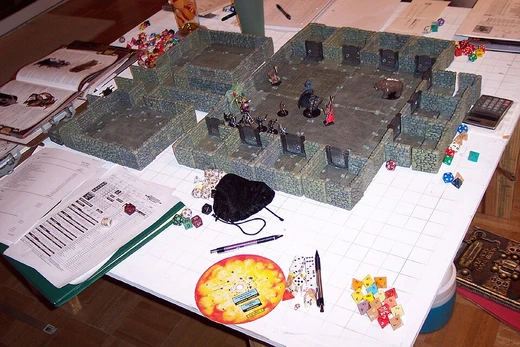
Battlesystem
Miniature wargame rules for mass fantasy battles in D&D.
Designed to work with Dungeons & Dragons, Battlesystem is a tabletop wargame for miniatures. The first version came in a boxed set in 1985, supporting first edition AD&D. A revised edition, a softcover book, followed in 1989 for AD&D 2nd Edition.
Quick Facts
- First release
- 1985
- First edition format
- Boxed set
- Second edition release year
- 1989
- Second edition designer
- Douglas Niles
- Second edition cover artist
- Glen Taranowski
- Second edition interior artists
- Jeff Easley and Keith Parkinson
Facts from the source article.
First edition
Battlesystem arrived in 1985, designed to work with both Advanced Dungeons & Dragons and the Basic or Expert sets of the game. It was marketed as the next step after the medieval miniature wargame Chainmail. In a game of Battlesystem, a single miniature could stand for a hero, a commander, or a group of troops, with the choice depending on the troops' level or hit dice. The game itself contains no statistics for any troops or characters; instead, all such numbers come from the relevant Dungeons & Dragons books. For example, if you wanted to add a creature from the Monster Manual as troops, you could figure out its point cost from the XP reward listed in that manual for defeating it. The first edition was a boxed set of rules and components for running large-scale fantasy battles, using miniatures rules that worked with metal figures, cardstock figures, or counters. The rule book is split into four parts, offering three levels of play. The first part is an introduction. The second part, called The Basic Game, covers the basics of movement and melee combat. The third part, The Intermediate Game, adds missiles, artillery, cavalry, individual heroes, special formations, and terrain effects. The fourth part, The Advanced Game, brings in magic, flying, weather, night battles, and special monsters, and also introduces campaign rules for linking Battlesystem games into a role-playing campaign. The game does not require a Dungeon Master, but the rule book recommends having a referee, especially for tricky magic like invisibility or illusions. The scenario book contains four scenarios. Three of these form a linked campaign in a generic fantasy setting, with one scenario for each level of the game. The fourth is an advanced game scenario set in Dragonlance, called the Battle of Qualinost, which takes place during the same time as DL2 Dragons of Flame, while the heroes are in Pax Tharkas.
Second edition
The second edition of Battlesystem did away with cardboard counters, making miniatures the only option for play. Each figure on the tabletop could stand for ten soldiers or riders, or for a lone hero or unique character. These figures had stats like Attack Dice, Armor Rating, Hits, Morale, and Movement, all pulled from the Advanced Dungeons & Dragons game. For example, a character’s THAC0 and maximum damage set their Attack Dice, and their armor class set their Armor Rating. The Attack Dice rating told players which die to use, from a d4 up to a d12. When a group attacked, each figure rolled one die; a unit of eight figures with an Attack Dice of 6 would roll 8d6. Higher rolls meant more hits. The defender then rolled dice equal to the number of hits, and any roll above the defender’s Armor Rating canceled one hit. Hits that were not canceled became casualties. The magic section ran about seven pages, mostly explaining how spells worked. A major change was making 25 mm miniatures the standard size. Players could still use 15 mm figures, but the base size grew to fit larger models, and every photo in the rulebook showed 25 mm miniatures. Published in 1989, this edition was designed for use with 2nd edition Advanced Dungeons & Dragons. Douglas Niles designed it, with cover art by Glen Taranowski. Kim Mohan, Jon Pickens, and Dave Sutherland handled editing and development. Michael Weaver and Ral Partha Enterprises, Inc. took the battle scene photos, while Dick Kahn Studio, Inc. shot the rules diagrams. Dave Sutherland painted the figures, Jeff Easley and Keith Parkinson provided interior art, and Stephanie Tabat and Dave Sutherland did the graphic design. The second edition eventually came out as two separate books: Battlesystem in 1989 and Battlesystem Skirmishes in 1991.
More in Dungeons & Dragons
Spotted an error? Know more?
Reader corrections go straight into our review queue. Suggest an edit · How this site is sourced