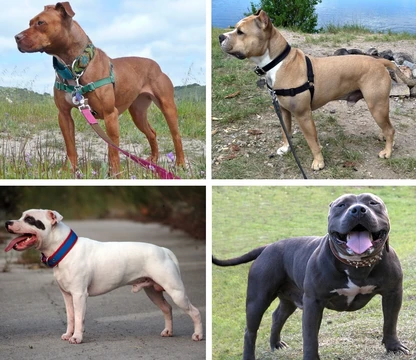
American Bully
Last updated

via Wikipedia: American Bully · see source
The American Bully is a modern breed of dog that was developed as a companion dog, and originally standardized and recognized as a breed in 2004 by the American Bully Kennel Club (ABKC). Their published breed standard describes the dog as giving the "impression of great strength for its size". The majority of major international kennel clubs do not recognize the American Bully as a separate breed, including the UK Kennel Club, the American Kennel Club, and the International Canine Federation. On July 15, 2013, the breed was recognised by the US-based United Kennel Club (UKC).
History
The American Pit Bull Terrier was the foundation breed used to create the American Bully. Over time, a particular APBT strain was crossbred to produce a stockier physique, and breeders initially misrepresented these dogs as purebred APBTs. Eventually, enough breeders agreed the dogs were sufficiently different to warrant a separate breed. Development of the American Bully began in the 1980s, with most of the final behavioral and aesthetic product completed in the 1990s.
The breed was first recognized by the American Bully Kennel Club in 2004, which documented pedigrees and showed the breed against its written standard. According to the ABKC, the initial goal was to produce a dog with lower prey drive and more bully traits than the American Staffordshire Terrier. Mass and heavy bone were prioritized. The United Kennel Club states that several other breeds were used to attain the muscular look, including the American Bulldog, English Bulldog, and Olde English Bulldogge.
The American Bully Registry states the breed was bred as a companion dog, with efforts to reduce gameness. According to Bullywatch, XL-Bully lines in the UK are extremely inbred due to a small founding population imported in 2014–2015, many originating from a dog named Kimbo.
Appearance
The United Kennel Club and American Bully Kennel Club breed standards are similar, but the ABKC recognizes four size varieties based on height—Standard, Pocket, XL, and Classic—while the UKC recognizes only one standard size. All dogs are classified and shown as Standard until they reach one year of age, then separated into varieties. The standard American Bully is a medium-sized dog with a compact, bulky, muscular body, heavy bone structure, and a blocky head.
Males must be 17 to 20 inches tall at the withers, females 16 to 19 inches. The XL type requires males 21 to 23 inches and females 19 to 22 inches. The Classic is a lighter-framed dog within the same height range as the Standard, lacking exaggerated features and arguably showing clearer American Pit Bull Terrier or American Staffordshire Terrier lineage. Outside the official standard, some dogs are bred smaller (Micro) or larger (XXL), but these labels are not recognized by kennel clubs.
Breed-specific legislation
Germany passed a law on dangerous dogs in 2001 that prohibits import or transfer of certain breeds, including American Staffordshire Terrier, Bull Terrier, Pit Bull Terrier, and Staffordshire Bull Terrier, as well as their crosses. In February 2023, a German court ruled that classifying a dog whose father was an American Bully as dangerous is permissible under state law. Within a year, two people were killed by American Bullies in Germany, both family pets; the country averages about three fatal dog attacks per year.
In Ireland, the American Bully is restricted as a Bandog, requiring muzzling and a lead no longer than two meters in public. In July 2024, the Irish minister announced a two-stage ban beginning October 1, 2024: phase one bans breeding, rehoming, reselling, and importing; phase two limits ownership to licensed, microchipped, and neutered dogs. Turkey makes it illegal to own or breed an American Bully. The United Arab Emirates prohibits possession and circulation of the breed.
In the UK, XL Bullies were responsible for over half of dog-related human deaths from 2021 to 2023, leading to their addition to the Dangerous Dogs Act in January 2024, with requirements for exemption certificates, insurance, microchipping, neutering, and secure conditions.
More in Dog Breeds Originating in the United States
Sources
Compiled from Wikipedia and the sources listed below. Text from Wikipedia is available under CC BY-SA 4.0; this entry is adapted from it.
- Wikipedia: American Bully (CC BY-SA 4.0).
Spotted an error? Know more?
Reader corrections go straight into our review queue. Suggest an edit · How this site is sourced