Olde English Bulldogge
Last updated

via Wikipedia: Olde English Bulldogge · see source
The Olde English Bulldogge is an American dog breed recognized by the United Kennel Club (UKC) in January 2014 and listed in the UKC Guardian Dog Group. The breed was developed in the early 1970s by David Leavitt of Coatesville, Pennsylvania, who aimed to recreate the athleticism and appearance of the 18th-century bull-baiting dog while improving temperament and health. It has been noted by U.S. researchers as a viable candidate for outcrossing to help restore genetic diversity in the modern Bulldog.
History
In the early 1970s, David Leavitt of Coatesville, Pennsylvania, set out to recreate the look and athleticism of the Regency Period bull-baiting dog while breeding for a far milder temperament. He used a cattle line breeding method from Ohio State University’s Dr. Fechimer, starting in 1971. The initial mix was half Bulldog, one-sixth American Bulldog, one-sixth Bullmastiff, and one-sixth other breeds. After several planned generations, the Olde English Bulldogge bred true.
Leavitt created the Olde English Bulldogge Association (OEBA) to keep the stud book and handle registrations. In the 1980s, Ben and Karen Campetti of Sandisfield, Massachusetts, worked closely with him on the breeding program.
Leavitt stopped breeding in 1993, handing the OEBA registry and his stock to Working Dog Inc., run by Michael Walz of Pennsylvania. The Olde English Bulldogge Kennel Club (OEBKC) formed in 2001, and in 2005 Leavitt helped merge the OEBA registry into the OEBKC’s. In August 2008, the breed was enrolled with the Canine Developmental Health and Performance Registry to be evaluated for UKC recognition.
The UKC granted full recognition effective January 1, 2014, with the OEBKC as the official Parent Club. To preserve his original goals and distinguish his dogs, Leavitt named his line Leavitt Bulldogs in 2004 and founded the Leavitt Bulldog Association the next year. The UKC now accepts registrations from the Leavitt Bulldog Association, the OEBKC, and the Olde Bulldogge Club Europe as Olde English Bulldogges.
Appearance
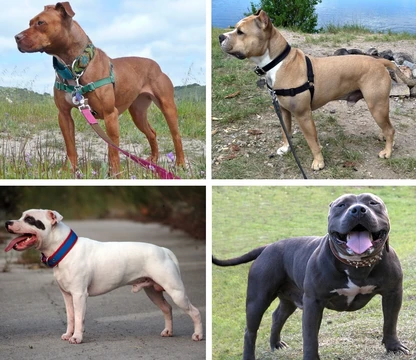
The Olde English Bulldogge is a medium-sized, muscular breed built for strength and fluid, agile movement. Its body is well-balanced and proportioned, giving the impression it can work without breathing trouble in hot or cold weather. The large skull matches the muscular body and prominent shoulders, with a clear furrow running between the eyes. A narrow skull or domed forehead are faults.
The muzzle is square, wide, and deep. The bite is undershot or reverse scissors, and the lower jaw curves moderately from front to back. Wide nostrils have a vertical line running from the nose tip to the upper lip’s bottom. The nose is large, broad, and black.
Eyes are medium-sized, almond-shaped, and dark to light brown with black rims, set wide and low at the muzzle’s top level. Small ears can be rose, button, or tulip, with rose preferred, placed high, wide, and toward the skull’s back edge. The neck is medium in length, wide, and slightly arched. The body is sturdy, powerful, and slightly rectangular from the side, with a wide, deep chest.
Hind legs are well-muscled, appearing slightly longer than the forelegs, and are straight, parallel, and set apart. Accepted colors are brindle and solid colors, with or without white. Males weigh 60 to 80 pounds and stand 17 to 20 inches at the withers; females weigh 50 to 70 pounds and stand 16 to 19 inches.
Health
The Olde English Bulldogge may be healthier than many modern bulldog breeds, though it can be affected by disorders common to any breed. Proponents maintain it does not suffer from the same disorders as purebred Bulldogs.
A 2016 study in Canine Genetics and Epidemiology examined genetic diversity among registered Bulldogs and mentioned the Olde English Bulldogge as an outcross candidate to introduce new genetics. In the European Union, rules for farm animals grant freedom from discomfort and from pain, injury, and disease. A 2013 Swiss constitutional amendment extends such rights to all animals, and many Swiss breeders have outcrossed Bulldogs with the Olde English Bulldogge, creating the Continental Bulldog to bring the Bulldog into compliance.
Did You Know?
- The breed was recognized by the UKC in January 2014, five years after being registered by the CDHPR, a privately held business in Kalamazoo, Michigan.
- David Leavitt modeled his breeding program after a livestock line breeding scheme developed by Nathan Fechimer, a professor in the Department of Dairy Science at Ohio State University.
More in Dog Breeds Originating in the United States
Sources
Compiled from Wikipedia and the sources listed below. Text from Wikipedia is available under CC BY-SA 4.0; this entry is adapted from it.
- Wikipedia: Olde English Bulldogge (CC BY-SA 4.0).
Spotted an error? Know more?
Reader corrections go straight into our review queue. Suggest an edit · How this site is sourced