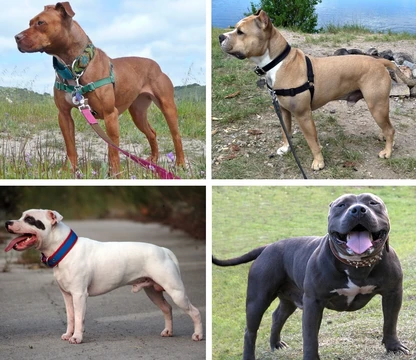
American Pit Bull Terrier
Last updated
The American Pit Bull Terrier (APBT) is a medium-sized, short-haired dog breed recognized by the United Kennel Club and the American Dog Breeders Association, but not the American Kennel Club. Its early ancestors came from England, and it is larger than the English Staffordshire Bull Terrier by several inches and pounds. The breed varies in size, with males typically standing 18–21 inches tall and weighing 35–60 pounds, while females are slightly smaller.
History
Until the mid-19th century, the now-extinct Old English Terriers and Old English Bulldogs were crossed to produce a dog combining the terrier's gameness with the bulldog's strength and athleticism. This type, known as the bull and terrier, was bred in England. In the United Kingdom, these dogs were used in bloodsports such as bull baiting and bear baiting, which were banned in 1835 under new animal welfare laws. Dog fighting then became more common, as it was cheaper and easier to conceal.
The bull and terrier arrived in the United States between 1845 and 1860, where dog fighting continued. On February 10, 1898, the breed was recognized by the United Kennel Club as the American Pit Bull Terrier. For a brief period in the early 20th century, the UKC registered the breed with the word 'pit' in parentheses to improve public acceptance, but soon reverted. In early 20th-century America, pit bulls served as catch dogs for semi-wild cattle and hogs, hog hunters, livestock drivers, and family companions.
Today, they fill roles as companion dogs, working dogs, athletic sport dogs, police dogs, and therapy dogs, though they also constitute the majority of dogs used in illegal dog fighting in America and are reported in other nefarious activities.
Health
The breed tends to be hardy, with an average lifespan of 12 to 14 years, longer than many similarly sized breeds. Genetic conditions to watch for include bone diseases such as hip dysplasia, canine degenerative myelopathy, and kneecap dislocation. The short coat can be prone to skin problems like mange and allergies. Other health issues include thyroid and congenital heart defects.
The breed has a higher than average incidence of hip dysplasia, though culling for performance has helped reduce this and other problems like patella issues, thyroid dysfunction, and congenital heart defects. Dilute coat colors do not increase the occurrence of skin allergies compared to other breeds. American Pit Bull Terriers are more susceptible to parvovirus if unvaccinated, especially as puppies, so vaccination is imperative starting at 39 days old, continuing every two weeks until four months, then at eight months, and annually thereafter.
They are prone to demodex mange due to culling for performance. There are two types: localized, which causes small hair patches on the head and feet and often heals as puppies mature, and generalized, a more severe form with hair loss over the entire body and scabby, bloody skin, usually hereditary due to immunodeficiency genes. A skin scraping test diagnoses demodex mange, and ivermectin injections or oral medications are the most common treatment.
Bloodlines
The American Pit Bull Terrier’s bloodlines trace back to two main origins: many come from 20th-century dog fighting circles, while others were shaped for United Kennel Club conformation shows in the 1980s. One example is the Castillo bloodline, started by Tekla Castillo in the early 1980s. It blended several lines to emphasize strength, intelligence, and temperament, with foundation dog “PR” Nelson’s Hazard Joe, bred from Camarano’s Buster Jo and Coonie’s Bonnie.
This line also connects to breeders like Earl Tudor, Joe Corvino, and J.P. Colby. The Colby bloodline, a black-nosed line begun by John Pritchard Colby in 1889, is considered a cornerstone of the breed. Colby imported top fighting bull and terriers from Ireland and England. His dog Colby’s Pincher became a widely used stud, appearing in most APBT pedigrees today.
The Colby family still preserves this bloodline. Understanding these histories offers context, but responsible breeding and the dogs’ welfare remain the priority.
American Staffordshire Terrier
In 1935, a Cradley Heath bull and terrier strain was accepted as a purebred breed by The Kennel Club in England as the Staffordshire Bull Terrier. The following year, the American Kennel Club, noting the growing popularity of the American Pit Bull Terrier already registered by the UKC, decided to recognize the American breed but renamed it, with the condition that breeders would not breed dogs for dogfighting. The name 'American Bull Terrier' was considered but dismissed due to protests from English Bull Terrier breeders; 'Yankee Terrier' was also dismissed.
The name 'Staffordshire Terrier' was chosen, claiming the breed originally came from Staffordshire, England. On June 10, 1936, about 50 UKC dogs entered the AKC stud book as Staffordshire Terrier. Wilfred Truman Brandon founded the AKC Staffordshire Terrier Club of America. The Colby dog Colby's Primo was among the first considered an ideal model of the breed standard.
The AKC stud book was opened a few more times until it closed around the 1970s. In 1972, the AKC renamed the breed American Staffordshire Terrier, as it intended to recognize the British Staffordshire Bull Terrier as a separate breed.
A dispute persists over whether the American Pit Bull Terrier and American Staffordshire Terrier are separate breeds or the same. Since 2015, the ADBA considers them separate. The UKC is the only kennel club that accepts registering American Staffordshire Terriers as American Pit Bull Terriers.
Did You Know?
- Out of 115 dogs earning UKC 'superdog' status, 34 have been American Pit Bull Terriers and 13 were American Staffordshire Terriers.
- The breed's natural agility makes it one of the most capable canine climbers, so good fencing is a must.
- Twelve countries in Europe, as well as Australia, Canada, parts of the United States, and several other nations, have enacted breed-specific legislation on pit bull-type dogs.
More in Dog Breeds Originating in the United States
Sources
Compiled from Wikipedia and the sources listed below. Text from Wikipedia is available under CC BY-SA 4.0; this entry is adapted from it.
- Wikipedia: American Pit Bull Terrier (CC BY-SA 4.0).
Spotted an error? Know more?
Reader corrections go straight into our review queue. Suggest an edit · How this site is sourced