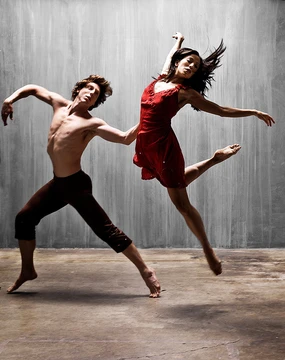
Turkish folk dance
Turkish folk dances reflect a complex, sophisticated culture.

Turkish folk dances reflect the country’s position between three seas and along major trade routes, which has shaped a varied and layered dance culture. Most of these dances are line dances, performed in different styles across the regions.
In East Thrace, the dance form is Hora. The Aegean, Marmara, and parts of central-eastern Anatolia feature Zeybek, while the western Mediterranean region has Teke. Spoon dances (Kaşık Havası) and Karşılama appear in western central Anatolia, the western Black Sea, southern Marmara, and the eastern Mediterranean. The central and eastern Black Sea region is known for Horon. Halay is common in eastern and central Anatolia, and the northeastern part of the country features Bar and Lezginka.
Bar dances are group performances done outdoors, common in Erzurum, Bayburt, Ağrı, Kars, Artvin, and Erzincan. Dancers stand side by side, holding hands or linking arms and shoulders. Men and women perform separate versions. The main instruments are davul and zurna, with clarinet later added for women’s dances. Typical time signatures include 2/4 and 4/4, with occasional 3/4 and 5/8. Aksak rhythms, characteristic of Turkish folk music, appear in unusual and interesting forms. Dancers wear costumes and move with pride, turning their hands as they hop.
Halay refers to dances widespread in eastern, south-central, central, and southeastern Turkey. Their rhythms and choreography vary greatly. They are usually accompanied by davul and zurna, but also by kaval, sipsi, çığırtma, or bağlama, and are sometimes performed with folk songs.
Horon comes from the Black Sea region and derives from the Greek word “choros,” meaning dance. It originated in Laz culture as a pagan dance and is circular, with short, distinct steps. Horon differs sharply from other Turkish folk dances in tempo, rhythm, and measure. It is generally performed in groups, with a characteristic measure of 7/16. Because the melodies are very fast, they are hard to play on many instruments, so davul and zurna are practical. A small zurna called “cura” is often used, and in inland areas, instruments like bagpipe and mey appear. Other measures include 5/8 and 9/8.
Zeybek dances are widespread in western Anatolia and originated from the Zeybeks of the Aegean region. They can be performed by one, two, or a group, and the name changes to “seymen” in central Anatolia. Zeybek uses 9/8 measures with tempos ranging from very slow to very fast. Very slow Zeybeks use 9/2, slow ones 9/4, and others 9/8. Very fast dances, like the teke (goat) dance from Burdur–Fethiye, also follow a 9/8 measure. Another dance in the same region, bengi, has a different musical character and uses a 9/4 measure. Slow Zeybeks traditionally use two drums and two zurnas, with one zurna providing a constant accompaniment. Fast Zeybeks may use bağlama, reed, or marrow bow; the teke dance region traditionally uses reed.
Other forms include Karsilamas, a wedding music style with fast, face-to-face performance, using a dominant 2/4 measure and sometimes others. Its traditional instruments are two drums and two zurnas. This form also appears as Tsifteteli/Çiftetelli. Kasap havasi, or Hasapiko, meaning “butcher’s dance,” is a modern dance from Istanbul and East Thrace, originating with Byzantine butchers and later adopted by the Byzantine military. Kaşık Oyunları, or wooden-spoon dances, are mostly found in the Mediterranean region and have a distinct structure and performance style.
- field
- Folk dance
- nationality
- Turkish
- known_for
- Line dances, regional diversity, use of davul and zurna
Lore & Background
Turkish folk dances reflect the country’s complex culture, shaped by its position facing three seas and straddling important trade routes. The dominant forms are types of line dance, with many varieties performed across different regions. In the eastern part of Anatolia, Bar dances are performed by groups in the open, side-by-side with hands, shoulders, and arms linked. Men’s and women’s Bar dances differ, and the primary instruments are the davul and zurna, with clarinet later added for women’s dances. The characteristic measures include 5/8 and 9/8, with aksak measures applied in unique structures. Dancers wear costumes and perform with pride, turning their hands as they hop. Halay is widespread in eastern, south-central, central, and southeastern Turkey, featuring diverse rhythmic and choreographic elements, often accompanied by davul and zurna, as well as kaval, sipsi, çığırtma, or bağlama, or sung with folk songs. Horon, originating from Laz culture, is a circular dance of the Black Sea region with distinct short steps and a characteristic measure of 7/16. Its fast melodies are difficult to render on most instruments, so the small zurna called cura is used, along with bagpipe or mey in interior areas. Zeybek dances are widespread in western Anatolia, originating from the Zeybeks of the Aegean region. They are performed by one, two, or a group, with measures of 9/8 and tempos ranging from very slow to very fast. The traditional instruments for slow zeybeks are drum and zurna, often with two of each, while fast zeybeks use bağlama, reed, or marrow bow. The teke dance of the Burdur–Fethiye region is a very fast zeybek character dance with a traditional measure of 9/16. Other forms include Karsilamas, a facing dance with a dominant measure of 9/8 and a traditional two-drum, two-zurna combination; Kasap havasi, a butcher’s dance from Istanbul and East Thrace with Byzantine origins; and Kaşık Oyunları, wooden-spoon dances spread over the Mediterranean region with a distinct arrangement.
Reader's Guide
Turkish folk dances are significant for their diversity and cultural complexity, reflecting the country's geography and history. They include forms such as Bar, Halay, Horon, Zeybek, and others like Karsilamas, Kasap havasi, and Spoon dances. These dances are performed with traditional instruments like davul and zurna, and often involve specific measures and formations. The dances are not only entertainment but also preserve regional identities and historical influences, such as the Greek origins of Horon and Syrtos. Their legacy continues in modern Turkey, with some forms like Kolbastı being common among teens.
Did You Know?
- The dominant dance forms in Turkey are types of line dance.
- Bar dances are performed side-by-side, hand, shoulder, and arm-in-arm.
- Horon derives from the Greek word 'choros' meaning dance.
- Zeybek dances have a variety of tempos from very slow to very fast.
Frequently Asked Questions
What is Turkish folk dance?
Turkish folk dance is the collective term for the traditional dance traditions of Turkey, a nation bordered by three seas and positioned along historic trade corridors. These dances express a layered, sophisticated culture that grew out of centuries of cross-cultural contact.
What makes Turkish folk dance distinctive?
The hallmark form is the line dance, in which performers link up and move in long connected chains. Recognized styles include Zeybek, Bar, Halay, Hora, Horon, spoon dances, and Lezginka, each carrying its own regional character.
What instruments accompany Turkish folk dance?
The signature pairing is the davul, a large double-headed drum, and the zurna, a piercing double-reed wind instrument. Together they supply the driving rhythm that propels the line-dance formations.
Why is Turkish folk dance culturally important?
Because Turkey sits at the crossroads of major trade routes and faces three seas, its dance vocabulary absorbed and blended influences from many neighboring traditions. The result is a striking regional diversity, with distinct communities performing their own styles in their own ways.
How many types of Turkish folk dance are there?
There is no single fixed count; the tradition encompasses many different types carried out in varied ways across the country. Named styles range from Zeybek and Bar to Halay, Hora, Horon, spoon dances, and Lezginka, among others.
More in Dance 1-24
Spotted an error? Know more?
This is a living reference — every entry is fact-audited, and reader corrections feed straight into our audit queue. Suggest an edit · See this site's audit record