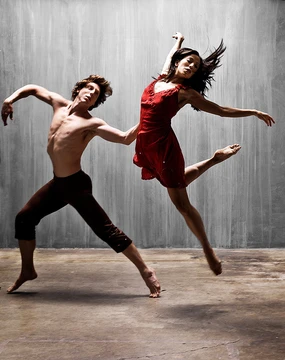
Circle dance
Ancient social dance in circles, linking communities worldwide.

Circle dance, also known as chain dance, is a social dance style performed in a circle, semicircle, or curved line, where participants maintain physical contact through hand-to-hand, finger-to-finger, or hands-on-shoulders connections. Unlike line dancing, anyone can join without needing a partner, following a leader around the floor. The dances range from gentle to energetic, serving either as an uplifting group experience or as part of meditation. This formation is likely the oldest known dance tradition, common across many cultures for marking special occasions, rituals, and strengthening community bonds. Modern circle dance blends traditional folk dances, primarily from European or Near Eastern sources, with newly choreographed pieces set to both ancient and modern music, including classical and contemporary songs.
Historically, circle dancing appears in cave paintings from the Mesolithic period at the Bhimbetka rock shelters in India, showing dancers holding hands. In the Balkans, medieval tombstones called Stećci from Bosnia and Hercegovina (12th–16th centuries) depict linked figures, while 14th-century murals at Lesnovo Monastery in Macedonia show young men dancing arm-in-arm. A Bulgarian 14th-century sermon condemned chain dances as "devilish and damned." In Central Europe, Germany’s Reigen dates from the 10th century, possibly originating from devotional dances at early Christian festivals, despite church denunciations. Frescoes in Tyrol’s Runkelstein Castle and in Denmark’s Ørslev church (circa 1400) show chain dancers. In the Mediterranean, 14th-century accounts by Boccaccio describe circle dancing, and a Siena fresco by Lorenzetti shows women performing a bridge figure to a tambourine. Travelers to Constantinople in the late 16th century recorded Greek weddings featuring circle dances. Modern examples include the Balkan Hora, danced in a counterclockwise circle with three steps forward and one back, and the Kolo common in South Slavic regions. Circle dancing is found across the Middle East, Europe, South Asia, South America, Tibet, and among Native Americans, and is used in worship traditions such as the Islamic Haḍra Dhikr.
- type
- Social dance formation
- origins
- Ancient, probably the oldest known dance formation
- distribution
- Worldwide, including Europe, Middle East, South Asia, Americas
- characteristics
- Dancers in physical contact, hand-to-hand or hands-on-shoulders, follow a leader
- associated_cultures
- Arabic, Israeli, Assyrian, Kurdish, Turkish, Armenian, Balkan, South Asian, Native American, and others
Lore & Background
Circle dancing, also known as chain dance, is a social dance performed in a circle, semicircle, or curved line, with participants in physical contact through hand-holding, finger-linking, or placing hands on shoulders. Unlike line dancing, dancers follow a leader, and anyone can join without needing a partner. The style ranges from gentle to energetic, serving as either an uplifting group experience or a meditative practice. It is likely the oldest known dance formation, used across cultures for rituals, celebrations, and community bonding. Modern circle dance blends traditional folk dances, mainly from European or Near Eastern sources, with newly choreographed pieces set to ancient and contemporary music, including classical and modern songs. Evidence of this tradition appears in Mesolithic cave paintings at Bhimbetka in India, showing dancers holding hands. In the Balkans, medieval tombstones from the 12th to 16th centuries depict linked figures, and a 14th-century Bulgarian sermon condemned chain dances as "devilish and damned." Central Europe’s German "Reigen" dates from the 10th century, possibly originating from early Christian devotional dances, despite church denunciations. Frescoes in Tyrol and Denmark, as well as accounts from 14th-century Italy and 16th-century Constantinople, document circle dancing at weddings and festivals. Modern forms include the Balkan Hora, danced in a counterclockwise circle with a three-steps-forward, one-step-back pattern, and the South Slavic Kolo. The dance is found in many regions, including the Middle East, Southeast Europe, South Asia, Western Europe, South America, Tibet, and among Native Americans, and is used in worship by traditions such as the Church of England and Islamic Haḍra Dhikr.
Reader's Guide
Circle dance has persisted across millennia and continents, serving as a means of social bonding, ritual, and celebration. Its modern forms include the Hora in the Balkans, Kolo in South Slavic regions, Sardana in Catalonia, and Kalamatianos in Greece. The dance is also used in religious worship, such as in the Church of England and Islamic Haḍra Dhikr. Its adaptability—ranging from gentle to energetic, and from traditional folk to classical music—has ensured its continued relevance. The dance's emphasis on physical contact and following a leader fosters a sense of unity and collective participation, making it a powerful tool for community building across diverse cultures.
Did You Know?
- Circle dancing is probably the oldest known dance formation.
- Cave paintings at Bhimbetka in India from the Mesolithic period show people dancing holding hands.
- A 14th-century Bulgarian sermon called chain dances 'devilish and damned.'
- The German circle dance 'Reigen' dates from the 10th century and may have originated from devotional dances.
Origins & Historical Evolution
The roots of square dancing stretch back through centuries of European social dance traditions. One of the earliest identifiable influences was the Morris dance, an energetic English form performed by six men in a line. Closely related was English country dance, which featured groups of couples arranged in circles, lines, or squares. Three of those, including "Dull Sir John," even used the exact phrase "A Square Dance for eight thus." These early forms already contained structural concepts still recognized today, such as head couples performing an action that side couples then repeat. By the early 1800s, English country dances had merged with French traditions to produce the quadrille, a dance for four couples arranged in a square. When European settlers carried these forms to North America, they took root and evolved significantly, particularly after the American Revolution, when the quadrille gained widespread popularity.
The Caller & Musical Tradition
Originally, quadrilles and their predecessors were performed from fully memorized sequences of steps. A transformative shift occurred when African American musicians, who played the accompanying music, began verbally calling out the steps for dancers to follow. This practice, which became widespread by the early 1900s, gave birth to the role of the modern caller. In most American forms of square dance today, a caller prompts dancers through a sequence of steps, keeping time with the beat and, in some traditions, the phrasing of the music. In other variations, however, there is no caller at all; dancers instead memorize and execute a specific routine. The musical landscape of square dancing is equally diverse. Some forms rely on traditional tunes passed down through generations, while others embrace more modern musical styles. In the United States, the term "square dance" encompasses both the dance itself and the social events where it is performed, often organized by square dance clubs, bands, or individual enthusiasts. Attire ranges from strict dress codes in certain traditions to completely casual settings in others.
Global Variations & Regional Styles
Square dancing manifests in remarkably different forms across the globe. In the United States, traditional square dance is not standardized and breaks down into at least three major regional styles: the Northeast or New England tradition, the Southeast or Appalachian tradition, and the Western style. The New England and Appalachian forms have been particularly well documented since the early days of the republic and have survived into the twenty-first century. In England, Ireland, and Scotland, the term "square dance" is used less frequently, and dance events often blend square, circle, and line formations. Distinct traditions there include Playford dances, regional folk dances, Irish ceili, Irish set dances, and Scottish country dances. In many countries and regions, through preservation and repeated performance, square dances have achieved the status of folk dance. The standard four-couple square formation can also be modified to include more or fewer dancers or arranged in a different shape entirely. These dances appear in over one hundred different formations worldwide, with the Square and the Longways Set being by far the most popular.
Cultural Legacy & Institutional Recognition
Square dancing's cultural footprint in the United States is extraordinary. The dance became strongly associated with the romanticized image of the American cowboy during the twentieth century, cementing its place in the national imagination. Beginning in the 1970s, a sustained campaign by square dancers to establish the dance as the national dance led to thirty-one states officially designating it as their state dance. Preservation efforts also played a crucial role: starting in the 1930s, Lloyd Shaw solicited step definitions from callers across the country to document and preserve traditional western square dancing, making it accessible to other teachers. The American folk music revival in New York City during the 1950s was itself rooted in the resurgent interest in square and folk dancing in the 1940s, giving musicians like Pete Seeger popular exposure. Industrialist Henry Ford also played a notable role in popularizing the form.
Frequently Asked Questions
What exactly is a Circle dance?
A Circle dance is a social dance formation in which participants stand in a circle, semicircle, or curved line while maintaining physical contact with one another, such as holding hands or placing hands on shoulders. It is sometimes called a chain dance and is typically led by a single dancer who sets the pattern for the group.
How old is the Circle dance and where did it originate?
It is widely regarded as probably the oldest known dance formation in human history, with roots stretching back to ancient times. Rather than belonging to one specific culture, it emerged independently across many regions, making a single point of origin difficult to pin down.
Which cultures and regions practice Circle dances?
The form appears worldwide across Europe, the Middle East, South Asia, and the Americas. Specific traditions are associated with Arabic, Israeli, Assyrian, Kurdish, Turkish, Armenian, Balkan, South Asian, and Native American communities, among others.
What makes a Circle dance different from other group dances?
Its defining feature is the closed or open circular formation combined with continuous physical contact between adjacent dancers, often following a lead dancer's movements. This structure creates a shared, synchronized experience rather than individual performance.
Why is the Circle dance considered culturally important?
It has long served as a communal ritual for marking special occasions, celebrations, and rites of passage across diverse societies. By physically linking participants in a shared pattern, it reinforces a sense of belonging and collective identity within the group.
More in Dance 1-24
Spotted an error? Know more?
This is a living reference — every entry is fact-audited, and reader corrections feed straight into our audit queue. Suggest an edit · See this site's audit record