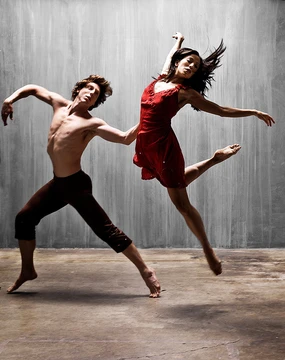
Concert dance
Dance performed for an audience with theatrical elements.

Concert dance, called performance dance, theatre dance, or dance theatre in the UK, is dance created for an audience. It typically includes theatrical features like rehearsed choreography, costumes, set pieces, and sometimes a story. While often staged in a theatre, that setting isn't mandatory, and the dance is usually choreographed and performed to pre-set music. In contrast, social dance and participation dance can happen without an audience and are generally not choreographed or set to fixed music, though there are exceptions—for instance, some ceremonial and baroque dances mix concert and participation dance by letting participants switch between performer and audience roles.
Many dance styles are mainly performed in a concert context. Ballet began as court dance in Italy, grew in France and Russia, then spread across Europe and beyond. It became an academic subject taught in schools, and amateur and professional companies moved it from courts to theatres, making it a widely performed concert style. Modern and contemporary dance emerged in the 20th century as offshoots of traditional ballet; though each developed its own movement quality and shares only part of a common technique repertoire, both are still primarily performed in concert or theatre settings. Acrobatic dance started in the United States and Canada in the early 1900s as a vaudeville act. It has since evolved, with its movements now based in ballet technique, and has always been a concert dance form. Classical Indian dance originated in Indian temples. After the Indian independence movement (1947–1950), it became a university subject, dance schools appeared, and it turned into a concert dance form performed in theatres. Classical Persian dance was elevated to an art form during the Qajar dynasty (1795–1925), performed in the Shah's royal court and among elite and bourgeois families until the 20th century. It then evolved into its modern form and became a widely performed concert dance style.
Other styles include belly dance, Bharatanatyam, eurythmy, hip hop dance, Japanese traditional dance, jazz dance, tap dance, and Wuju.
In the United Kingdom, "theatre dance" is a common term for a range of performance dance disciplines, especially in dance teaching. The UK has several dance training and examination boards, most with a separate branch for theatre dance and codified syllabi for each technique. Many dance teachers and schools worldwide prepare students for exams and qualifications with UK-based organisations, such as the Royal Academy of Dance, the Imperial Society of Teachers of Dancing, and the International Dance Teachers Association. All UK theatre dance organisations consistently offer classical ballet, tap, and modern or jazz as core theatre branch subjects. Many also offer "theatre craft" or "stage dance," designed to reflect choreography seen in musical theatre.
- field
- Performing arts
- known_for
- Dance performed for an audience with theatrical elements
- related_forms
- Ballet, modern dance, contemporary dance, acrobatic dance, classical Indian dance, classical Persian dance
Lore & Background
Concert dance encompasses many styles that are principally performed in a concert context. Ballet originated as courtroom dance in Italy, then flourished in France and Russia before spreading across Europe and abroad, becoming an academic discipline taught in schools and institutions. Modern dance and contemporary dance emerged largely as 20th century offshoots of traditional ballet technique, each evolving their own quality of movement while sharing only a portion of their common repertoire of techniques. Acrobatic dance emerged in the United States and Canada in the early 1900s as one of the types of acts performed in vaudeville, with dance movements now founded in ballet technique.
Reader's Guide
Concert dance is significant as a broad category that distinguishes performance-oriented dance from social or participatory dance. It has shaped the development of numerous dance styles, from classical forms like ballet and classical Indian dance to modern genres. In the United Kingdom, theatre dance is a common term used to indicate a range of performance dance disciplines, widely used in reference to the teaching of dance. The UK has a number of dance training and examination boards, with the majority having a separate branch dedicated to theatre dance, with codified syllabi in each technique. Many dance teachers and schools worldwide prepare their pupils for dance examinations and qualifications with a UK-based organisation, including the Royal Academy of Dance, the Imperial Society of Teachers of Dancing, and the International Dance Teachers Association. All UK theatre dance organisations are consistent in offering classical ballet, tap and modern or jazz as their core theatre branch subjects, and many also offer 'theatre craft' or 'stage dance' devised to reflect choreography seen in musical theatre.
Did You Know?
- Concert dance is also known as performance dance, theatre dance, or dance theatre in the United Kingdom.
- Some ceremonial dances and baroque dances blend concert dance with participation dance by having participants assume the role of performer or audience at different moments.
Defining Characteristics and the Audience Boundary
Concert dance—sometimes called performance dance, theatre dance, or dance theatre in the United Kingdom—is fundamentally defined by the presence of an audience. Unlike social or participation dance, which can occur without spectators and typically lacks both fixed choreography and a predetermined musical score, concert dance is built around rehearsed sequences, deliberate costumes, designed set-pieces, and often a narrative thread that guides the performance. While a theatre venue is the most common home for such work, it is far from a requirement; the essential ingredient is the act of performing for others. The music, too, is usually set in advance rather than improvised. That said, the boundary between concert and participation dance is not always rigid. Certain ceremonial traditions and baroque-era forms blur the line, shifting participants between the roles of performer and observer within a single event. This fluidity reminds us that concert dance, for all its structure, exists on a spectrum rather than in a sealed category.
A Global Mosaic of Styles
The concert dance world encompasses a remarkable range of traditions, each with its own historical trajectory. Ballet began as a pastime of Italian courts before taking root in France and Russia, eventually becoming a formal academic discipline taught in dedicated schools. The formation of amateur and professional troupes carried it from private courts into public theatres, where it remains one of the most widely staged concert forms. Modern and contemporary dance, by contrast, grew out of ballet technique in the twentieth century; while each has developed its own distinctive movement vocabulary, both continue to find their primary home in concert and theatre halls. Acrobatic dance, born in the vaudeville stages of the United States and Canada in the early 1900s, has always been a concert form and now builds its vocabulary on ballet foundations.
The United Kingdom's Theatre Dance Framework
In the United Kingdom, the term "theatre dance" carries a specific institutional weight that extends well beyond a single style. It functions as an umbrella label for a broad family of performance disciplines and is especially prevalent in educational contexts. The country hosts numerous dance training and examination boards, most of which maintain a dedicated theatre dance branch with its own codified syllabi for each technique. Three organisations stand out as particularly influential: the Royal Academy of Dance, the Imperial Society of Teachers of Dancing, and the International Dance Teachers Association. These bodies set standards that ripple far beyond British shores, as dance teachers and schools around the world prepare their students for examinations administered by UK-based organisations. Across all of these institutions, the core theatre branch consistently includes classical ballet, tap, and either modern or jazz as foundational subjects. Many boards additionally offer a "theatre craft" or "stage dance" track, specifically designed to mirror the choreography students would encounter in musical theatre productions.
From Private Spaces to Public Stages
A recurring pattern across concert dance history is the migration of movement traditions from restricted, private settings into open public performance. Ballet's journey from Italian courtrooms to the grand stages of Europe and beyond is perhaps the most well-known example, yet it is far from unique. In India, classical dance forms that had long been rooted in temple rituals only became university subjects, acquired dedicated schools, and entered theatrical spaces after the independence movement of the late 1940s and early 1950s. Similarly, classical Persian dance was elevated to an art form under the Qajar dynasty and remained the preserve of the royal court and wealthy families until the twentieth century, when it evolved into its modern expression and became a widely performed concert style. Even acrobatic dance, which debuted as a vaudeville act in North America in the early 1900s, has since transformed into a discipline grounded in ballet technique while retaining its concert-stage identity. In each case, the shift from a closed, often elite or sacred context to a public theatrical one marked a decisive moment in the dance's cultural life.
Frequently Asked Questions
Who is Concert dance?
Concert dance is a performing-arts discipline in which rehearsed, choreographed movement is presented to a live audience, often layered with theatrical staging, costumes, and sometimes a narrative thread. It goes by several regional names, including performance dance and dance theatre in the United Kingdom.
What are Concert dance's powers/role?
Its core strength is turning structured choreography into a staged spectacle, typically set to fixed music and supported by set-pieces and costume design. Unlike social or participatory forms, it is built around intentional artistic presentation to an audience rather than casual, improvised movement.
How does Concert dance's story end?
A typical concert-dance 'arc' closes when the final choreographed sequence resolves and the performers take their bows before the audience. There is no single canonical ending, since every new production rewrites the narrative from scratch.
Why is Concert dance important?
It acts as the umbrella discipline under which ballet, modern and contemporary dance, acrobatic dance, and classical traditions from India and Persia all present their work publicly. Without this framework, choreographed movement would lack a dedicated structure and venue for audience-facing performance.
What are Concert dance's related forms?
Its closest allies include ballet, modern and contemporary dance, acrobatic dance, and the classical dance traditions of India and Persia. It stands in clear contrast to social dance and participation dance, which generally lack a fixed audience, set choreography, or prescribed music.
More in Dance 1-24
Spotted an error? Know more?
This is a living reference — every entry is fact-audited, and reader corrections feed straight into our audit queue. Suggest an edit · See this site's audit record