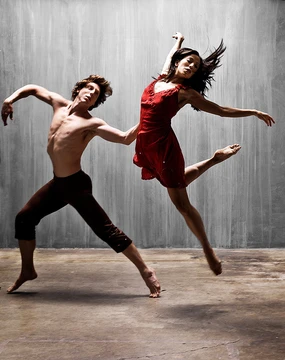
Swing (dance)
A category of social dances developed with swing jazz music.

Swing dance is a broad category of social dances that grew alongside swing jazz music during the 1920s through the 1940s, though each individual dance style actually started before the swing era. Hundreds of different swing dance styles emerged, but the ones still practiced today include Charleston, Balboa, Lindy Hop, West Coast Swing, and Collegiate Shag. Of these, Lindy Hop is the most famous; it got its start in Harlem in the early 1930s. Most swing dances began as vernacular African-American dances within Black communities, but a few, like Balboa, came from outside those communities. The term "swing dance" wasn't commonly used to describe a group of dances until the latter half of the 1900s. Before that, "swing" referred to the jazz music style that inspired the dances. "Jitterbug" can mean any form of swing dance, but it's often used specifically for the six-count version of Lindy Hop known as East Coast Swing. A person who danced swing was called a swing dancer. "Jitterbug" could also refer to Lindy Hop, Shag, or other swing styles. Bandleader Cab Calloway famously used the term because dancers' fast, bouncy movements made them "look like a bunch of jitterbugs out there on the floor." Today, the term swing dancing often includes West Coast Swing, Carolina Shag, East Coast Swing, Hand Dancing, Jive, Rock and Roll, Modern Jive, and other dances that came along in the 1940s and later. In Europe, a strong tradition of social and competitive boogie woogie and Rock 'n' Roll adds those dances to local swing dance cultures. **Original forms from the 1920s and early 1930s**
Balboa is a very fast eight-count dance done in closed position. Its earliest form, "Pure Balboa," came from the conservative dance halls of southern California, where space was limited and strict rules banned the wild kicks of Charleston and Lindy Hop. Pure Balboa features an upright posture with partners chest to chest. Step variations play with rhythm and style from the knee down, and involve changes in direction. It's often danced to fast jazz, usually 180–320 BPM, though many prefer a slower 170–190 BPM. Most dancers consider both Pure Balboa and Bal-Swing part of the same dance. Bal-Swing developed when original Balboa dancers tried fancier variations that broke the chest-to-chest connection, introducing spins, turns, dips, tricks, and even air steps. Charleston can be danced partnered or solo, often to faster music. It uses several positions: side-by-side, hand-to-hand, and tandem. In "jockey position," the closed position opens so both partners face forward without separating. In side-by-side Charleston, partners open completely, connecting only at touching hips and arms—the leader's right arm touches the follower's back, and the follower's left arm touches the leader's shoulder. Both partners swing their free arms like in solo Charleston. In both jockey and side-by-side, the leader steps back on the left foot, and the follower steps back on the right. In tandem Charleston, one partner stands in front of the other (usually the follower), both face the same direction, and both start by stepping back on the left foot. The partner behind holds the front partner's hands, and their joined arms swing back and forth like in the basic step. Collegiate Shag (or "Shag") is danced mainly to up-tempo swing and sometimes pre-swing jazz (185–200+ BPM). It likely started in the Carolinas in the 1920s and spread across the U.S. during the 1930s. Shag is still danced by swing enthusiasts worldwide and is believed to have been the first and most popular swing dance of the original swing era. Lindy Hop evolved in the early 1930s. It's an African American dance known for its high physical energy. Its eight-count basic, the "swingout," moves from open position through closed position and back. The dance emphasizes improvisation and can include other steps in eight-count and six-count rhythms. The name "Lindy Hop" is often credited to "Shorty" George Snowden, who, when asked by a newspaper writer what dance they were doing, supposedly replied "the Lindy Hop" because Charles Lindbergh had just made his solo flight across the Atlantic. Whether Shorty George actually coined the name is debated, but it stuck. The Savoy Ballroom in Harlem was the home of Lindy Hop. As its popularity grew, professional troupes formed and toured the U.S. and Europe performing versions of it. **Forms from the late 1930s and early 1940s**
Big Apple: A partner dance and a "called" circle dance that began in the African American community in the early 20th century.
- field
- Social dance
- known_for
- Category of dances developed with swing jazz music, 1920s–1940s
Lore & Background
Swing dance was not commonly used to identify a group of dances until the second half of the 20th century. Historically, the word swing referred to a style of jazz music, which inspired the evolution of the dance. Jitterbug is any form of swing dance, though it is often used as a synonym for the six-count derivative of Lindy Hop called 'East Coast Swing'. One who danced swing was called a swing dancer. The term was famously associated with swing era band leader Cab Calloway because, as he put it, the dancers 'look like a bunch of jitterbugs out there on the floor' due to their fast, often bouncy movements. Original forms dating from the 1920s and early 1930s include Balboa, a very fast eight-count dance in closed position that evolved in the mostly conservative dance halls of southern California. Charleston is danced partnered or solo, often to faster music, and includes a number of positions. Collegiate Shag is done primarily to up tempo swing and sometimes pre-swing jazz music, believed to have originated in the Carolinas in the 1920s. Lindy Hop evolved in the early 1930s, a dance of African American origin characterized by a high degree of physical vigor and an eight-count basic called the 'swingout'.
Reader's Guide
Swing dance represents a significant cultural and historical development in social dance, emerging from the swing jazz era of the 1920s–1940s. Its roots in African-American communities gave rise to iconic dances like the Lindy Hop, which became the best-known swing dance today. The term 'swing dancing' is often extended to include later derivatives such as West Coast Swing, East Coast Swing, Jive, Rock and Roll, and Modern Jive. A strong tradition of social and competitive boogie woogie and Rock 'n' Roll in Europe adds these dances to their local swing dance cultures. The legacy of swing dance endures through continued practice worldwide, with styles like Balboa, Charleston, and Collegiate Shag still danced by enthusiasts. Its influence is seen in both social and competitive contexts, preserving the improvisational and energetic spirit of the original era.
Did You Know?
- Swing dance was not commonly used to identify a group of dances until the second half of the 20th century.
- The term 'jitterbug' was famously associated with swing era band leader Cab Calloway because dancers 'look like a bunch of jitterbugs out there on the floor'.
- Balboa evolved in the mostly conservative dance halls of southern California where space was limited and strict codes of conduct were enforced.
- Collegiate Shag is believed to have been the first and most popular swing dance of the original swing era.
Frequently Asked Questions
What is Swing (dance)?
Swing (dance) refers to a broad category of social dances that grew up alongside the swing style of jazz music during the 1920s through the 1940s. Each individual dance within the category actually predates the swing era itself, but they became closely associated with that musical movement.
Which specific dances are part of the Swing category?
Hundreds of styles were developed under the swing umbrella, but the ones that have endured beyond the era include Charleston, Balboa, Lindy Hop, West Coast Swing, and Collegiate Shag. Of these, Lindy Hop is by far the most widely recognized today.
Where did the Lindy Hop originate?
The Lindy Hop, the best-known swing dance, took shape in Harlem in the early 1930s. It remains the flagship style that most people associate with swing dancing today.
What is the cultural background of most swing dances?
The majority of swing dances began as vernacular African-American social dances rooted in Black communities. However, a few styles, such as Balboa, were influenced by non-African-American traditions before merging into the broader swing dance world.
Why is the Swing dance category significant in dance history?
Swing (dance) represents one of the most vibrant periods of social dance innovation, producing hundreds of distinct styles over just a couple of decades. Its legacy persists because several key dances—especially the Lindy Hop—remain actively danced and taught worldwide.
More in Dance 1-24
Spotted an error? Know more?
This is a living reference — every entry is fact-audited, and reader corrections feed straight into our audit queue. Suggest an edit · See this site's audit record