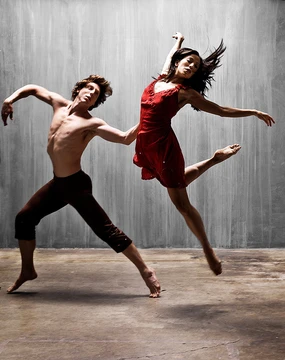
Foxtrot
Smooth, progressive dance popularized in the 1910s and standardized by Arthur Murray.

The foxtrot is a smooth, progressive partner dance defined by long, flowing movements across the floor. It is performed to big band music, often with vocals, and resembles the waltz in appearance but follows a 4/4 time signature. First introduced in the 1910s, the dance peaked in popularity during the 1930s and is still danced today.
The dance premiered in 1914 and was soon refined by the famous duo Vernon and Irene Castle, who gave it its characteristic elegance. The name’s origin is uncertain, though one theory links it to vaudeville performer Harry Fox. Both Vernon Castle and dance teacher Betty Lee credited African American dancers as the source; Castle noted he had seen the dance performed by Black dancers for fifteen years at a private club. Composer W. C. Handy claimed his “The Memphis Blues” inspired the foxtrot. During breaks from faster dances, the Castles’ music director James Reese Europe would play that tune slowly, intriguing the Castles, who then created a slow dance to match. They first called it the “Bunny Hug” in a magazine article, but while traveling abroad, they sent a wireless message to rename it “Foxtrot.” Later, Arthur Murray standardized the dance, incorporating tango-like positions.
Originally danced to ragtime, the foxtrot became the most popular fast dance from the late 1910s through the 1940s, with most records from that era being foxtrots. Neither the waltz nor the tango surpassed it, and even the Lindy Hop’s rise in the 1940s did not diminish its appeal, as both dances could use the same music. When rock and roll emerged in the early 1950s, record companies were unsure which dance style fit. Decca Records initially labeled its rock releases as foxtrots, including Bill Haley’s “Rock Around the Clock,” which sold over 25 million copies—making it arguably the best-selling foxtrot ever. Today, the foxtrot is still danced to the big band music used for swing.
Over time, the foxtrot split into slow and quick versions, called “foxtrot” and “quickstep.” The slow category includes the International (or English) style and the American continuity style, both using a slow-quick-quick rhythm at a slow tempo, as well as the social American style, which uses a slow-slow-quick-quick rhythm at a faster pace. In ballroom competitions, the slow version is sometimes called “Slow Foxtrot” or “Slowfox” to distinguish it from other foxtrot types.
Three main styles of slow foxtrot are common today: American Social, American Continuity, and International. All are partner dances where couples move counter-clockwise around the floor to similar music, but they differ in technique, positions, and figures.
The American Social style is widely used in the U.S. for social dancing, especially in crowded spaces or among partners with little formal training. Its key feature is that dancers close their feet at the end of most figures, rather than passing them, which slows progress and allows some figures to be danced in place. Figures usually start with partners facing each other in closed position, with the man leading on his left foot. This consistency makes it easy to string figures together. Body contact is not required; all leads come through arm frames, avoiding awkwardness. This style is the only one allowed at the bronze (beginner) level of American Style competition, so it is also called “American Bronze Foxtrot.”
The American Social style uses both six-count and eight-count figures, alternating between them—one of the few challenges in the dance. Syncopation is generally avoided. Six-count figures span one and a half measures of music, using a slow-slow-quick-quick rhythm (two counts each for the slows, one each for the quicks). Examples include the basic forward and back movement, alternating quarter turns (zig-zag), rock turns, promenade, promenade twist (12 counts), promenade pivot (12 counts), and sway step. Social dancers typically use alternating quarter turns to zig-zag around the room, mixing in promenades for variety. Rock turns help change direction at corners or avoid collisions.
- field
- Ballroom dance
- known_for
- Smooth, progressive dance with long flowing movements; most popular fast dance from late 1910s through 1940s
- popularizer
- Vernon and Irene Castle
Lore & Background
The origin of the name is unclear, though one theory is that it took its name from vaudevillian Harry Fox. Two sources, Vernon Castle and dance teacher Betty Lee, credit African American dancers as the source of the foxtrot. Castle saw the dance, which 'had been danced by negroes, to his personal knowledge, for fifteen years, [at] a certain exclusive colored club'. W. C. Handy notes in his autobiography that his 'The Memphis Blues' was the inspiration for the foxtrot. During breaks from the fast-paced Castle Walk and One-Step, the Castles' music director, James Reese Europe, would slowly play 'The Memphis Blues'. The Castles were intrigued by the rhythm, and Jim suggested they create a slow dance to go with it. They introduced what they then called the 'Bunny Hug' in a magazine article, but later changed the name to 'Foxtrot' via a wireless from mid-ocean. It was subsequently standardized by Arthur Murray, in whose version it began to imitate the positions of tango. At its inception, the foxtrot was originally danced to ragtime. From the late 1910s through the 1940s, it was the most popular fast dance, and the vast majority of records issued during these years were foxtrots. The waltz and tango never overtook it. Even the popularity of the Lindy Hop in the 1940s did not affect the foxtrot's popularity, since it could be danced to the same records. When rock and roll emerged in the early 1950s, Decca Records initially labeled its rock and roll releases as 'foxtrots', most notably 'Rock Around the Clock' by Bill Haley and His Comets, which sold more than 25 million copies. Over time, the foxtrot split into slow and quick versions, referred to as 'foxtrot' and 'quickstep' respectively.
Reader's Guide
The foxtrot's significance lies in its enduring popularity and influence on social dance. Its adaptability allowed it to survive the rise of the Lindy Hop and even early rock and roll, with Decca Records labeling rock and roll releases as foxtrots. The dance's legacy includes the development of distinct styles—American Social, American Continuity, and International—each with unique techniques and figures. The American Social Style remains a staple for beginners and crowded dance floors, while the American Continuity Style is used in competitive and theatrical settings. The International Style, also called Slow Foxtrot or Slowfox, is a standard in ballroom competitions. The foxtrot's ability to evolve while maintaining its core smooth, progressive character has ensured its continued practice today.
Did You Know?
- The foxtrot was originally called the 'Bunny Hug' before being renamed via a wireless from mid-ocean.
- Decca Records initially labeled its rock and roll releases as 'foxtrots', including 'Rock Around the Clock' by Bill Haley and His Comets.
- Two sources, Vernon Castle and dance teacher Betty Lee, credit African American dancers as the source of the foxtrot.
- The foxtrot split into slow and quick versions, with the quick version known as the quickstep.
Frequently Asked Questions
How does the Foxtrot differ from the Waltz?
Although the two dances share a similar visual flow, the Foxtrot moves in a 4/4 meter rather than the waltz's triple-time feel, giving it a distinctly different rhythmic character. The Foxtrot also favors longer, more gliding steps compared to the waltz's step pattern.
Who made the Foxtrot famous?
Vernon and Irene Castle are widely credited with popularizing the dance for a mass audience during the 1910s. Arthur Murray later helped standardize its technique for ballroom instruction and competition.
When was the Foxtrot at its peak?
The dance dominated the ballroom scene from the late 1910s through the 1940s, with its absolute height of popularity arriving in the 1930s. It was regarded as the most popular fast dance of that entire era.
Is the Foxtrot still danced today?
Yes, the Foxtrot remains an active part of both ballroom and social dance practice in the present day. It continues to be taught, performed, and competed in, keeping its place in the dance canon nearly a century after its creation.
More in Dance 1-24
Spotted an error? Know more?
This is a living reference — every entry is fact-audited, and reader corrections feed straight into our audit queue. Suggest an edit · See this site's audit record