Radetzky March (novel)
A family saga mirroring the Habsburg Empire's decline.
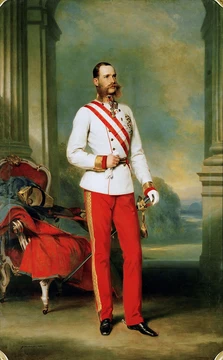
Joseph Roth's 1932 novel, Radetzky March, traces the Habsburg Monarchy's collapse through the Trotta family's story. The book spans 1859 to 1916 and is an early work where Emperor Franz Joseph I appears as a recurring historical figure. English translations were done by Geoffrey Dunlop, Joachim Neugroschel, and Michael Hofmann.
Quick Facts
- Title orig
- Radetzkymarsch
- Author
- Joseph Roth
- Country
- Berlin, Germany
- Language
- German
- Genre
- Novel
- Publisher
- Gustav Kiepenheuer Verlag
- Released
- 1932
- Format
- Print (Hardback & Paperback)
Facts from the source article.
Plot
The novel relates three generations of the Trotta family, professional Habsburg soldiers and bureaucrats of Slovenian origin, from their zenith during the empire to its breakup during and after the First World War. In 1859, during the Battle of Solferino, the blundering Emperor Franz Joseph I is almost killed; Infantry Lieutenant Trotta topples the Emperor from his horse to thwart snipers. The Emperor awards Trotta the Order of Maria Theresa and ennobles him, which ultimately leads to the family's ruination, paralleling the imperial collapse of Austria-Hungary. After his elevation, Baron Trotta von Sipolje is regarded by his family as a man of superior quality, though he feels uncomfortable among the aristocracy. As a father, the first Baron is disgusted by historical revisionism in school textbooks that misrepresent his battlefield rescue. He appeals to the Emperor to correct the book, but the Emperor orders the story deleted from official history, considering an uninspiring truth useless for patriotism. Later generations misunderstand the elder generation's reverence for the legend and consider themselves rightful aristocrats.
Literary significance
Radetzky March is Joseph Roth's best-known work and was critically acclaimed after its first publication in German in 1932. In 2003, literary critic Marcel Reich-Ranicki included it in Der Kanon of the most important German-language literary novels. The novel explores ironies and humour in well-intentioned actions that led to the decline of a family and an empire, with the Emperor remaining ignorant of the unintended consequences of rewarding his subjects. The title derives from the Radetzky March by Johann Strauss Sr., a symbolic composition heard at critical narrative junctures. Peruvian writer Mario Vargas Llosa ranked it as the best political novel ever written. Over time, the novel brought its author acclaim as one of the greatest German-language writers of the 20th century.
Publication history
The first German edition was published in 1932 by Verlag Kiepenheuer in Berlin. It was re-issued in 2010 with epilogue and commentary by Werner Bellmann. Translations include English by Geoffrey Dunlop in 1933, Danish by Soffy Topsøe in 1933, Swedish by Hugo Hultenberg, French by Blanche Gidon in 1934, Russian in 1939, Spanish in 1950, Czech in 1961, Romanian in 1966, Polish in 1977, Hebrew in 1980, Portuguese in 1984, Croatian in 1991, and Persian by Mohammad Hemmati in 2016.
More in Cultural Depictions of Franz Joseph I of Austria
Spotted an error? Know more?
Reader corrections go straight into our review queue. Suggest an edit · How this site is sourced