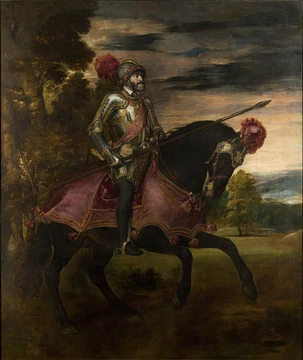
Equestrian Portrait of Charles V
Titian's equestrian portrait of Charles V after Mühlberg.
Last updated
Equestrian Portrait of Charles V, also known as Emperor Charles V on Horseback or Charles V at Mühlberg, is an oil-on-canvas painting by Titian. Created in 1548 while the artist was at the imperial court of Augsburg, it commemorates Charles V's victory at the Battle of Mühlberg against Protestant armies. The work is noted for its directness and sense of contained power, with the horse's strength barely restrained and the shining armour and deep reds evoking battle and heroism.
Commission
Charles V’s sister, Mary of Austria, Queen of Hungary, arranged for this equestrian portrait, but the emperor himself dictated exactly how he wanted to appear. He understood that portraits shaped public perception and admired Titian not just for his technical skill but for how he portrayed imperial authority. During the same visit, Titian also painted a seated version of Charles, now kept in Munich.
By this time, the painter and emperor had grown so close that courtiers grew uneasy over a mere artist’s access to the ruler. Titian was given rooms near Charles’s own and saw him often. He called Augsburg the world’s glory and wrote to his friend Lorenzo Lotto that he enjoyed every favor from both the court and the emperor.
Description
Titian’s painting blends different approaches: the armor and horse tack are rendered with the precise realism of his earlier style, while the trees, sky, and landscape use the broad color and bold brushwork he developed in the 1540s. Iconographic references are scarce but present. The lance evokes Saint George, the model of a military knight-saint. The red on Charles’s helmet, his sash, and the horse’s trim symbolizes the Catholic faith in 16th-century warfare.
Titian was so determined to achieve these intense reds that he had half a pound of red lake pigment shipped from Venice to Augsburg, believing it so fiery and brilliant that it would outshine crimson on velvet or silk. Drawing from Roman military statues, Renaissance equestrian prints, and possibly Dürer’s Knight, Death and the Devil, Titian breaks from the usual pose of a horse with one front leg raised. Here the horse rears or breaks into a canter, balancing on its hind legs, while Charles sits upright and relaxed, holding the reins lightly—a sign of his expert horsemanship.
Unlike Dürer’s knight riding through dark woods past death and evil, Charles moves from a shadowy forest into an open but ominous landscape.
Influence
Many later equestrian portraits of monarchs show a debt to Titian's depiction of Charles. Anthony van Dyck's 1620 Portrait of Charles I on Horseback incorporates many of Titian's ideals. Goya's 1812 Equestrian Portrait of the 1st Duke of Wellington expands further, removing heroism and presenting a diminished, isolated figure undersized compared to his mount, almost overwhelmed by the landscape and charging towards a dark skyscape.
More in Cultural Depictions of Charles V, Holy Roman Emperor
Sources
Compiled from Wikipedia and the sources listed below. Text from Wikipedia is available under CC BY-SA 4.0; this entry is adapted from it.
- Wikipedia: Equestrian Portrait of Charles V (CC BY-SA 4.0).
Spotted an error? Know more?
Reader corrections go straight into our review queue. Suggest an edit · How this site is sourced