Hernani (drama)
Victor Hugo's romantic drama that sparked the Battle of Hernani.
Last updated
Hernani, ou l'Honneur Castillan is a Victor Hugo play written in rhyming alexandrines. Its 1830 premiere sparked famous clashes between Romantic and Classicist audiences. Today it is best known for inspiring Verdi’s opera Ernani, not for its own quality.
History
First performed by the Comédie-Française in Paris on 25 February 1830, the play is now better known for the riots that broke out at its premiere than for its own quality. Victor Hugo rallied fellow Romantics like Hector Berlioz and Théophile Gautier to fight back against Classicists who saw the work as a direct assault on their ideals.
The play appears in Edgar Allan Poe's "The Masque of the Red Death" to describe the scale and splendor of Prince Prospero's ball, while the character Gillenormand in Les Misérables condemns it. Giuseppe Verdi based his opera Ernani, with an Italian libretto by Francesco Maria Piave, on the drama; it premiered in Venice in 1844. An English adaptation by American playwright John Strand came out in 2013.
Plot
The play takes place in an imagined version of the 1519 Spanish court, revolving around romantic intrigue and courtly love. Three men—two nobles and a bandit—all desire the same woman. The plot is so tangled that one biographer of Victor Hugo noted that summarizing it, like with Notre-Dame de Paris, fails to capture its complexity.
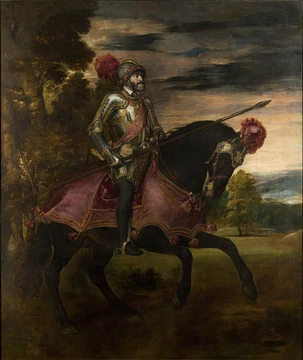
In the opening, King Don Carlos of Spain, who will later become Holy Roman Emperor Charles V, hides in Doña Sol’s bedroom with the help of her maid. When Doña Sol enters to meet her lover Hernani, they talk about her forced marriage to her elderly uncle and Hernani’s past as a bandit whose father was executed by the previous king. They plan to elope, but Don Carlos steps out of his hiding place, interrupting them.
The two men draw swords, but are stopped by the arrival of Doña Sol’s uncle and fiancé, Don Ruy Gomez de Silva. He demands an explanation. Don Carlos reveals his identity, claiming he came to discuss Emperor Maximilian’s death with Ruy Gomez, and says Hernani is part of his retinue, allowing everyone to leave without conflict.
Having overheard the elopement plan, Don Carlos later shows up at the meeting point with noble friends, intending to seduce Doña Sol himself. She recognizes and rejects him. Enraged, he tries to abduct her.
As they struggle over a dagger, Hernani arrives with sixty men, having overpowered the king’s three companions. Hernani declares his hatred for the king because of his father’s execution and challenges him to a duel. This time, knowing Hernani is a bandit, the king refuses—only nobles can duel—and instead dares Hernani to murder him.
Hernani’s honor stops him from attacking a defenseless man. The king escapes and orders his men to arrest Hernani and his band. Hernani says goodbye to Doña Sol and flees.
Did You Know?
- Don Ruy Gomez de Silva, Duke of Pastrana, gets his name from an actual duke by that name, though the fictional version is an old man in 1519, whereas the actual de Silva would have been a toddler at this date.
- Hernani's name comes from a Basque town where Hugo once stayed.
More in Cultural Depictions of Charles V, Holy Roman Emperor
Sources
Compiled from Wikipedia and the sources listed below. Text from Wikipedia is available under CC BY-SA 4.0; this entry is adapted from it.
- Wikipedia: Hernani (drama) (CC BY-SA 4.0).
Spotted an error? Know more?
Reader corrections go straight into our review queue. Suggest an edit · How this site is sourced