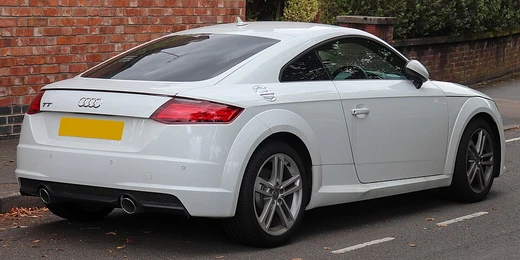
Coupé
A fixed-roof car with a sloping rear roofline.
A coupé is a two-door passenger car defined by its sloping or cut-off rear roofline. The name comes from French horse-drawn carriages built for two people, without rear-facing seats, and derives from the word for "cut." While some coupés have only two seats, others include rear seats that are smaller and of lower quality than the front ones.
Quick Facts
- First applied to
- horse-drawn carriages for two passengers without rear-facing seats
- Origin of term
- French past participle of couper ("to cut")
- Earliest four-door coupé marketed
- Rover P5 Coupé (1962)
- Quad coupé examples
- 2003 Saturn Ion
- 2003 Mazda RX-8
- 2011–2022 Hyundai Veloster
Facts from the source article.
Did You Know?
- The pronunciation without an accent ("coupe") entered American vernacular no later than 1936 and featured in the Beach Boys' 1963 song "Little Deuce Coupe."
- The coupé was considered an ideal vehicle for women to use for shopping or social visits.
Definition
A coupé is a fixed-roof car with a sloping rear roofline and one or two rows of seats. Debate exists over whether a coupé must have two doors for passenger egress or whether four-door cars can also be considered coupés. This debate arose in the early 2000s when models such as the Mazda RX-8 and Mercedes-Benz CLS-Class were marketed as "four-door coupés" or "quad coupés," though the Rover P5 introduced a variant in 1962 with a lower, sleeker roofline marketed as the Rover P5 Coupé. In the 1940s and 1950s, coupés were distinguished from sedans by their shorter roof area and sportier profile. More recently, when a model is sold in both coupé and sedan body styles, the coupé is generally sportier and more compact. The 1977 version of International Standard ISO 3833 defines a coupé as having two doors, a fixed roof, usually limited rear volume, at least two seats in at least one row, and at least two side windows. The definition began to blur with the introduction of 2+2 body styles, which have a sleek, sloping roofline, two doors, two functional front seats, and two small rear seats. Some manufacturers further blur the definition by applying "coupé" to hatchback or liftback models, often with a fold-down rear seat for improved practicality.
History
The earliest coupé cars borrowed their layout from horse-drawn carriages: the driver sat outside in front, while two passengers were enclosed behind on a single bench seat. By the 1910s, the word described a two-door vehicle where the driver and up to two passengers shared an enclosed space with one bench. An exception was the coupé de ville, or coupé chauffeur, which kept the driver’s area open. In 1916, the Society of Automobile Engineers proposed a standard body-type naming system. Over the 20th century, “coupé” came to mean a close-coupled car, with the rear seat pushed forward and the front seat set back. From the 1960s onward, it generally meant a two-door car with a fixed roof. After 2005, some four-door models were sold as “four-door coupés,” but opinions are divided on whether they are actually sedans. Edmunds, an American automotive guide, claims the four-door coupe category does not truly exist.
Variations
A berlinetta is a lightweight sporty two-door car, typically with two seats but also including 2+2 cars. A club coupe is a two-door car with a larger rear-seat passenger area compared with the smaller rear-seat area in a 2+2 body style; it has a full-width rear seat accessible by tilting the front seatbacks forward. A hardtop coupe is a two-door car lacking a structural B-pillar between the front and rear side windows, creating an effect like a convertible coupé with windows down. This body style was popular in the United States from the early 1950s until the 2000s, and was also available in European and Japanese markets. Safety regulations for roof structures in rollovers limited new models, and the style declined as automakers focused on cost reduction. Saab used the term "combi coupé" for a body similar to the liftback. A two-door car with no rear seat or a removable rear seat was developed for traveling salespeople in the late 1930s. The 1921 and 1922 LaFayette models included a close-coupled version with two center-opening doors on each side marketed as a Four-Door Coupe, and the 1927 Nash Advanced Six was available in a four-door coupe body style. More recently, the description has been applied to four-door cars with a coupe-like roofline, such as the low-roof model of the 1962–1973 Rover P5, the 1992–1996 Nissan Leopard / Infiniti J30, and models like the 2005 Mercedes-Benz CLS, 2010 Audi A7, Volkswagen CC, Volkswagen Arteon, and 2012 BMW 6 Series Gran Coupe. Several cars with one or two small rear doors and no B-pillar have been marketed as "quad coupes," including the 2003 Saturn Ion, 2003 Mazda RX-8, and 2011–2022 Hyundai Veloster.
Positioning in model range
In the United States, some coupes are simply two-door variants of family sedans, while others differ significantly from their four-door counterparts. The AMC Matador coupe (1974–1978) had a shorter wheelbase with distinct aerodynamic fastback styling, sharing almost nothing with the conventional four-door versions. The Chrysler Sebring and Dodge Stratus coupes and sedans (late-1990s through 2000s) had little in common except their names; the coupes were engineered by Mitsubishi and built in Illinois, while the sedans were developed by Chrysler and built in Michigan. Some coupes exist as model lines in their own right, such as the Alfa Romeo GT or Infiniti Q60, or have little engineering in common with other vehicles from the manufacturer, like the Toyota GT86.
More in Coupe Cars
Spotted an error? Know more?
Reader corrections go straight into our review queue. Suggest an edit · How this site is sourced