Structure formation
Process creating galaxies and voids from density ripples.
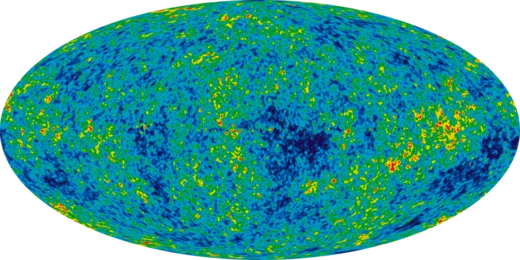
Structure formation in physical cosmology describes the creation of galaxies, galaxy clusters, and larger structures via gravitational and hydrodynamic processes operating on cosmological inhomogeneities. The universe began in a hot, dense, nearly uniform state approximately 13.8 billion years ago, but today exhibits structures on all scales, from stars and planets to galaxy clusters and sheet-like structures separated by enormous voids. Structure formation applies models of gravitational instability to small ripples in mass density to predict these shapes.
The process began after recombination, when the universe had cooled enough for stable hydrogen and helium atoms to form, releasing the cosmic microwave background. Measurements of this background reveal minute temperature variations—a few parts in one hundred thousand—that trace the density fluctuations serving as seeds for all later structures. Before this, a mechanism like cosmic inflation established the universe’s homogeneity, isotropy, and flatness, while amplifying quantum fluctuations into slight density ripples. During the radiation-dominated era, density fluctuations larger than the cosmic horizon grew proportionally to the scale factor, while smaller ones remained frozen due to the Mészáros effect. After matter-radiation equality, dark matter ripples could grow freely, forming gravitational wells into which baryonic matter later fell. Dark matter, feeling only gravity, collapsed into halos unimpeded by radiation pressure, attracting normal hydrogen. As hydrogen density increased, stars ignited, emitting ultraviolet light that re-ionized surrounding atoms. This hierarchical process built small structures first—stars and stellar clusters—then galaxies, groups, clusters, and superclusters. The modern Lambda-CDM model successfully predicts the large-scale distribution of galaxies, clusters, and voids, though galaxy-scale formation involves complex nonlinear baryonic physics such as gas heating, cooling, star formation, and feedback, studied via observations like the Hubble Ultra-Deep Field and large computer simulations.
- field
- Physical cosmology
- known_for
- Explaining the creation of galaxies, clusters, and voids via gravitational instability
- key_model
- Lambda-CDM model
- key_observations
- Cosmic microwave background radiation, galaxy surveys, Lyman-α forest
Lore & Background
Structure formation began after recombination, when the universe cooled enough to form stable hydrogen and helium atoms, emitting the cosmic microwave background (CMB). Before this, cosmic inflation amplified minute quantum fluctuations into slight density ripples of overdensity and underdensity. The early universe was dominated by radiation, with density fluctuations larger than the cosmic horizon growing proportional to the scale factor, while smaller structures remained frozen due to the Mészáros effect. Dark matter collapses into halos, attracting normal matter; as hydrogen density increases, stars ignite and re-ionize surrounding atoms. Hierarchical structure formation proceeds from first stars and stellar clusters to galaxies, groups, clusters, and superclusters.
Reader's Guide
The modern Lambda-CDM model successfully predicts the observed large-scale distribution of galaxies, clusters, and voids, but on the scale of individual galaxies there are complications due to nonlinear processes involving baryonic physics, gas heating and cooling, star formation, and feedback. Understanding galaxy formation is a major topic of modern cosmology research, via observations such as the Hubble Ultra-Deep Field and large computer simulations. Dark matter plays a crucial role because it feels only gravity, allowing compact structures to form without opposition from radiation pressure; without dark matter, galaxy formation would occur substantially later. The linear power spectrum, calculated from dark matter perturbations, is of comparable importance to the CMB and is measured by galaxy surveys like the Sloan Digital Sky Survey and Lyman-α forest surveys. When perturbations grow sufficiently, nonlinear physics requires N-body simulations, such as the Millennium simulation, which show the universe composed largely of voids with densities as low as one-tenth the cosmological mean, with matter condensing into filaments and haloes forming groups, clusters, and superclusters.
Did You Know?
- The Mészáros effect describes how structures smaller than the horizon remained frozen during radiation domination.
- The largest N-body simulation as of 2005 was the Millennium simulation, which simulated millions or even billions of particles.
More in Cosmology Concepts 1-24
Spotted an error? Know more?
This is a living reference — every entry is fact-audited, and reader corrections feed straight into our audit queue. Suggest an edit · See this site's audit record