Cosmic neutrino background
Relic neutrinos from one second after the Big Bang.

The cosmic neutrino background (CνB) is a hypothesized form of background particle radiation made up of neutrinos, also referred to as relic neutrinos. These neutrinos possess extremely low energies, on the order of 10⁻⁴ to 10⁻⁶ eV, and their current temperature is believed to be about 1.95 K.
This background is a remnant of the Big Bang. In contrast to the cosmic microwave background (CMB), which emerged when the universe was 379,000 years old, the CνB separated from matter when the universe was just one second old. Because neutrinos interact so rarely with other matter, these relic neutrinos have persisted to the present day. Their energies are roughly 10¹⁰ times smaller than those of high-energy neutrinos, which are already notoriously difficult to detect. Consequently, direct observation of the CνB in detail may not be possible for many years, if ever. Nevertheless, Big Bang cosmology provides strong indirect evidence for its existence.
**Origin** In the early universe, a hot, dense plasma expanded and cooled. Particles within this plasma collided and reacted, maintaining equilibrium. About one second after the Big Bang, equilibrium among electrons, positrons, and neutrinos broke down. Annihilation reactions, such as those involving these particles, ceased because the universe’s expansion left neutrinos too far apart to interact. At that point, neutrinos decoupled and began free streaming—traveling without further collisions. Because the universe was nearly perfectly homogeneous, this decoupling happened everywhere simultaneously. These neutrinos have been moving through an ever-expanding universe for over 13 billion years, and despite their vast numbers, their characteristic temperature is very low.
**Temperature Estimation** The CνB’s temperature cannot be measured directly but can be inferred from the CMB’s measured temperature and early-universe physics. Neutrinos and photons were once in thermal equilibrium. Neutrinos decoupled first, but before photons decoupled, electrons and positrons in the hot plasma annihilated, producing additional photons and raising the temperature. Conservation of entropy allows us to estimate this heating. In an equilibrium mixture, each particle’s entropy is proportional to its effective number of degrees of freedom (g). For the species involved, g equals +2 for each photon (or other massless bosons) and +7/4 for each electron, positron, or other fermion. The total entropy is conserved. Annihilation converts the entropy of photons, electrons, and positrons into entropy of photons alone. As a result, photons end up hotter than the earlier-decoupled neutrinos by the cube root of the ratio of their degrees of freedom. Since the CMB’s current temperature is 2.725 K, the neutrino background temperature is calculated to be about 1.95 K.
This calculation holds strictly for massless, relativistic neutrinos. For neutrinos with non-zero rest mass, once they become non-relativistic at low temperatures, describing their velocity in terms of temperature is no longer appropriate. However, their kinetic energy remains correct, and one should instead refer to their collective energy density, which stays relevant and well-defined.
**Indirect Evidence** Relativistic neutrinos contribute to the universe’s radiation energy density, typically parameterized by the effective number of neutrino species (N_eff). The Standard Model, with its three neutrino species, predicts N_eff ≈ 3.046, which includes a small correction from non-thermal spectral distortions during electron-positron annihilation. This radiation density influenced many early-universe physical processes, leaving detectable imprints on measurable quantities, allowing N_eff to be inferred from observations.
*Big Bang nucleosynthesis (BBN):* The expansion rate during BBN depends on N_eff, which in turn affects the predicted primordial abundances of light elements. Astrophysical measurements of primordial helium-4 and deuterium abundances yield N_eff = 3.28 ± 0.28 at 68% confidence, closely matching the Standard Model expectation.
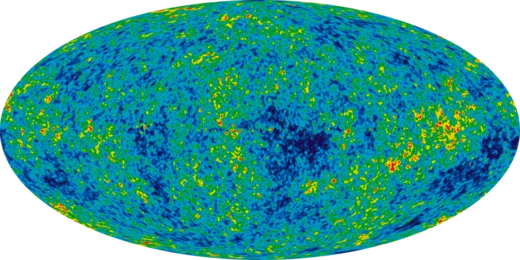
*Cosmic microwave background (CMB):* The CνB affects CMB anisotropies and matter perturbation growth in two ways: through its contribution to radiation density (which determines, for example, the time of matter-radiation equality) and through neutrinos’ anisotropic stress, which dampens acoustic oscillations. Additionally, free-streaming massive neutrinos suppress small-scale structure growth. Data from the WMAP spacecraft’s five-year survey, combined with type Ia supernova data and baryon acoustic oscillation measurements, gave N_eff = 4.4 ± 1.5 at 68% confidence, independently confirming BBN constraints. The Planck spacecraft collaboration has since published the tightest bound on N_eff, at 3.30 ± 0.27.
**Phase Changes** Big Bang cosmology makes numerous predictions about the CνB, and strong indirect evidence for its existence comes from both BBN predictions of helium abundance and CMB observations.
- also_known_as
- Relic neutrinos, CNB, CνB
- decoupled
- 1 second after the Big Bang
- current_temperature
- ~1.95 K
- energy_range
- 10⁻⁴ to 10⁻⁶ eV
- composition
- Neutrinos (ν) and antineutrinos (ν̄)
Lore & Background
The cosmic neutrino background (CνB) is a relic of the Big Bang, composed of neutrinos that decoupled from the rest of matter when the universe was roughly one second old, far earlier than the cosmic microwave background, which dates from when the universe was about 379,000 years old. At decoupling, the hot, dense plasma of the early universe was expanding and cooling; reactions such as electron-positron annihilation into neutrinos ceased because the particles became too widely spaced to interact. The neutrinos then entered a state of free streaming, traveling through the expanding universe for over 13 billion years. Today, these relic neutrinos are estimated to have a very low temperature, roughly 1.95 K, derived from the known temperature of the cosmic microwave background and the conservation of entropy during electron-positron annihilation, which heated the photons relative to the neutrinos. Their energies are extremely low, around 10⁻⁴ to 10⁻⁶ eV, making direct detection extraordinarily difficult—about 10¹⁰ times smaller than even high-energy neutrinos, which are themselves notoriously hard to observe. While direct observation may not be possible for many years, strong indirect evidence exists. The CνB contributes to the radiation energy density of the universe, influencing Big Bang nucleosynthesis and the formation of cosmic microwave background anisotropies and large-scale structure. Measurements of primordial helium and deuterium abundances, as well as data from the WMAP and Planck spacecraft, yield an effective number of neutrino species consistent with the Standard Model prediction of three, providing robust confirmation of the CνB's existence.
Reader's Guide
The cosmic neutrino background (CνB) is a relic of the Big Bang, composed of neutrinos that decoupled from the rest of matter when the universe was approximately one second old, far earlier than the cosmic microwave background, which dates from when the universe was 379,000 years old. At decoupling, the universe was a hot, dense plasma in thermal equilibrium; as it expanded and cooled, reactions such as electron-positron annihilation ceased because neutrinos became too widely spaced to interact, entering a state of free streaming. These neutrinos have been traveling through the expanding universe for over 13 billion years. Their temperature today is estimated indirectly from the cosmic microwave background temperature and the conservation of entropy during electron-positron annihilation, which heated photons relative to neutrinos. While the CνB cannot be directly measured due to its extremely low energy—roughly 10⁻⁴ to 10⁻⁶ eV, about 10¹⁰ times smaller than high-energy neutrinos—its existence is strongly supported by indirect evidence. Relativistic relic neutrinos contribute to the universe’s radiation density, parameterized as the effective number of neutrino species. Big Bang nucleosynthesis predictions of primordial helium and deuterium abundances, which depend on this radiation density, yield values consistent with the Standard Model’s three neutrino species. Additionally, the CνB influences cosmic microwave background anisotropies and the growth of matter perturbations, affecting the time of matter–radiation equality and suppressing small-scale structure formation. Observations from the WMAP and Planck spacecraft, combined with supernova and baryon acoustic oscillation data, have provided independent constraints on the effective number of neutrino species, confirming the theoretical expectations.
Did You Know?
- The cosmic neutrino background decoupled when the universe was just one second old.
- Its current temperature is estimated at roughly 1.95 K.
- Neutrinos in the CνB have energies around 10⁻⁴ to 10⁻⁶ eV.
- The CνB may not be directly observed in detail for many years, if at all.
More in Cosmology Concepts 1-24
Spotted an error? Know more?
This is a living reference — every entry is fact-audited, and reader corrections feed straight into our audit queue. Suggest an edit · See this site's audit record