Chronology of the universe
Standard timeline of cosmic history from inflation to present.

The universe’s timeline, as currently understood through physical cosmology, starts with a period called inflation, the earliest phase backed by solid observational evidence. This happened about 13.8 billion years ago, when space expanded with extreme rapidity in a minuscule fraction of a second. When inflation ended, the energy that drove it transformed into particles and radiation, making the universe intensely hot and dense—an event that marks the start of the Big Bang.
At some early point, a process called baryogenesis created a slight surplus of matter over antimatter. Most matter and antimatter particles annihilated in pairs, leaving behind that small excess of matter and a huge amount of radiation. As the universe cooled further, other heavy particles either annihilated or decayed, eventually leaving a plasma dominated by protons, neutrons, electrons, photons, and neutrinos.
After the first second, the plasma thinned enough that neutrinos stopped interacting efficiently with other particles and began streaming freely, forming the primordial neutrino background. Five seconds later, electrons and positrons annihilated each other, transferring their energy into the rest of the plasma. Within the first three minutes, the temperature dropped enough for stable nuclei to form through Big Bang nucleosynthesis, producing hydrogen, helium, and a trace of lithium. In most cosmological models, dark matter is assumed to have been produced by this time, though its exact origin is unknown.
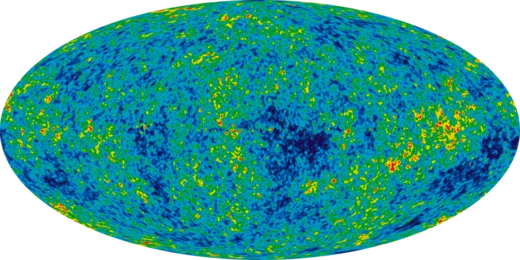
Around 380,000 years later, electrons were captured by nucleons to form stable atoms. This made the universe transparent to photons, generating the cosmic microwave background. Next, gravity gradually collapsed the atomic gas. As the gas compressed and heated, it ignited nuclear fusion, creating the first stars. Over millions of years, gravitational attraction built galaxies and the larger structures we see today. After about nine billion more years, the universe shifted from being matter-dominated to dark energy-dominated, leading to the accelerated expansion observed now.
Many modifications to this standard timeline have been proposed, introducing new phases of expansion, particles, or other cosmological mechanisms. These often focus on changes to events before Big Bang nucleosynthesis, since direct observational evidence for that period is lacking. Viable alternatives to inflation that still produce the observed large-scale structure have also been suggested.
In this model, space and time are linked: as time increases, space expands. Time at any point in space—like a galaxy—can be defined by an imaginary clock that moves with that point as the universe expands, synchronized to a single point in the distant past. Light from distant galaxies was emitted in the past and travels at light speed, so knowledge of a distant galaxy is limited to a single moment called the lookback time. As that light travels, the universe continues to expand, stretching its wavelength—an effect called cosmological redshift. Redshift can be measured by comparing incoming light to known spectroscopic lines, and the result relates to the comoving distance to the source. Thus, experimental knowledge of the universe’s chronology comes from observing distant light.
The chronology can be divided into four parts: inflation (the first era with experimental evidence, ending when energy converts to particles during reheating); the hot Big Bang (the universe cools and expands from a hot, dense state, forming baryons, nuclei, and the cosmic microwave background); gravity building cosmic structure (reduced density lets matter dominate over radiation, and gravitational attraction forms stars, galaxies, and clusters); and cosmic acceleration (continued expansion allows dark energy to overcome gravity, inhibiting larger structures). Within these broad sections are many events and transitions. Older models divided the chronology differently, using different terminology or emphasis.
Modern cosmological timelines begin with inflation, the earliest period with solid observational support. Anything earlier falls under non-standard cosmology, a subject of much unconfirmed research.
- Earliest supported stage
- Inflation, 13.8 billion years ago
- Key events
- Big Bang, baryogenesis, nucleosynthesis, recombination, star formation, dark energy dominance
- Duration of inflation
- Between 10⁻³³ and 10⁻³² seconds
- Expansion factor during inflation
- At least 10²⁶
- Time of nucleosynthesis
- Within first three minutes
- Current era
- Dark energy dominated, accelerated expansion
Lore & Background
The chronology of the universe describes the history and future of the universe according to the current understanding of physical cosmology. The earliest stage supported by observational evidence is inflation, a period of extremely rapid exponential expansion that occurred in a tiny fraction of a second. Once inflation ended, the energy driving it was converted into particles and radiation, heating the universe into a very hot, dense state and initiating the Big Bang. At some early stage, baryogenesis produced a small excess of matter over antimatter; most matter and antimatter particles annihilated in pairs, leaving a small surplus of matter and a large amount of radiation. As the universe cooled, heavy particles annihilated or decayed, leaving a plasma dominated by protons, neutrons, electrons, photons, and neutrinos. After the first second, the plasma became dilute enough that neutrinos ceased interacting efficiently and began free streaming, producing the primordial neutrino background. Within the first three minutes, the temperature allowed stable nuclei to form via Big Bang nucleosynthesis, yielding hydrogen, helium, and a small amount of lithium. Dark matter is usually assumed to have been produced by this epoch, though its production mechanism is unknown. Around 380,000 years later, electrons were captured by nucleons to form stable atoms, making the universe transparent to photons and producing the cosmic microwave background. Gravitational collapse of atomic gas then ignited nuclear fusion, creating the first stars, and over millions of years formed galaxies and larger structures. After a further nine billion years, the universe transitioned from matter-dominated to dark energy-dominated, leading to accelerated expansion. Many modifications to the standard timeline have been proposed, especially before Big Bang nucleosynthesis, due to lack of direct observational evidence.
Reader's Guide
The chronology of the universe is the foundational framework for modern cosmology, integrating particle physics and general relativity to explain the evolution of the cosmos from its earliest observable moments. It provides a testable sequence of events—inflation, baryogenesis, nucleosynthesis, recombination, structure formation, and dark energy dominance—that aligns with key observational evidence such as the cosmic microwave background and the abundance of light elements. The timeline highlights the interplay between expansion, cooling, and particle interactions, and underscores the role of inflation in generating large-scale structure from quantum fluctuations. While the standard chronology is well-supported, the article notes significant uncertainty about processes before nucleosynthesis, including the mechanism of inflation and the production of dark matter. This openness to modification reflects the dynamic nature of cosmology, where theoretical models continue to evolve as new data emerge. The chronology thus serves both as a summary of current knowledge and as a guide to unresolved questions, making it essential for understanding the universe's past and future.
Did You Know?
- Inflation expanded the universe by at least a factor of 10²⁶ in about 10⁻³⁶ seconds.
- Big Bang nucleosynthesis within the first three minutes produced hydrogen, helium, and a small amount of lithium.
- The universe transitioned from matter-dominated to dark energy-dominated after about nine billion years.
More in Cosmology Concepts 1-24
Spotted an error? Know more?
This is a living reference — every entry is fact-audited, and reader corrections feed straight into our audit queue. Suggest an edit · See this site's audit record