Particle horizon
Boundary between observable and unobservable regions of the universe.
The particle horizon, also known as the cosmological horizon, comoving horizon, or cosmic light horizon, marks the greatest distance from which light has had time to reach an observer since the beginning of the universe. It functions like a terrestrial horizon, dividing what can be observed from what cannot, and its present-day distance defines the size of the observable universe. Because the universe expands, this distance is not simply the universe’s age multiplied by the speed of light (roughly 13.8 billion light-years), but rather the speed of light multiplied by the conformal time. The existence and properties of this horizon depend on the specific cosmological model used.
In a kinematic model, the particle horizon is a distance measured in comoving coordinates, a system that accounts for cosmic expansion via a dimensionless scale factor set to one today. The total comoving distance light can travel since the Big Bang is found by summing incremental distances over time. This comoving horizon increases steadily and can serve as a time parameter; it equals the conformal time elapsed since the Big Bang times the speed of light. Conformal time differs from the universe’s age as measured by a traditional clock (estimated around 13.8 billion years), instead representing time measured by a Marzke-Wheeler “light clock.” As conformal time grows, the particle horizon recedes, so the observable universe’s size always increases. The proper distance to the horizon at any time is the comoving distance multiplied by the scale factor.
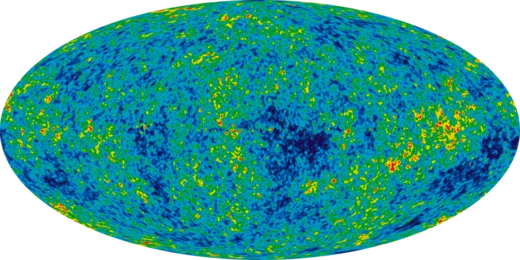
In the FLRW cosmological model, the universe is approximated as composed of non-interacting perfect fluids, each with a density, pressure, and equation of state. Using the Hubble function, critical density, and dimensionless energy densities, the Hubble function can be expressed in terms of redshift. The evolution of the particle horizon for an expanding universe is given by an integral involving the speed of light and the Hubble function. The particle horizon concept also illustrates the horizon problem: extrapolating back to recombination, the particle horizon was much smaller, meaning regions of the cosmic microwave background separated by a certain angular size should have been out of causal contact. That the entire CMB is in thermal equilibrium is unexplained by standard expansion, leading to cosmic inflation as a popular resolutio
- also known as
- cosmological horizon, cosmic light horizon
- defines
- size of the observable universe
- conformal time today
- 1.48 × 10^18 s
- age of the universe (traditional clock)
- 4.35 × 10^17 s
- scale factor today
- 1
Lore & Background
The particle horizon is defined within a comoving coordinate system, which inherently accounts for the expansion of the universe through a dimensionless scale factor set to one at the present time. In this framework, the incremental distance light travels is related to the time interval divided by the scale factor. The total comoving distance light can have traveled since the Big Bang defines the conformal time, and the particle horizon is equal to this conformal time multiplied by the speed of light. This horizon increases monotonically over time, meaning the observable region of the universe continually expands. The proper distance to the particle horizon at any given time is found by multiplying the comoving distance by the scale factor at that time. The specific value of this distance depends on the details of the scale factor's evolution. In the standard FLRW cosmological model, the universe is treated as a collection of non-interacting perfect fluids, each with a density, pressure, and equation of state. The evolution of the particle horizon in an expanding universe can be expressed using the Hubble function and the redshift, with the derivative taken with respect to FLRW time. The concept is central to the horizon problem: at the time of recombination, the particle horizon corresponded to a small angular size on the sky, meaning widely separated regions of the cosmic microwave background should not have been in causal contact, yet the CMB is observed to be remarkably uniform. This discrepancy is a key unresolved issue in the Big Bang model, commonly addressed by the theory of cosmic inflation.
Reader's Guide
The particle horizon is significant because it defines the limit of what can be observed in the universe. Due to the expansion of the universe, it is not simply the age of the universe times the speed of light (approximately 13.8 billion light-years), but rather the speed of light times the conformal time. The particle horizon recedes constantly as time passes and the conformal time grows, so the observed size of the universe always increases. The existence, properties, and significance of a cosmological horizon depend on the particular cosmological model. In the FLRW cosmological model, the universe can be approximated as composed of non-interacting constituents, each a perfect fluid with density, partial pressure, and state equation, and the Hubble function and critical density are defined.
Did You Know?
- The particle horizon is also called the cosmological horizon or cosmic light horizon, but it is not synonymous with the comoving horizon; the comoving horizon is the comoving distance to the particle horizon.
- The conformal time today is 1.48 × 10^18 seconds, while the age of the universe as measured by a traditional clock is about 4.35 × 10^17 seconds.
- The proper distance to the particle horizon at time t is given by d_p(t) = a(t) ∫_0^t (c dt' / a(t')).
- The particle horizon recedes constantly as time passes, so the observed size of the universe always increases.
Defining the Boundary of the Observable
The particle horizon—known by several interchangeable names including cosmological horizon, comoving horizon, and cosmic light horizon—marks the farthest reach from which photons could possibly have arrived at an observer over the entire lifetime of the cosmos. Much as a person standing on a beach sees the horizon as the line where visible sea meets invisible sky, this cosmological concept draws a boundary separating everything we can, in principle, observe from everything that remains forever beyond our sight. At the present epoch, the distance to this boundary effectively sets the radius of the observable universe. Crucially, because space itself has been expanding since the Big Bang, the horizon's distance is not the naive product of the universe's age and the speed of light (which would yield roughly 13.8 billion light-years). Instead, it equals the speed of light multiplied by a quantity called conformal time, a measure that accounts for the stretching of space. The precise existence, magnitude, and physical meaning of this horizon are not universal constants; they shift depending on which cosmological model one adopts.
Conformal Time and the Light-Clock Age
In the mathematical treatment of the particle horizon, physicists work within a comoving coordinate system—one that has the universe's expansion already woven into its geometry. A dimensionless scale factor, conventionally normalized to unity at the present day, governs how light propagates through this framework. The incremental distance a photon covers is inversely proportional to the scale factor at that moment, and the total comoving distance accumulates as an integral from the Big Bang to the present. This accumulated quantity, the conformal time η, grows monotonically and therefore serves as a valid time parameter. The particle horizon is simply this conformal time multiplied by the speed of light. At today's epoch, η₀ works out to approximately 1.48 × 10¹⁸ seconds. This figure is not the same as the familiar cosmic age of about 4.35 × 10¹⁷ seconds, which is read off a conventional clock in the Robertson-Walker metric. Rather, η₀ represents the universe's age as registered by a Marzke-Wheeler light clock, a fundamentally different temporal standard that reflects the cumulative path of light through expanding space.
An Ever-Expanding Frontier
Because conformal time increases without bound as the universe ages, the particle horizon is never stationary; it recedes continuously, meaning the observable universe grows larger at every moment. This perpetual expansion of the visible domain is a direct consequence of light having more time to travel and of the conformal time integral accumulating additional contributions. To translate the comoving distance into a physically meaningful proper distance at any given epoch, one multiplies the comoving integral by the scale factor at that time. The resulting expression shows that the proper distance to the horizon at time t equals a(t) times the integral of c dt' divided by a(t') from zero to t. Since the scale factor's functional form encodes the detailed expansion history of the cosmos, the numerical value of the horizon distance is sensitive to the specific behavior of a(t). In other words, the horizon is not a fixed number but a model-dependent quantity whose magnitude shifts with the assumed dynamics of cosmic expansion.
Model Dependence and the FLRW Framework
The particle horizon is not a single, model-independent number; its existence, properties, and significance all hinge on the particular cosmological model under consideration. In the standard Friedmann-Lemaître-Robertson-Walker (FLRW) framework, the universe is idealized as a collection of non-interacting components, each behaving as a perfect fluid characterized by its own density, partial pressure, and a linear equation of state relating pressure to density through a parameter ωᵢ. These individual constituents sum to give the total density and total pressure that drive the expansion. The Hubble function, which captures the rate of expansion, emerges from this combined energy content. Because the scale factor a(t) is determined by the interplay of these densities, pressures, and their equations of state, the conformal time integral—and therefore the horizon distance—inherits all of that model-specific structure. Different choices for the cosmic inventory, or different assumptions about how components interact, will yield different horizon distances and different rates at which the observable universe expands.
Frequently Asked Questions
What is the Particle Horizon in cosmology?
The Particle Horizon (also called the cosmological horizon or cosmic light horizon) marks the farthest distance from which any light has had time to reach an observer since the universe began. It essentially draws the line between the part of the cosmos we can see and the part that remains forever out of reach.
What does the Particle Horizon actually define?
At any given epoch, the distance to the Particle Horizon sets the radius of the observable universe. In the present epoch, with a scale factor of 1, it encloses the entire region of space whose light has had enough time to arrive to us.
What are the key numerical values associated with the Particle Horizon today?
The conformal time at the present epoch is approximately 1.48 × 10¹⁸ seconds, while the age of the universe on a traditional clock is about 4.35 × 10¹⁷ seconds. The scale factor today is normalized to 1.
How is the Particle Horizon different from the comoving horizon?
The comoving horizon is not the horizon itself but rather the comoving distance measured out to the Particle Horizon. In other words, it is a coordinate-based distance to the boundary, not the boundary's physical extent.
Why does the Particle Horizon matter for understanding the universe?
It establishes the fundamental limit of what any observer can ever see, since no signal from beyond that boundary has had enough time to arrive. This makes it central to questions about the size, structure, and ultimate knowability of the cosmos.
More in Cosmology Concepts 1-24
Spotted an error? Know more?
This is a living reference — every entry is fact-audited, and reader corrections feed straight into our audit queue. Suggest an edit · See this site's audit record