Missing baryon problem
Missing baryons are baryonic matter not yet observed in the recent universe.

In cosmology, the missing baryon problem refers to a mismatch between the amount of ordinary matter seen in the early universe and the amount found in the present-day cosmos. Measurements from the cosmic microwave background and Big Bang nucleosynthesis show that baryonic matter makes up about 4.8% of the universe’s total energy. However, when astronomers add up all the baryons they can detect in the recent universe, they find less than half of that predicted amount. This issue is separate from the dark matter problem, which involves non-baryonic material.
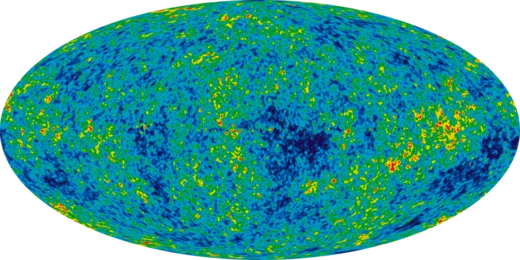
The early universe’s baryon abundance is determined through two independent methods. First, Big Bang nucleosynthesis theory predicts the relative amounts of light elements like helium and lithium; matching observed abundances requires baryons to account for 4–5% of the universe’s critical density. Second, detailed analysis of fluctuations in the cosmic microwave background—particularly the second peak of its power spectrum—also yields a baryon fraction around 5%. The CMB constraint is more precise, but both methods agree.
For the late universe, the baryon density is estimated by directly counting all known baryonic matter. This is challenging because much of it is not luminous. Techniques include using the Lyman-alpha forest, where diffuse gas clouds are visible when backlit by stars; gravitational microlensing, where a dark object’s mass is inferred from its distortion of a distant source’s image; and the Sunyaev–Zel’dovich effect, which detects free electrons through their imprint on the CMB, regardless of temperature. Before 2017, surveys found baryons distributed as 10% inside galaxies, 50–60% in the circum-galactic medium, and 30–40% unaccounted for, totaling about 70% of theoretical predictions. Large-scale galaxy surveys in the 2000s revealed this deficit, prompting theorists to predict gas flowing between galaxies and clusters.
The Lambda-CDM model predicts that intergalactic matter forms a low-density web (1–10 particles per cubic meter) called the warm-hot intergalactic medium (WHIM). Simulations suggest missing baryons reside in galactic haloes at 10⁶ K and in the WHIM at 10⁵–10⁷ K, with recent observations supporting this. The WHIM has three states: a warm phase (10⁵–10⁵.⁷ K) with neutral hydrogen, observed via Oxygen-VI absorption lines; a hot phase (10⁵.⁷–10⁶.³ K), seen through Oxygen-VII in soft X-rays; and a very hot phase (10⁶.³–10⁷ K), with few hydrogen or hydrogen-like metals, mostly near galaxy cluster outskirts. The warm phase, previously detected, makes up about 15% of the baryon content. The WHIM is mostly ionized hydrogen, making detection difficult, so astronomers rely on highly ionized oxygen lines like OVI and OVII.
The known baryon census once totaled around 60% of the predicted amount, until the missing baryon problem was resolved. This contrasts with the universe’s overall composition, where baryons are only 5% of the total, with dark energy and dark matter dominating. About 7% of baryons exist in stars and galaxies, while most lie around galaxies or clusters. The Lyman-alpha forest contains roughly 28% of baryons. The warm WHIM phase was detected via soft X-ray absorption in 2012, accounting for 15% of the total. The intracluster medium (ICM) holds about 4% of baryons; it is mostly ionized hydrogen, with a density of about 10⁻³ particles per cm³, and makes up about 10% of a galaxy cluster’s mass (the rest being dark matter). The circum-galactic medium (CGM), confirmed in 2003 by Chandra and Xmm-Newton, is a large sphere around galaxies (radius > 70–200 kpc) and accounts for 5% of total baryons.
Three main methods detect the WHIM where missing baryons are found: the Sunyaev–Zel’dovich effect, Lyman-alpha emission lines, and metal absorption lines.
- field
- Cosmology
- known_for
- Discrepancy between early-universe and late-universe baryon counts
- early_universe_baryon_fraction
- ~4.8% of universe's energy contents
- late_universe_observed_fraction
- Less than half of early-universe amount
- resolution_mechanism
- Warm-hot intergalactic medium (WHIM)
Lore & Background
The missing baryon problem arises from two independent early-universe measurements: Big Bang nucleosynthesis, which predicts baryonic matter makes up 4–5% of the universe's critical density based on observed element abundances, and analysis of cosmic microwave background anisotropies, which yields a baryon fraction on the order of 5%. These agree that baryonic matter accounts for about 4.8% of the universe's energy contents. However, direct summation of known baryonic matter in the late universe—using techniques such as Lyman-alpha forest observations, gravitational microlensing, and the Sunyaev–Zel'dovich effect—found that observed baryons account for only about 60% of the total predicted amount, with the remainder termed 'missing.'
Reader's Guide
The missing baryon problem arose from a discrepancy between early-universe measurements and a census of baryons in the recent observable universe. Observations of the cosmic microwave background and Big Bang nucleosynthesis independently indicated that baryonic matter constitutes approximately 4.8% of the universe's energy content. However, summing all known baryonic matter in the present-day universe—including stars, galaxies, black holes, planets, and diffuse interstellar gas—accounted for less than half of that amount. This deficit was distinct from the dark matter problem, as dark matter is non-baryonic. Large-scale galaxy surveys in the 2000s confirmed the deficit, prompting theorists to predict that gas must flow between galaxies and galaxy clusters. The Lambda-CDM model predicted that matter between galaxies exists in a low-density web-like formation called the warm-hot intergalactic medium (WHIM), with temperatures between 10⁵ and 10⁷ K. The WHIM is composed of warm, hot, and very hot states, each detectable via specific absorption lines such as Oxygen-VI and Oxygen-VII. Prior to 2017, baryons were distributed with 10% inside galaxies, 50–60% in the circum-galactic medium, and 30–40% unaccounted, totaling about 70% of theoretical predictions. The resolution of the problem confirmed that the missing baryons reside in this diffuse, ionized WHIM, reinforcing the standard cosmological model.
Did You Know?
- The missing baryon problem is different from the dark matter problem, which is non-baryonic in nature.
- The Lyman-alpha forest contains around 28% of the baryons in the universe.
- The Sunyaev–Zel'dovich effect can detect baryons in the WHIM by measuring the y-parameter from inverse Compton scattering of CMB photons.
More in Cosmology Concepts 1-24
Spotted an error? Know more?
This is a living reference — every entry is fact-audited, and reader corrections feed straight into our audit queue. Suggest an edit · See this site's audit record