Lambda-CDM model
Standard cosmological model of dark energy and cold dark matter.

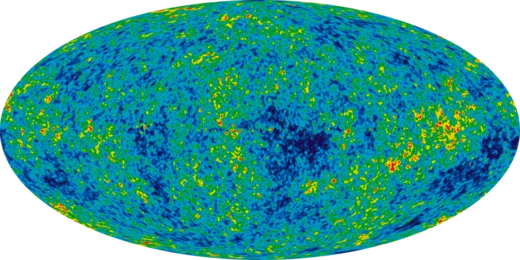
The standard framework for Big Bang cosmology, which describes the universe's history, is the Lambda-CDM (ΛCDM) model. Its name comes from two key components: a cosmological constant (Λ), linked to dark energy, and cold dark matter (CDM), alongside ordinary matter. This model is the simplest one that successfully explains several major observations: the existence and structure of the cosmic microwave background; the large-scale arrangement of galaxies; the observed amounts of hydrogen, helium, and lithium; and the accelerating expansion of the universe, seen in light from distant galaxies and supernovae. It operates on the assumption that general relativity correctly describes gravity on cosmic scales. The model became the accepted concordance cosmology in the late 1990s, resolving a period when different observed properties of the universe seemed contradictory and no consensus existed on the universe's energy density composition. Over decades, ΛCDM has effectively matched a wide range of astronomical data, though remaining problems with its assumptions have spurred the development of alternative models.
The model rests on three postulates about spacetime: the cosmological principle (the universe is uniform, isotropic, and expanding); Hermann Weyl's postulate that spacetime geodesics intersect at a single point where time can be synchronized, creating behavior like an expanding perfect fluid; and general relativity, which links spacetime geometry to matter and energy distribution. These postulates simplify general relativity into the Friedmann equations, which describe how the universe's scale factor evolves based on the pressure and density of a perfect fluid. The evolving density includes various forms of energy and matter—such as baryons, photons, neutrinos, and dark matter—each influencing the scale factor differently. These component densities become parameters determined by fitting the model to astrophysical observations, aiming to describe the observable universe from about 0.1 seconds after the Big Bang to the present.
The most precise observations that constrain these densities come from statistical inhomogeneities, called "perturbations," in the early universe. Because the Friedmann equations assume homogeneity, additional theory is needed for comparison with experiments. Inflation provides a simple explanation for these perturbations, proposing an extremely rapid early expansion that separates quantum fluctuations before they can equilibrate. These perturbations are characterized by extra parameters, also set by matching observations. Finally, light from astronomical sources must travel through the universe; the latter part of its journey passes through ionized space, where electrons can scatter the light and alter its anisotropies, an effect captured by one additional parameter.
The model includes a well-documented expansion of the spatial metric, observed as the redshift of spectral lines from distant galaxies and as time dilation in supernova light curves. Both effects are attributed to a Doppler shift as electromagnetic radiation travels through expanding space. This expansion increases distances between objects not gravitationally bound, but does not enlarge objects like galaxies themselves. Because it arises from general relativity, it allows distant galaxies to recede from each other faster than light; local expansion remains subluminal, but the cumulative expansion over great distances can exceed light speed. The cosmological constant (Λ) represents a vacuum energy or dark energy in empty space, explaining the universe's accelerating expansion against gravity's pull. It has negative pressure, contributing to the stress-energy tensor, which, in general relativity, drives acceleration. Based on 2018 Dark Energy Survey results using Type Ia supernovae, dark energy makes up 68.3% or more of the universe's mass-energy density (with specific estimates like 0.669 ± 0.038 from that survey, or values from the 2018 Planck satellite data). Dark matter is introduced to account for gravitational effects in large-scale structures—such as non-keplerian galaxy rotation curves, gravitational lensing by galaxy clusters, and enhanced galaxy clustering—that cannot be explained by observed matter alone. The ΛCDM model specifically proposes cold dark matter, which is non-baryonic (not made of protons, neutrons, or electrons), cold (moving much slower than light at the epoch of radiation-matter equality, excluding neutrinos), dissipationless (unable to cool by radiating photons), and collisionless (interacting with other particles only through gravity and possibly the weak force). Dark matter constitutes about 26.5% of the universe's mass-energy.
- field
- Cosmology
- known_for
- Standard model of Big Bang cosmology incorporating dark energy and cold dark matter
- components
- Dark energy (Λ), cold dark matter (CDM), ordinary matter
- dark_matter_fraction
- ~26.5% of mass-energy density
- ordinary_matter_fraction
- ~4.9% of mass-energy density
Lore & Background
The Lambda-CDM model is the standard form of the Big Bang theory, governing the chronology of the universe. Its name reflects its core components: a cosmological constant (Λ) linked to dark energy, and cold dark matter (CDM), alongside ordinary matter. The model emerged in the late 1990s as a concordance cosmology, resolving a period when observed properties of the universe appeared mutually inconsistent and the makeup of its energy density lacked consensus. It assumes general relativity is the correct theory of gravity on cosmological scales. The model is based on three postulates: the cosmological principle (the universe is homogeneous and isotropic and expanding), Hermann Weyl’s postulate that spacetime geodesics intersect at only one point allowing synchronized time, and general relativity relating spacetime geometry to matter and energy distribution. These simplify to the Friedmann equations, which describe the evolution of the universe’s scale factor in terms of the pressure and density of a perfect fluid. The model includes cosmic inflation to generate perturbations from quantum fluctuations, characterized by additional parameters matched to observations. Light from astronomical observations passes through ionized space, where electrons scatter it, altering anisotropies. The expansion of space is documented via redshift of spectral lines and time dilation in supernova light curves, attributed to a Doppler shift as light travels across expanding space. This expansion allows distant galaxies to recede faster than light, though local expansion is subluminal. The cosmological constant has negative pressure, driving accelerating expansion against gravity. Dark matter is non-baryonic, cold (velocity far below light speed at radiation-matter equality), dissipationless, and collisionless, interacting only through gravity and possibly the weak force.
Reader's Guide
The ΛCDM model has been successful in modeling a broad collection of astronomical observations over decades, including the cosmic microwave background, large-scale structure, light-element abundances, and the accelerating expansion. It proposes cold dark matter as non-baryonic, cold, dissipationless, and collisionless, interacting only through gravity and possibly the weak force. Dark matter constitutes about 26.5% of the mass-energy density, while ordinary matter makes up 4.9%, with most ordinary matter unseen. The model's remaining issues challenge its assumptions and have led to many alternative models. The earliest epoch supported by observational evidence is cosmic inflation, followed by reheating and the hot Big Bang. Cosmic inflation addresses the horizon problem, and the universe may be larger than the observable particle horizon.
Did You Know?
- The ΛCDM model emerged in the late 1990s as a concordance cosmology after a period of inconsistent observations.
- Cold dark matter is hypothesized to be non-baryonic, cold, dissipationless, and collisionless.
- The model allows for distant galaxies to recede from each other at speeds greater than the speed of light.
More in Cosmology Concepts 1-24
Spotted an error? Know more?
This is a living reference — every entry is fact-audited, and reader corrections feed straight into our audit queue. Suggest an edit · See this site's audit record