Horizon problem
A cosmological fine-tuning problem in the Big Bang model.

The horizon problem, also known as the homogeneity problem, is a cosmological fine-tuning issue within the Big Bang model. It arises from observations that widely separated regions of space appear homogeneous, yet normal physical processes require causal connection, and these regions are too far apart to have interacted since the Big Bang given the speed of light limit. This creates a difficulty in explaining the observed homogeneity without a mechanism that sets the same initial conditions everywhere.
The problem was first identified by Wolfgang Rindler in 1956. It stems from the finite speed of light, which limits causal contact between distant regions. For example, a galaxy observed at ten billion light-years away in one direction and another at the same distance in the opposite direction are separated by twenty billion light-years. Since the universe is only about 13.8 billion years old, light from one has not yet reached the other, placing them outside each other’s particle horizons. In accepted relativistic physics, no information—including physical interactions like heat flow—can travel faster than light, so these regions cannot have exchanged information. Without common initial conditions, one would expect their properties to differ, and the universe to be inhomogeneous.
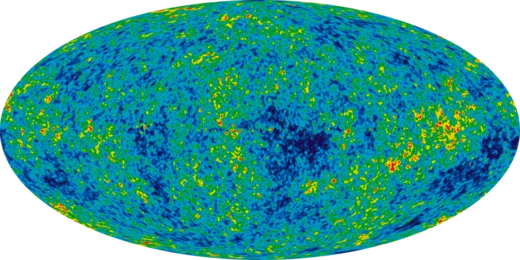
However, observations of the cosmic microwave background (CMB) and galaxy surveys show the observable universe is nearly isotropic and homogeneous. CMB temperatures across the sky are coordinated to a very high degree, implying the entire observable universe must have been causally connected long enough to reach thermal equilibrium. The CMB originates from the epoch of recombination, about 300,000 years after the Big Bang, when photons decoupled from matter and began free-streaming. At that time, the particle horizon—the maximum distance light could have traveled—was much smaller than the scale of the CMB we observe today. Two points on the CMB sky, separated by more than this horizon distance, could not have been in causal contact, yet they show nearly identical temperatures. This mismatch between the expected inhomogeneity and the observed uniformity is the horizon problem. The most commonly accepted solution is cosmic inflation, with alternative proposals including a cyclic universe or a variable speed of light.
- first_pointed_out_by
- Wolfgang Rindler
- field
- Cosmology
- key_observation
- Homogeneity of widely separated regions without causal contact
- most_accepted_hypothesis
- Cosmic inflation
Lore & Background
The horizon problem, also known as the homogeneity problem, arises from observations showing that widely separated regions of the universe appear remarkably uniform, despite being too distant to have ever exchanged information. The cosmic microwave background (CMB) and galaxy surveys reveal the observable universe is nearly isotropic, which implies homogeneity. Specifically, CMB sky surveys measure temperature differences of only about ΔT/T ≈ 10⁻⁵, meaning the entire sky must have been causally connected long enough to reach thermal equilibrium. However, according to the Big Bang model, physical causes traveling at the speed of light could not have bridged these distances within the age of the universe. When the CMB light was emitted, only about 300,000 years after the Big Bang, the universe was much younger, and causal spheres were far smaller than the separation between opposite points on the CMB sky. Those points could not have contacted each other because their spheres of causality do not overlap. This fine-tuning problem was first pointed out by Wolfgang Rindler in 1956. The most commonly accepted explanation is cosmic inflation, with alternative proposals including a cyclic universe or a variable speed of light.
Reader's Guide
The horizon problem highlights a fundamental tension between the observed uniformity of the universe and the causal structure of the Big Bang model. Without a mechanism to set identical initial conditions across causally disconnected regions, the homogeneity of the CMB and large-scale structure is difficult to explain. The most commonly accepted hypothesis to resolve this is cosmic inflation, which posits a period of rapid expansion that would have brought distant regions into causal contact before they separated. Alternative solutions include a cyclic universe or a variable speed of light. The problem remains a key driver of theoretical cosmology, shaping models of the early universe and testing the limits of the standard Big Bang framework.
Did You Know?
- Observations of the cosmic microwave background show temperature differences of only about ΔT/T ≈ 10⁻⁵ across the sky.
- The most commonly accepted hypothesis to explain the horizon problem is cosmic inflation.
- Alternative solutions propose a cyclic universe or a variable speed of light.
More in Cosmology Concepts 1-24
Spotted an error? Know more?
This is a living reference — every entry is fact-audited, and reader corrections feed straight into our audit queue. Suggest an edit · See this site's audit record